Why Now Is the Right Time to Record, Not Your Seventies
Waiting until retirement to preserve your voice and stories overlooks the biology, the busyness, and the research. Here's why your forties are the real window.
The Myth of "Someday"
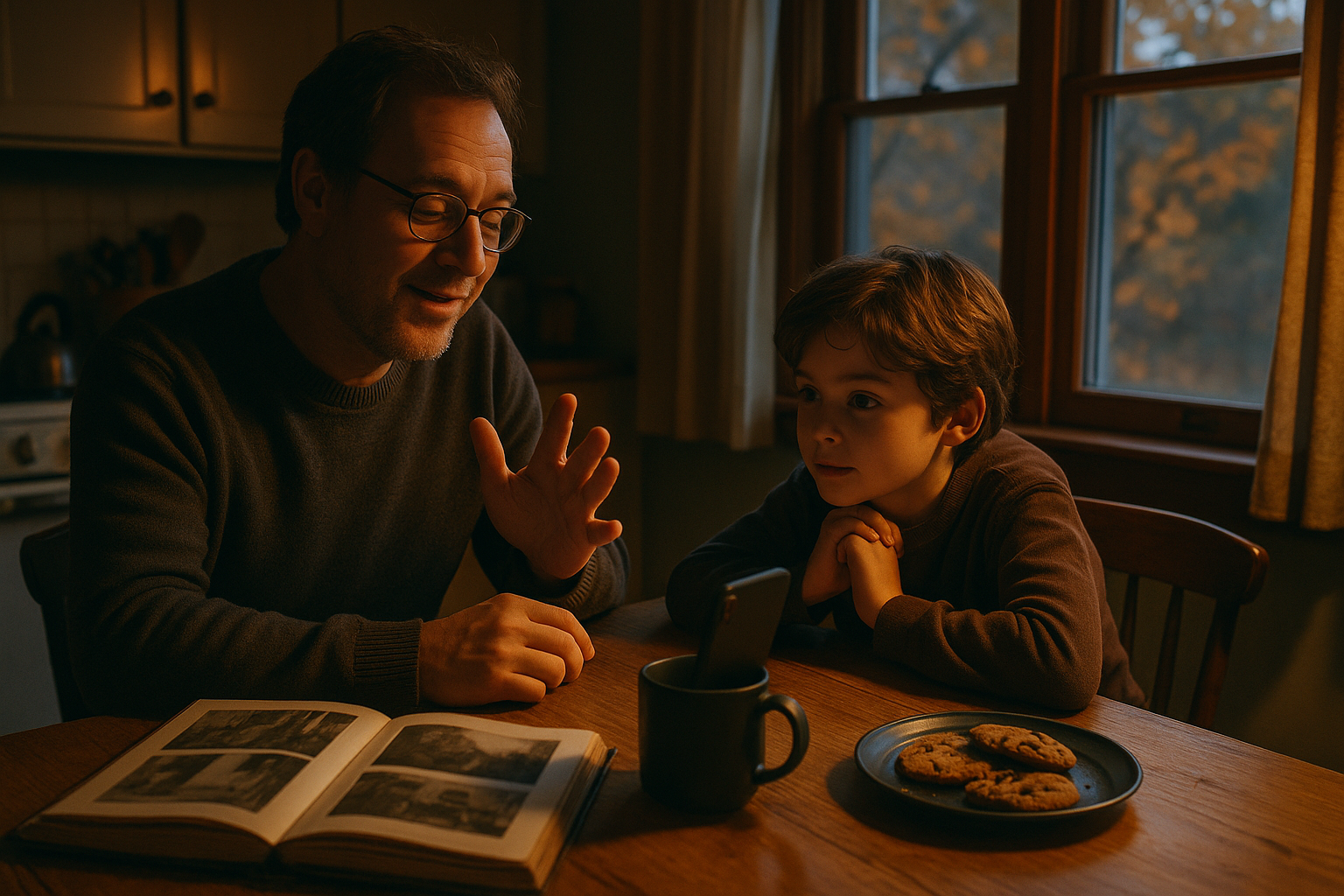
Many parents in their twenties and forties assume that recording their voice, their stories, and their life lessons is a project for later—something to tackle in retirement, when there's more time and the urgency of raising kids has faded. But that instinct gets the timeline backwards. The voice you have right now, the memories that are still vivid, and the small daily moments with your children are not guaranteed to wait for you. Preserving even a few minutes of a bedtime story or a family history conversation today can become one of the most valued keepsakes your family owns, and services like Voice After Life.com exist precisely because so many families wish they had started sooner.
It's easy to picture legacy planning as something for the elderly. But the data on caregiving, memory, and even the physical voice itself suggests the opposite: your forties may be the actual sweet spot.
You're Already the "Sandwich Generation"—Which Means You're Already Thinking About Legacy
If you're in your forties, you are statistically likely to be caught between two generations at once. People in their 40s are the most likely to be sandwiched between their children and an aging parent, with more than half in this age group having a living parent age 65 or older while also raising a child younger than 18 or helping an adult child financially. That means many parents are already watching their own parents' memories, health, and stories become harder to access—often before anyone thought to record them. Many people in their twenties believe they are invincible and are automatically promised tomorrow but we are not. We see tragedies everyday of someone who has gone to soon.
This dual role is emotionally full, but it also creates a natural, non-morbid entry point into legacy thinking. You don't have to frame voice preservation as "end of life" planning. You can frame it as simply continuing what you're already doing: holding your family's story together across generations.
Your Voice Is Not Static—It Changes With Age
One of the most overlooked reasons to record earlier rather than later is biological. The human voice itself ages. Researchers describe this process as presbyphonia, a condition involving a physiological process of aging voice that includes morphological changes in the coverage mucosa, muscle, and cartilage of the larynx. A systematic review in European Geriatric Medicine found that presbyphonia identifies vocal changes due to anatomical and physiological changes of the larynx occurring during the aging process, affecting about 10–20% of elderly adults and potentially impacting their quality of life . A more recent scoping review noted that laryngeal aging involves cumulative changes to the vocal folds and surrounding tissue that can eventually produce a weak, breathy, or hoarse voice, especially when combined with respiratory aging, hormonal shifts, and hearing loss .
In plain terms: the warm, familiar timbre your children associate with you today is not permanent. Waiting until your seventies to record a voice message means recording a voice that has already changed—sometimes considerably—from the one your kids grew up hearing.
The Stories You Tell Now Shape Who Your Kids Become
There's also a compelling psychological reason to start earlier rather than later, and it has nothing to do with mortality—it's about your children's resilience right now. Psychologists Marshall Duke and Robyn Fivush at Emory University spent years studying what holds families together, eventually developing the "Do You Know?" scale to measure how much children know about their family's history. Their research found that the more children knew about their families, the higher their self-esteem was, as well as their sense of control over their lives, and children who were informed of their family history were more resilient and handled stress better than those who were not informed . Notably, this held true even independent of how emotionally close the family was: knowing family history predicted resilience independent of how warm or cohesive the current family was, and a child in a somewhat distant family who knew detailed family stories did better than a child in a warm, close family who didn't know their family's background .
Journalist Bruce Feiler brought this research to wide public attention in the New York Times, reporting that children who knew their family narrative tended to do better than other children when they faced challenges, proved to be more resilient and able to moderate the effects of stress, had a stronger sense of control over their lives, and had higher self-esteem . This is not a reason to wait until your children are grown to pass down family history—it's a reason to start telling and recording those stories while they're young enough for the stories to shape them.
Waiting Often Means Never Getting to It
There's a broader pattern in how Americans handle life-planning tasks: procrastination compounds with age. Research on estate planning found that the majority of respondents believe estate planning should start between ages 30-39, yet the actual average age of estate plan creation is 42 . In other words, even when people know a task is important, they routinely delay it by a decade or more. There's little reason to think voice and story preservation is any different—except that a will can still be written at 75, while a parent's voice, memory sharpness, and daily presence in a child's life cannot be recreated on the same timeline.
What "Recording" Actually Looks Like
This doesn't require a formal studio session or a single, perfect narration of your life story. It can be as simple as:
- Recording the answer to a question your child asks at dinner—like how you met their other parent, or what your own childhood home smelled like.
- Narrating a family recipe out loud while you cook it.
- Leaving a short voice message for a future birthday or graduation.
- Capturing your own parents' stories while you still can, since you're likely the bridge generation holding that history.
Over time, these small recordings become part of a much larger archive on Voice After Life . com. Many parents find it easier to build this archive gradually rather than treating it as a single overwhelming project, and having a dedicated place to organize and store these voice memories—such as through Voice After Life—can make the difference between scattered phone recordings and a preserved, accessible family archive.
Starting Now Is the Gift
Your twenties is not too early to think about being remembered. Your forties is not too early to think about legacy. Between the realities of the sandwich generation, the documented biology of vocal aging, and decades of research on how family narrative shapes children's resilience, the case for starting now—rather than waiting for retirement—is stronger than it first appears. The stories, recipes, laughter, and advice that feel ordinary today are exactly what your children and grandchildren will treasure decades from now.
- Voice After Life.com
Sources
- Do You Know? How Family Stories Benefit Children and Adolescents in Myriad Ways — The Covenant Foundation
- EveryDay Strong: Teaching kids about family history helps increase resilience — Daily Herald
- What '1923' Secretly Teaches You About Raising Resilient Kids — StoryQuest
- The Stories That Bind Us — The Church of Jesus Christ of Latter-day Saints (citing Bruce Feiler, The New York Times)
- Aging voice: presbyphonia — Aging Clinical and Experimental Research (Springer Nature)
- The aging voice: a systematic review of presbyphonia — European Geriatric Medicine (Springer Nature)
- Presbyphonia: A Scoping Review for a Comprehensive Assessment of Aging Voice — ScienceDirect
- 54% of Americans in their 40s have both an aging parent and own child — Pew Research Center
- Trust & Will's 2025 Estate Planning Report: Demographic Breakdown — Trust & Will