Why Your Forties Are the Right Time to Record, Not Your Seventies
Your voice, memory, and stories are at their sharpest right now. Here's the research on why midlife—not old age—is the ideal time to start recording.
The Window Is Open Right Now
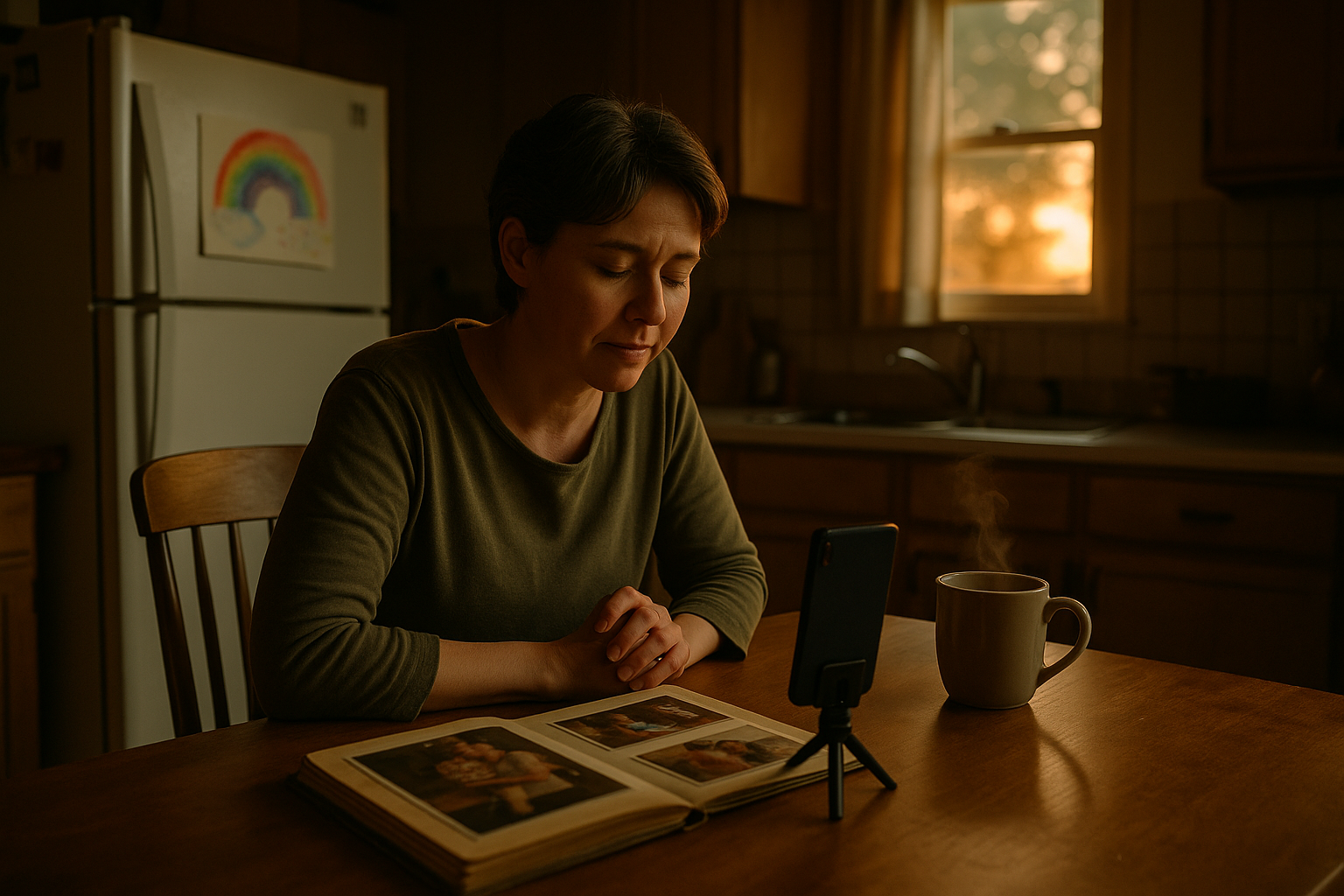
Most people assume that recording your voice and life stories for future generations is something to do "eventually"—maybe after retirement, maybe when health starts to decline, maybe when there's finally time. But the research on memory, voice, and family storytelling all points to a different answer: your thirties and forties are actually the ideal window, not a placeholder until later. Parents raising young children right now have front-row access to memories, humor, and details that will only get harder to recall with each passing year, which is exactly the kind of everyday life that can be preserved through Voice After Life.com before it fades.
It's a strange bit of denial that runs through modern life: we back up our phones obsessively but rarely back up ourselves. The stories about how you met your spouse, what your grandmother's kitchen smelled like, the advice your father gave you the night before your wedding—these live only in memory and conversation. And memory, it turns out, is not the stable archive we assume it to be.
Your Voice Is Already Changing—Even If You Can't Hear It Yet
It's tempting to think of the voice as a fixed part of identity, but physiologically, it is not. As we age, our vocal cords are muscles, and like other muscles in the body, as we age, our muscles become weaker, a process called sarcopenia, which affects the body at large and also the muscles inside the vocal folds, causing them to thin and not touch properly in the middle. According to specialists at UT Southwestern Medical Center, age-related voice changes vary widely, and people can begin to "sound old" in their 50s, while others retain a resonant voice well into their 80s. Research also suggests up to one in three older adults reportedly experiences dysphonia, an alteration in normal voice quality, with the most common issues being decreased loudness, hoarseness, and vocal fatigue, changes that usually come on slowly and can strike as early as the fifties.
That means the timbre, pitch, and warmth in your voice today—the exact sound a child associates with comfort—may not be identical ten or twenty years from now. Waiting until your seventies to record a message doesn't just risk losing the opportunity altogether; it risks capturing a voice that no longer sounds like the one your family remembers from your prime parenting years.
The Science Behind Why Stories Told at This Age Matter So Much
There's also a compelling body of psychological research about why the stories parents tell matter so much to children's development—and it strengthens the case for recording now rather than later. Psychologist Marshall Duke and his colleagues at Emory University spent years studying what they called the "intergenerational self," and found that children who know more about their families and family history are more resilient and tend to do better when facing challenges in life, possibly because seeing patterns of overcoming failures and surviving hard times helps children recognize that people can recover and triumph despite hardships.
Their well-known "Do You Know" scale asked children questions about their family's past, and the results were striking: the more children knew about their families, the higher their self-esteem and sense of control over their lives, and children who were informed of their family history were more resilient, handled stress better, and showed greater family unity, less anxiety, and fewer behavioral problems. Later research building on Duke and Fivush's work found that families that share "oscillating narratives"—stories that move through hardship and recovery rather than a simple arc of triumph or steady decline—tend to give children the strongest foundation for resilience and identity.
Parents in their thirties and forties are typically living through exactly this kind of story in real time: career setbacks and comebacks, the hard years of early parenting, financial stretches, health scares, and the small daily victories in between. Recording those experiences while they're fresh—rather than reconstructing a tidied-up version decades later—preserves the texture and honesty that researchers say matters most.
Memory Doesn't Wait for You to Get Around to It
Cognitive research on autobiographical memory is unambiguous about one thing: memories are not filed away untouched, waiting to be retrieved perfectly at any future date. One review of the science notes plainly that autobiographical memory is notoriously unreliable, and recall may be distorted, with false memories easily taking root over time. Other research on real-world event recall found that memory quantity and the richness of episodic detail declined with increasing age and retention interval—meaning the longer you wait to record a memory, the more of its detail is likely to have quietly eroded, even if the broad strokes remain.
This is precisely why the story your father tells about his childhood at 45 will likely carry more sensory detail, more accurate sequencing, and more emotional nuance than the same story told at 85. The forties are not just a convenient time to record—they are, from a memory-science standpoint, a genuinely better time.
The "Someday" Trap Isn't Limited to Legacy Planning
This same delay shows up in nearly every kind of legacy preparation, not just recorded stories. According to Trust & Will's 2025 estate planning research, the majority of respondents believe estate planning should start between ages 30-39, yet the actual average age of estate plan creation is 42—a decade-long gap between knowing something matters and actually doing it. Separate research from Caring.com found that procrastination has been the most popular answer for why people haven't made a will or a trust since 2022.
Recording your voice and stories tends to fall into the same psychological trap as writing a will: it feels important, it feels like something for "later," and later has a way of never quite arriving. The difference is that a will can still be drafted accurately at 70. A voice recording made at 70 simply cannot recreate the sound, memory sharpness, or daily texture of life at 40.
What This Actually Looks Like in Practice
Recording doesn't have to mean a single, polished autobiography. It can be:
- A short voice memo answering "what was the hardest year of your twenties, and how did you get through it?"
- A recorded bedtime story in your own voice, for a child who will one day want to hear it as an adult
- Audio reflections recorded around milestones—a child's first day of school, a new job, a move to a new city
- Answers to the kinds of questions Duke and Fivush's research suggests matter most: how you met your spouse, a family struggle you overcame, the story of a loved one's birth
The goal isn't perfection. It's capturing the version of your voice, memory, and perspective that exists today, because it is measurably different from the one that will exist in twenty or thirty years. For parents who want a simple, lasting way to hold onto that voice for the people who will miss it most, voiceafterlife.com offers a place to start building that record while the details, and the voice itself, are still vivid.
The forties are not too early. They are, according to the science of memory, voice, and family narrative alike, close to exactly on time.
- Voice After Life.com
Sources
- Why Your Voice Changes as You Age — AARP
- Aging Voice — UT Southwestern Medical Center
- Here's how your voice changes as you age — National Geographic
- EveryDay Strong: Teaching kids about family history helps increase resilience — Daily Herald
- The Value of Sharing Family Stories — Storyworth
- Testing the accuracy of the retrospective recall method used in expertise research — Behavior Research Methods / Springer Nature
- The Truth Is Out There: Accuracy in Recall of Verifiable Real-World Events — PubMed
- Trust & Will's 2025 Estate Planning Report: Demographic Breakdown — Trust & Will
- 2025 Wills and Estate Planning Study — Caring.com