Why a Letter in Your Own Handwriting Still Matters
Science and tradition agree: a handwritten letter carries something a text or email never can. Here's why the pen still matters, and how to preserve what you write.
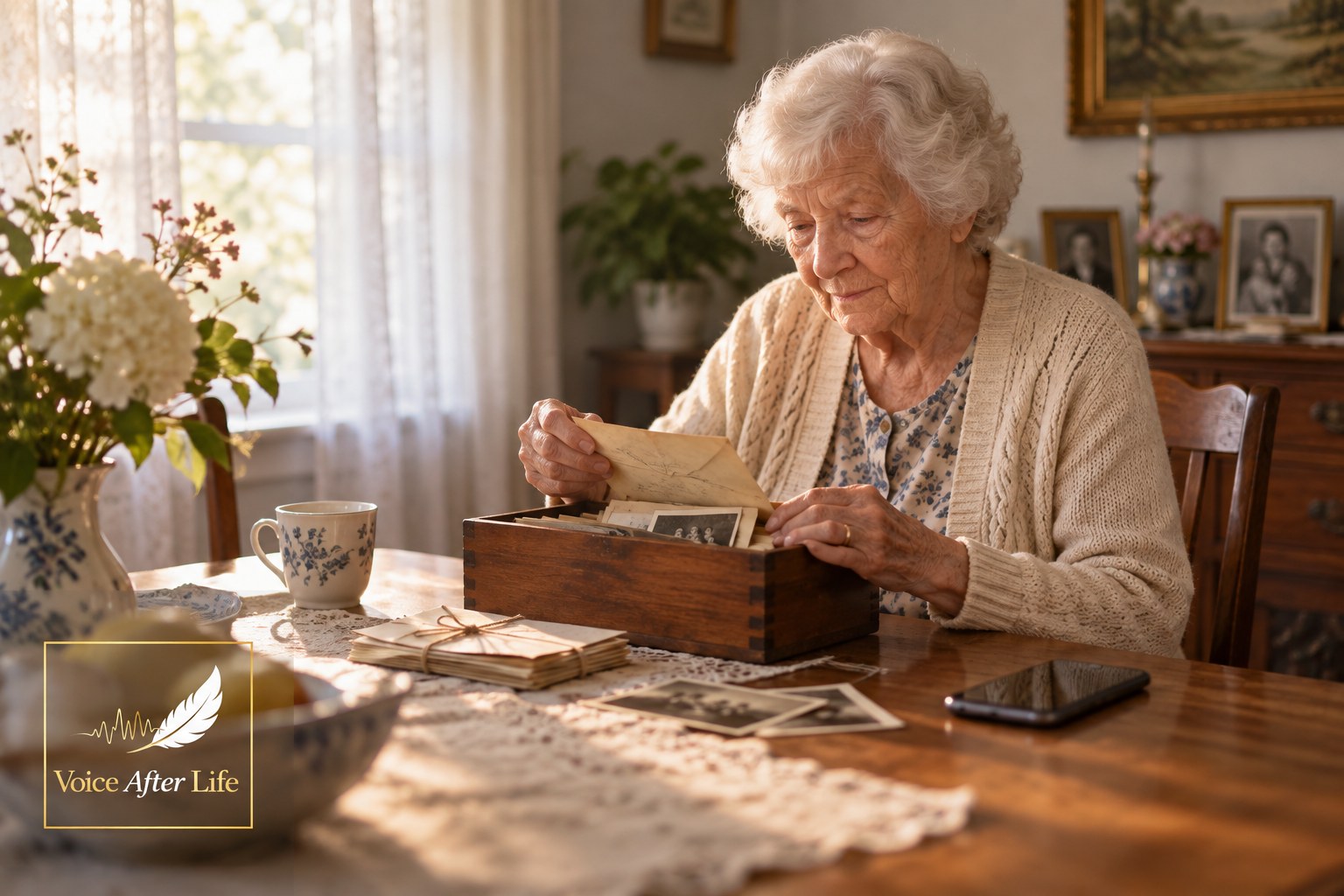
The Letter That Never Got Sent
Mark had meant to write the letter for years. Every Father's Day, he'd think about it — a few pages to his daughter, telling her the things he never quite said out loud. His wife, Diane, kept a similar note tucked in the back of her recipe box, half-finished, addressed to their son. Neither of them talked about it much. It just sat there, waiting for a quiet evening that never seemed to come.
That quiet evening is one many people in their fifties are starting to imagine differently. As families think about what they want to leave behind — not just property, but presence — more of them are turning to letters written by hand. Considering how families preserve these words for the people who matter most, Voice After Life.com has become a place where handwritten letters, once digitized, can sit alongside the voices and stories of the people who wrote them.
What Happens in the Brain When You Pick Up a Pen
It's tempting to assume a typed message and a handwritten one carry the same weight, as long as the words are right. Neuroscience suggests otherwise. Researchers using EEG have found that students taking notes by hand had higher levels of electrical activity across a wide range of interconnected brain regions responsible for movement, vision, sensory processing and memory, compared with typing. In the same study, when students wrote words by hand, sensors picked up widespread connectivity across many brain regions, while typing led to minimal activity, if any, in the same areas.
Psychologist Audrey van der Meer, who co-authored the research, put it plainly: the coordinated, full-body engagement of forming letters by hand simply doesn't happen with a keyboard. As one summary of her findings noted, brain connectivity patterns during handwriting are more elaborate and crucial for memory formation and encoding new information. That difference isn't just academic — it's part of why a handwritten letter can feel more "present" than a text, both to write and to read.
There's also an emotional dimension. Psychology Today has noted that writing helps people process life's emotional ups and downs through sense-making, and the greater the cognitive effort to find meaning, the greater the appreciation of the benefits and improved mood. The slower, more deliberate pace of handwriting seems to invite that kind of reflection in a way that quick typing doesn't.
More Than Words on a Page
A handwritten letter carries information that typed text simply can't hold. The slight tremor in a signature, the pressure of the pen, the way certain words get underlined — all of it is part of the message. One review of handwriting research put it this way: the pressure, slant, and flow of handwriting often change with emotions, indicating stress, happiness, or anxiety, which is part of why old letters can feel so alive decades later.
This is a large part of why families researching their own history so often gravitate toward letters over any other artifact. As one guide to preserving family correspondence explains, genealogists treasure handwritten letters because they reflect ancestors' thoughts and experiences in their own words, on paper they handled, providing a rare personal connection with ancestors.
Letters as a Legacy Tool, Not Just a Keepsake
Estate planning has traditionally focused on money and property. But a growing number of professionals now recognize a different kind of document: the legacy letter, sometimes called an ethical will. As one estate-planning resource describes it, while traditional estate planning documents like wills and trusts focus on the distribution of assets, a legacy letter serves a different purpose altogether — it captures who you are, your values, and the wisdom you wish to impart to future generations.
The research on what these letters do for the people who receive them is worth pausing on. A scoping review published in Palliative & Supportive Care found that receiving a letter from a loved one after death can modify the grief experience for survivors and provide family members and caregivers with a sense of consolation, solace, feeling the presence of the loved one with them, and encouragement. That's not a small thing. For a couple like Mark and Diane, sitting down to write to their grown children isn't only about the past — it's a way of showing up for a future conversation they won't be present for.
Starting the Letter
Most people get stuck before they get started. A few prompts that estate-planning and grief researchers commonly suggest:
- What do you want your children or grandchildren to know about where the family came from?
- What's a story you've never told, and why does it matter to you?
- What do you hope for the people you love, beyond the years you'll share with them?
There's no required length or format. A single page, written honestly, often means more than a polished essay.
Protecting the Letter Once It's Written
Once a letter exists, it becomes an object that needs care — paper degrades, ink fades, and basements and attics are hard on both. Archival guidance is fairly consistent on this point: letters should be stored in acid-free, lignin-free archival boxes and sleeves to prevent yellowing, and kept in a consistent climate-controlled environment, avoiding attics and basements with high humidity and temperature swings.
Digitizing a letter is one of the simplest ways to protect it further, since a scan or photograph means the words survive even if the original page doesn't. One archival guide recommends this step specifically so families can scan letters and envelopes to create a backup and share copies with family. Once a letter is scanned, families often want a place to keep that digital copy alongside other pieces of a person's story — a recorded memory, a voice message, a photograph with context behind it. That's the kind of collection many people build over time when preserving a loved one's letters and reflections at Voice After Life, so a single page doesn't end up as the only trace of everything someone meant to say.
The Letter Is Still Yours to Write
Mark eventually finished his letter. It wasn't long, and it wasn't perfect. But it was his handwriting, his pauses, his choice of words — the kind of thing his daughter will be able to hold, literally, long after the conversation that prompted it is forgotten. That's the quiet argument for writing by hand: not that it's more efficient, but that it's more him, in a way nothing typed could quite manage.
If there's a letter you've been meaning to write, this is as good a time as any to start.
- Voice After Life.com
Sources
- Why Writing by Hand Is Better for Your Brain — Psychology Today
- Handwriting Shows Unexpected Benefits Over Typing — The Psychiatrist
- Why Writing by Hand Is Better for Memory and Learning — Scientific American
- Interesting Psychological Facts About Handwriting — Institute of Graphology
- Legacy Letter Writing Guide — Trust & Will
- Leaving a lasting legacy: A scoping review of ethical wills — Palliative & Supportive Care, Cambridge Core
- How to Preserve Old Letters — Family Tree Magazine
- Preserving Handwritten Family Letters: A Practical Guide to Archival Care — A Record of My Father
- Guide to Preserving Handwritten Letters — Gaylord Archival