When You Are the Family Historian and Nobody Asked You to Be
Nobody appointed you the keeper of family photos and stories — you just became one. Here's how to carry that role well, without burning out.
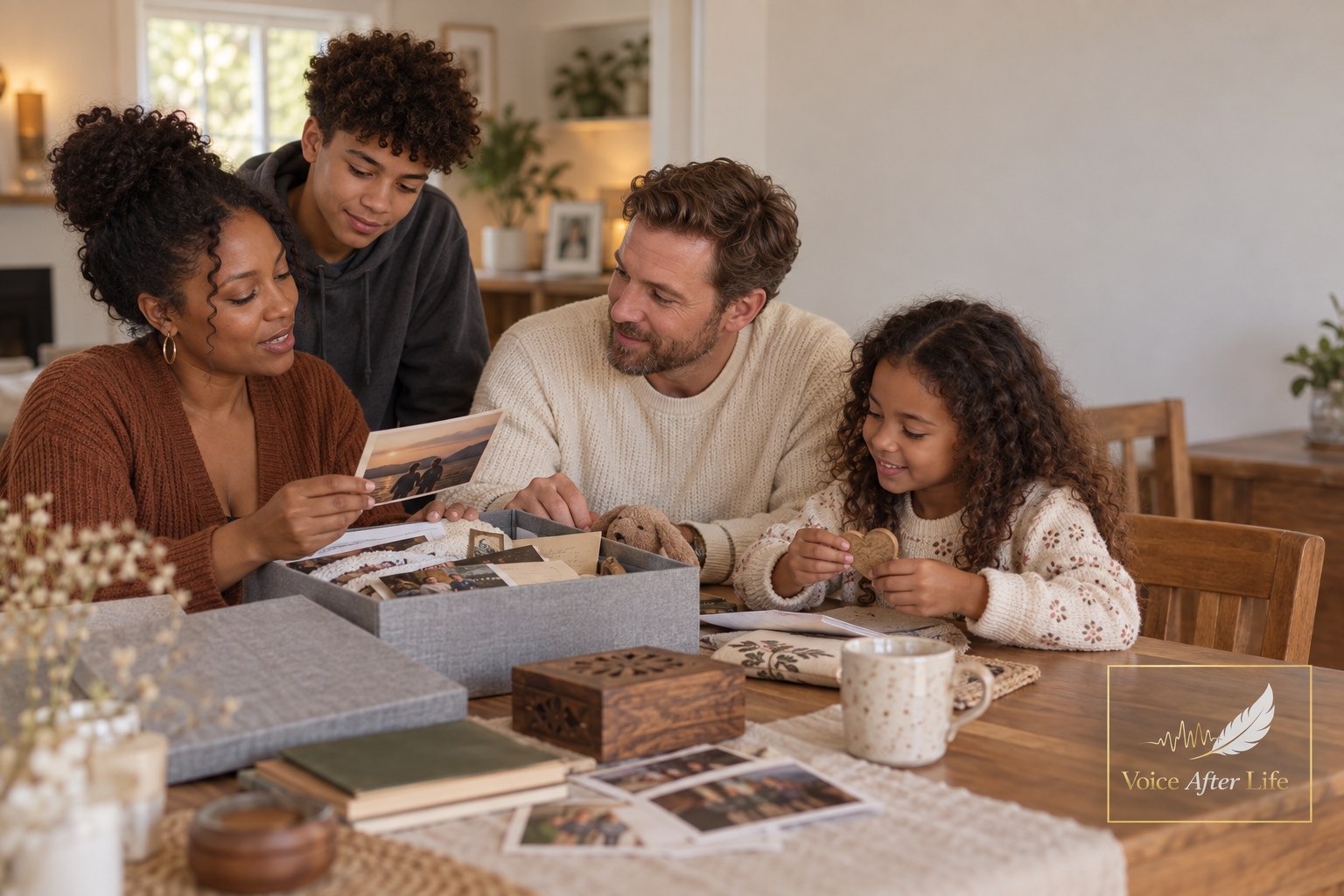
The Job Title Nobody Gave You
Somewhere along the way, without a vote or a ceremony, you became the one who knows. You're the one who can name every face in your abuela's photo albums, the one your cousins text when they need to know what year your tío moved to Chicago, the one who backs up the family group chat in her head because she's afraid someone will delete it by accident. For one young woman in her late twenties, it started small: scanning a shoebox of photographs for a cousin's quinceañera slideshow. A year later, she was the unofficial archivist for three generations, and nobody had ever sat her down and asked if she wanted the job.
If this sounds familiar, you're not imagining the weight of it. Recorded conversations, scanned documents, and the stories only you remember to ask about can all be gathered in one place through Voice After Life.com, which exists for exactly this kind of quiet, accidental responsibility. But before you think about where to put everything, it helps to understand why the role matters — and why it so often lands on one person's shoulders without anyone meaning for that to happen.
Why This Role Exists at All
Family historians aren't born; they're assigned by circumstance. Someone has to be the one who asks questions at the holiday table, who notices when a grandparent's stories are starting to repeat or fade, who feels a quiet urgency that nobody else in the room seems to share yet. Researchers who study family storytelling have found that the role itself is worth taking seriously. Decades of work by Emory University psychologists found that knowledge of family stories stood out as the main factor in predicting emotional well-being, or increased resilience, better adjustment, and improved chances of good clinical and educational outcomes . That finding held up under real-world stress: in a study that spanned the September 11th attacks, the ones who knew more about their families proved to be more resilient, meaning they could moderate the effects of stress .
It isn't only about knowing dates and names. The shape of the stories matters too. Research on these family narratives has shown that families that share "oscillating narratives" — stories that move through hardship and recovery, rather than a simple arc of triumph or steady decline — tend to give children the strongest foundation for resilience and identity. A story that shows a grandparent struggling, adapting, and coming through the other side does more for a child's sense of what the family is capable of than a frictionless success story . In other words, the awkward, unresolved, complicated stories you're gathering aren't a mess to clean up before sharing — they're often the most valuable part of the archive.
What the Job Actually Involves
Most people who fall into this role never formally learn how to do it. They improvise. Oral historians who've thought carefully about this process offer a few reminders that are worth holding onto.
First, this is relational work, not just recordkeeping. Guidance from the Smithsonian's National Museum of African American History and Culture puts it plainly: to begin, you must first understand that oral history is about relationships. Take time to plan the details of your oral history, so that during your recording you can build rapport with the individuals you plan to interview . The same guidance emphasizes that during a recording session, the oral history interview is a sacred space, based upon trust and a mutual understanding. Your narrator — in this case, your elder or family member — is an authority on their own life .
Second, good questions do the heavy lifting. Oral history practitioners consistently recommend open-ended prompts over yes-or-no ones, since bringing out new stories from family members about relatives alive and dead enables you to record the memories, experiences and opinions of your relatives while they are still alive, including capturing family stories passed down the generations . Asking about a grandparent's earliest childhood memory or the traditions tied to a particular holiday tends to open doors that a straightforward factual question won't.
Third, remember who the keepers of knowledge already are in your family. Every extended family tends to have at least one or two people who hold the context nobody else has. As one guide to oral history for genealogists notes, every family has one or two people who are the custodians of family knowledge: the person who knows who everyone is in the old photographs, who knows why the family uses certain names, who remembers the stories the patriarch or matriarch used to tell. Find these people and record them .
Protecting What You've Gathered
Once you've started collecting — photos, recordings, scanned letters — the next worry is keeping it all safe. The Library of Congress, which has spent years advising the public on exactly this problem, recommends a few concrete habits. Start by locating everything you have: identify all your digital files on cameras, computers, and removable media such as memory cards or external hard drives, include any files on the web or in the cloud, review social media platforms, and locate significant correspondence in email . From there, organization matters as much as storage: give individual files descriptive file names, tag photos with names of people and descriptive subjects, and create a directory or folder structure on your computer to organize the files you have selected .
Most importantly, don't let one copy be the only copy. A widely cited data-protection principle known as the 3-2-1 rule, used by IT professionals and archivists alike, recommends keeping three copies of your data, stored on two different media types, with one copy kept offsite . For a family archive, that might mean a folder on your computer, a backup drive kept somewhere else, and a cloud copy — so that a lost phone or a damaged hard drive never means a lost grandparent's voice.
You Don't Have to Carry It Alone
Here's the part that often gets missed: being the family historian doesn't mean you have to be the only place all of this lives, or the only person who can access it when something happens to you. Recordings, photo captions, and the stories behind them can be organized and shared with the people who'll need them someday through this approach to keeping family memory accessible, rather than scattered across old phones and unlabeled drives that only you know how to navigate.
The role you've taken on — often without meaning to — is one that researchers increasingly recognize as genuinely important to family well-being, not just a sentimental hobby. Treat your own effort with the same respect you give the stories themselves. Build in breaks. Ask for help labeling photos. Let a cousin take over one interview. The goal was never for this archive to live only in your head; it was for it to outlast all of you.
This article is for general educational purposes and does not constitute legal, financial, or professional archival advice. Consult a qualified professional — such as an estate attorney, archivist, or financial advisor — for guidance specific to your family's situation.
- Voice After Life.com
Sources
- How family stories help children weather hard times — Emory University
- Family Stories and Family Strength — Out in Under
- The Value of Sharing Family Stories — StoryWorth
- Capturing Your Family's Oral History — Smithsonian National Museum of African American History and Culture
- For family historians - Oral History Society — Oral History Society
- The Genealogist's Complete Guide to Oral History Recording — LifeEcho
- Digital Preservation Basics - Personal Digital Archiving — The New School Library / Library of Congress
- What Is the 3-2-1 Backup Strategy? Examples & Best Practices — SentinelOne