When You Are the Family Historian and Nobody Asked You to Be
How one relative quietly becomes the keeper of family photos and stories — and practical, research-backed steps to protect them before they're lost.
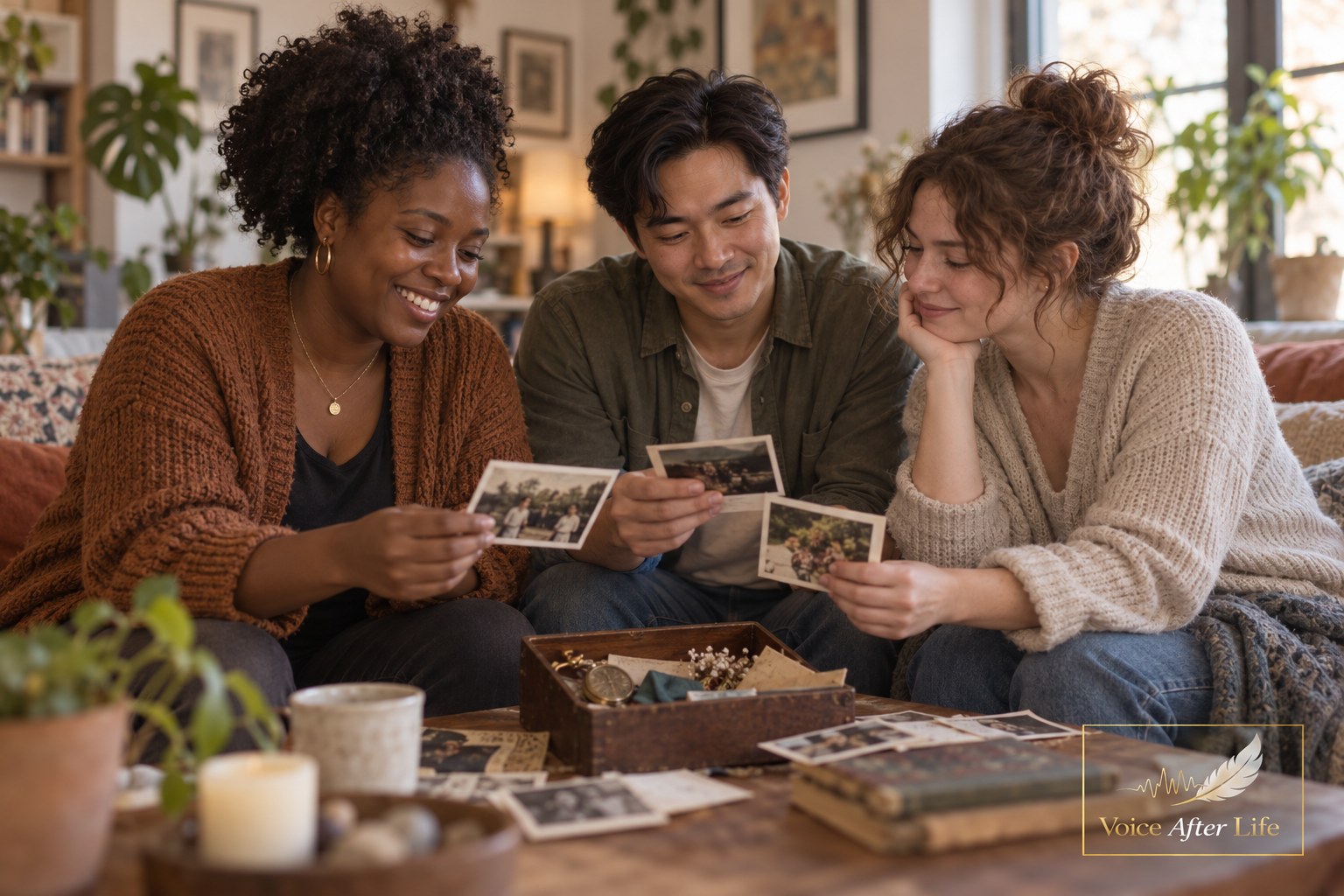
The Box Nobody Else Wanted
It usually starts small. Ryan, twenty-six, was helping his grandmother clear a closet after his grandfather's funeral when she handed him a shoebox of loose photographs and said, "You're good with this computer stuff — can you do something with these?" No one voted on it. No family meeting decided he'd be the one. But from that afternoon on, Ryan was the family historian, a role that tends to land on whoever happens to be standing nearest when the box appears.
That moment — a box, a hard drive, a voicemail nobody can bear to delete — is the reason a growing number of people are looking for somewhere permanent to put what they're suddenly responsible for. The photos, recordings, and stories a family archivist collects don't have to live only in a closet or a folder that might vanish with a crashed laptop; they can also be preserved as a lasting, shareable archive at Voice After Life.com.
How This Role Finds You (Not the Other Way Around)
Genealogists and family historians often use the terms almost interchangeably, but researchers who study the distinction note that the role frequently isn't chosen so much as inherited. As Family Tree Magazine explains, a family historian might also more easily fall into the role of “the” researcher in the family: the one who inherits photos, documents and other ephemera from relatives, and is tasked with preserving them in some way.
There's rarely a formal handoff. Someone is simply good with a scanner, or lives close enough to grandma's attic, or was the one who asked the right question at Thanksgiving dinner. Once that happens, cousins start forwarding old emails, an aunt drops off a bag of cassette tapes, and suddenly there's an unofficial archive growing in a spare bedroom.
Why the Clock Matters More Than It Feels Like
It's easy to assume there's plenty of time to "get to" organizing photos or finally interviewing an older relative. The research on oral history says otherwise. According to genealogical researchers cited by FamilySearch, National Archives historian Aaron Holt has observed that it only takes three generations to lose a piece of oral family history, and a story has to be deliberately and accurately retold across generations to survive at all.
That's a sobering timeline. A grandparent's memory of their own grandparent — details about where a family came from, what a great-great-aunt sounded like when she laughed, why a certain recipe is made a certain way — can disappear within a lifetime if no one writes it down or records it. The National Archives maintains extensive genealogy resources precisely because so much family history exists nowhere else but in memory and scattered personal papers.
The Digital Trap: When "Backed Up" Doesn't Mean Safe
One of the trickiest parts of this job is that digital files feel permanent even though they aren't. A consumer external hard drive — the kind most families use to store thousands of photos — should be assumed to fail somewhere between three and eight years, and solid-state drives lose data even faster when left unpowered for long stretches. Cloud accounts get forgotten, subscriptions lapse, and formats become obsolete in ways most people never anticipate until a file simply won't open anymore.
This isn't a hypothetical risk. Photographers and archivists who've tried to retrieve a decade-old folder of images have described searching through hard drives and cloud accounts only to find that hard drive failures, account migrations, format obsolescence, and simple neglect had quietly erased what once felt permanently safe. For a family archivist working with one-of-a-kind photographs, letters, and recordings, that's the nightmare scenario: not a dramatic loss, but a slow, invisible one.
Starting Small: What an Oral History Actually Requires
The good news is that preserving a family's history doesn't require professional equipment or formal training. The Library of Congress's guidance on capturing family stories recommends something refreshingly simple: choose a quiet place, start the recording by noting the date, place, and names of everyone involved, and then ask open-ended questions and let the person talk without interrupting. Afterward, families are encouraged to sit together and reflect on what surprised them or what they learned that they hadn't known before.
A few practical habits make a real difference for anyone stepping into this role:
- Record conversations as they happen. Family gatherings, holidays, and casual visits are often when the best stories surface unprompted.
- Back up in more than one place. A single hard drive or phone is not a preservation plan.
- Keep originals whenever possible. Digitizing a photo or tape doesn't mean the original should be discarded.
- Write down context immediately. Names, dates, and relationships fade from memory faster than the images themselves.
Over time, what starts as a shoebox of photos or a folder of voice memos can become something a family actually returns to — not just stored, but genuinely preserved and accessible to whoever needs it, whether that's a sibling across the country or a grandchild not yet born. For families ready to move beyond scattered files and toward something more permanent, a service built specifically for preserving voices and memories at Voice After Life offers one place to keep that work from being lost to a failed drive or a forgotten password.
Giving Yourself Permission to Do It Imperfectly
Perhaps the hardest part of unofficially inheriting this role is the pressure to do it perfectly — to scan every photo, transcribe every tape, catalog every name. That pressure is common enough among family historians that it has its own name in genealogy circles: the self-inflicted obligation to preserve everything at once. The more sustainable approach is usually the opposite — small, consistent efforts that prioritize what's most at risk of being lost, rather than one overwhelming project that never gets finished.
Ryan didn't scan the whole box that first week. He picked ten photographs, asked his grandmother who was in each one, and wrote her answers on the back. It wasn't everything. But it was something that didn't exist in writing the day before, and it will still exist long after the version in her memory is gone.
No one asks for this job. But for the person who ends up holding the box, the stakes are quietly enormous — and the smallest recorded conversation today can be the thing a family is grateful for decades from now.
- Voice After Life.com
Sources
- Genealogy vs. Family History | Definitions and Examples of Each — Family Tree Magazine
- Oral Family History Fades in Just Three Generations — FamilySearch
- How to preserve family photos and your whole archive — Digital Archivist
- Preserving Family Stories — Library of Congress
- Resources for Genealogists and Family Historians — National Archives
- I worry that my favorite photos will have vanished by 2040 — Digital Camera World