What Changes When Three Generations Sit Down to Record at Once
When grandparent, parent, and adult child record together, memory becomes conversation—and the stories that emerge are different from anything told alone.
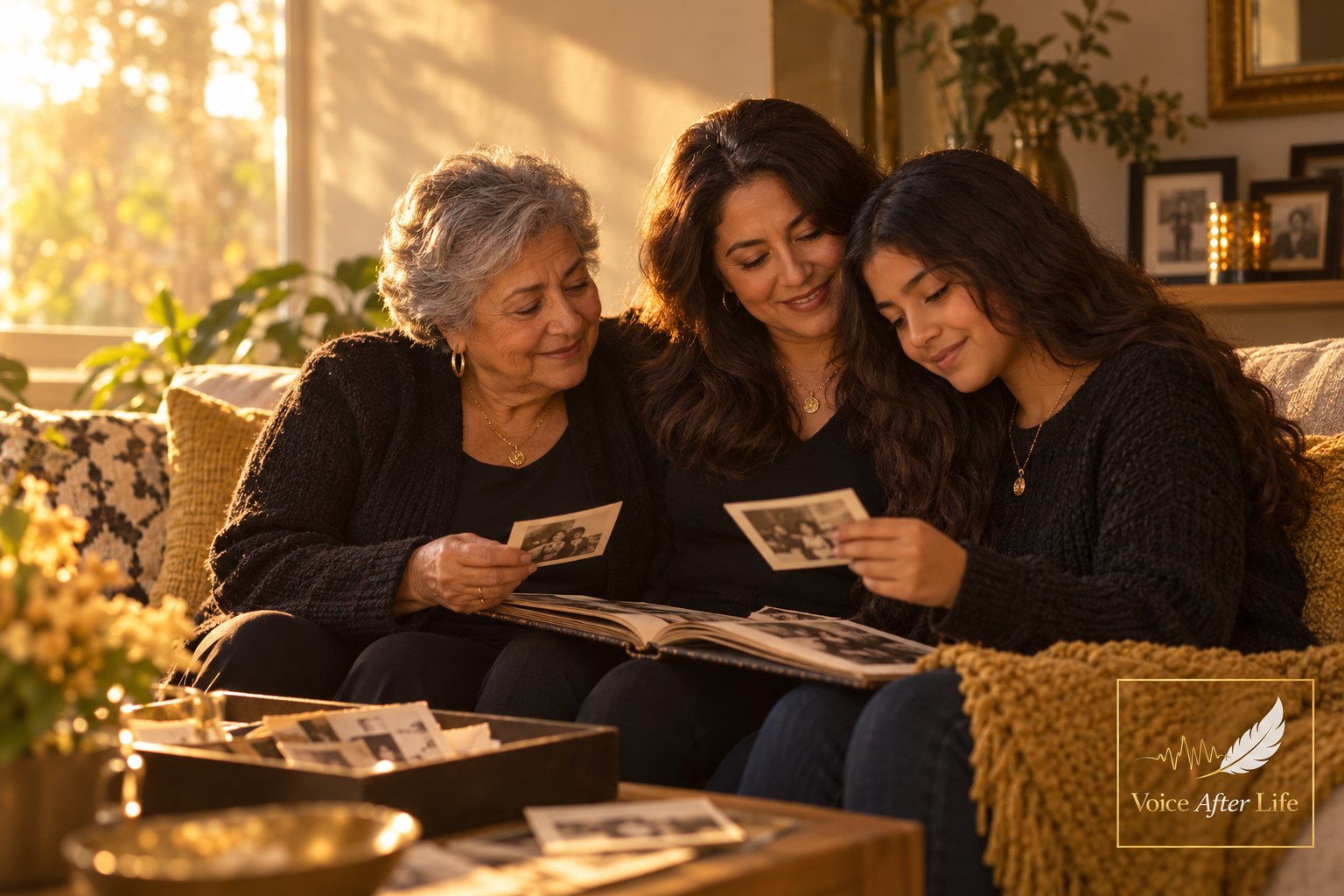
The Table Fills Up
Jake is 26, and for most of his life, family stories arrived secondhand. His grandfather's version of a story would get retold by his dad, softened or rearranged in the retelling, until Jake wasn't sure which details were memory and which were just how the family talked about the past. It wasn't until the three of them sat down together—grandfather, father, and Jake—with a single microphone between them, that Jake realized the story changes when more than one person is in the room to tell it.
This is the quiet discovery a lot of families make once they try recording across generations rather than one person at a time. A solo interview captures what someone remembers. A three-generation conversation captures how a family remembers—the corrections, the laughter, the moments when a father turns to his own father and asks a question he's never asked out loud before. Sessions like the one Jake sat through are exactly the kind of moment Voice After Life.com was built to help families capture before it's gone.
Memory Is Not a Solo Act
Researchers who study oral history have long noted that memory recorded in conversation behaves differently than memory recorded in isolation. Interactivity between generations means the people in the room share responsibility for the content and the shape of the story as it's told. Personal conversational narratives use language to translate life events into a coherent event sequence, arranging them across past, present, and future, and interactivity implies shared responsibility for the content and meaning-making. In practice, that means Jake's grandfather might start a story about immigrating for work, his father might jump in with the part he remembers hearing as a kid, and Jake ends up asking the question that reframes the whole thing. None of that happens in a one-on-one interview.
Oral historians have also pointed out something families often discover only after they've tried it: the emotional weight of a memory comes through differently when it's spoken aloud in real time. Emotions come through audio more than through transcripts. A grandfather's pause before answering a hard question, a father's laugh at a detail he'd forgotten—these are the textures that a written family history can never fully hold onto.
Why Three Generations Changes the Room
When only two people talk—say, a grandparent and a grandchild—the conversation tends to move in one direction: elder tells, younger listens. Add a middle generation, and the dynamic shifts. The parent becomes both a former listener and a current questioner, often prompting stories they themselves have heard only in fragments. Research on cross-generational dialogue suggests this blend of perspectives is part of what makes the exchange valuable in both directions. Older adults' socioemotional strengths, such as emotional stability and positivity, combined with younger adults' curiosity and open-mindedness, have the potential to foster respectful dialogue across generations.
For Jake, sitting between his father and grandfather, that meant watching his dad ask questions he'd apparently wondered about for decades but never voiced. The presence of a third generation gave him permission—or maybe just occasion—to finally ask.
There's a practical side to this too. Family historians who specialize in oral history note that group settings surface material that wouldn't come up otherwise. Recording family members together can bring out new stories from relatives about people alive and dead, enabling you to capture memories, experiences, and opinions while relatives are still alive, including family stories passed down the generations. A grandfather might not think to mention a detail unprompted, but if his son brings it up first, he'll often fill in the rest.
What Gets Lost When We Wait
Family researchers who study these dynamics tend to return to one theme: oral history work matters most when it happens while everyone involved is still able to take part. Without this work, these stories are gone forever—intergenerational stories carry lessons about how a family arrived at its current moment, physically, culturally, and economically. That urgency is different from ordinary nostalgia. It's the recognition that a three-way conversation is only possible for a limited window—while a grandparent's memory and voice are strong, while a parent still has an active stake in asking questions, while an adult child still has time to record more than one session.
There's also a well-documented benefit that runs in the other direction: toward the oldest generation in the room. Intergenerational contact can help reduce feelings of loneliness and stress, foster a greater appreciation for differences between generations, and create stronger social connections with those of different ages. A recording session isn't just an archival exercise for the family that comes after—it's a meaningful visit for the person being recorded, right now.
Making Room for the Conversation, Not Just the Content
Families who try this for the first time often over-plan it, arriving with a long list of questions and a rigid order of who speaks when. The better sessions tend to loosen that structure. Someone asks an opening question—what was it like the year you got married, what job did you hold the longest—and then the room does what rooms full of family do: it interrupts itself, corrects itself, laughs at itself.
That's the part worth protecting. A three-generation recording isn't really about producing a polished narrative. It's about letting three different vantage points on the same family exist in one place, at the same time, in each person's own voice. When that conversation is preserved rather than left to fade into secondhand retellings, a grandson like Jake gets something his own children may not otherwise have: a room where his grandfather and father are both speaking for themselves, at once. Preserving that exact kind of layered, overlapping conversation—not just a single voice, but a family talking together—is part of what a service like Voice After Life exists to make possible.
Starting the Conversation
There's no single right way to begin. Some families start with an object—a photograph, an old letter—and let questions follow naturally. Others simply hit record during a holiday visit and see what happens. What seems to matter more than method is simply choosing to sit down together, with the recorder running, before the chance passes.
For Jake, the session with his father and grandfather didn't answer every question he'd ever had about his family. But it did something else: it gave him a version of the story that included all three of them, disagreements and all, instead of one filtered account passed down secondhand. That's a different kind of family record—and, for many families, a harder one to get back to once the moment has passed.
- Voice After Life.com
Sources
- Family Oral History Across the World — Routledge
- Generational Strengths Help Bridge Political Divides: An Analysis of Cross-Partisan Conversations — Innovation in Aging / Oxford Academic
- For family historians - Oral History Society — Oral History Society
- The power of intergenerational storytelling to solidify community and effect change — American Press Institute
- Intergenerational Contact and the Benefits for Older Adults — Innovation in Aging / Oxford Academic
- Constructing the tellability of intergenerational memory narratives in collective remembering in StoryCorps — Memory Studies (SAGE)