Starting to Record in Your Eighties, When Time Already Feels Short
It's never too late to start. Here's how families are helping loved ones in their eighties begin recording stories, voices, and messages worth keeping.
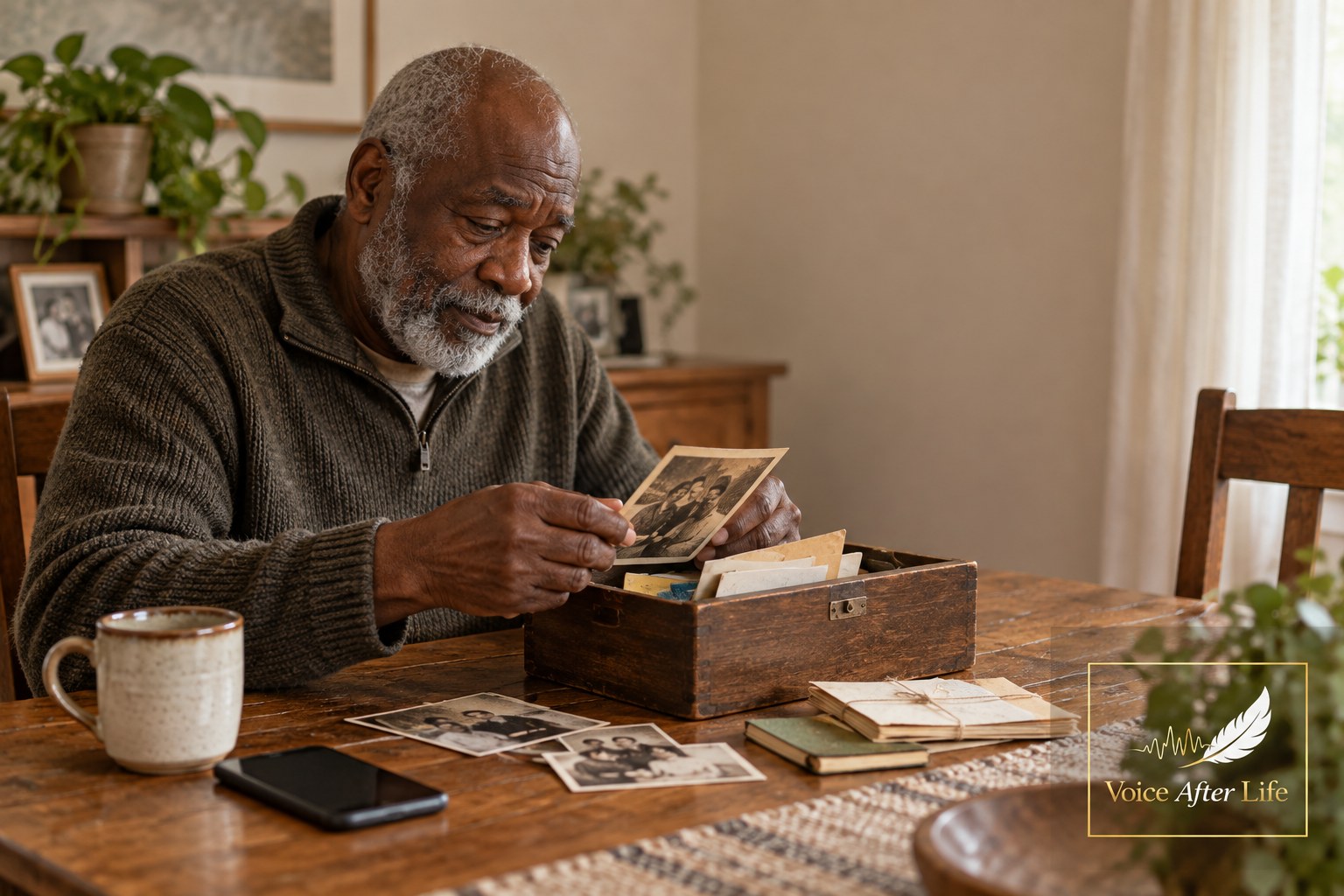
The Conversation Over Tea
Mei Lin, 64, had been putting it off for months. Every Sunday she visited her mother's apartment, and every Sunday she meant to ask if they could sit down together and record some stories — about the village her mother grew up in, about the years she raised four children on her own, about the recipes that never made it onto paper. Her mother had just turned 83, and Mei Lin kept telling herself there would be more time. One afternoon, over tea, her mother finally said it herself: "If you want to ask me things, ask me now."
That single sentence is why so many families arrive at Voice After Life.com, often after years of meaning to start a recording project and never quite finding the moment. Starting in your eighties can feel late. It rarely is.
Why It's Not Too Late to Begin
There is a quiet myth that legacy recordings belong to people who plan ahead in their fifties or sixties, and that starting later means starting behind. The research on aging tells a different story. A person who reaches 65 today can, on average, expect nearly two more decades of life, and many of those years are lived in reasonably good health. In the United States, a 65-year-old has a total life expectancy of 85.2 years, rising to 86.4 at 70, 87.9 at 75, and 89.7 at 80 . In other words, someone beginning to record their stories at 83 is not necessarily at the end of the process — they may simply be at the start of a new chapter of it.
What matters more than age is what happens when older adults are given the chance to look back. A systematic review and meta-analysis of reminiscence and life review programs involving more than two thousand older participants found that experimental groups of older adults significantly improved their quality of life and life satisfaction after engaging in structured reminiscence. Separate research has shown that reminiscence therapy, defined as using the recall of past events, feelings, and thoughts facilitating pleasure, is one type of psychotherapy that could alleviate depressive feelings among older adults, improve their quality of life, and help them live independently . Recording a life story is, in many ways, a natural extension of that same process — a structured, gentle invitation to remember out loud.
What Late-Life Storytelling Often Looks Like
Doctors and researchers who work with seriously ill or aging patients have studied this directly. A well-known intervention called dignity therapy invites people to narrate their own life story with a facilitator, producing a document the family can keep. As one researcher explained on NPR, the approach grew from research into what gives people a sense of dignity near the end of life, including the idea of leaving something that will outlast that person, and it seemed the appropriate response was to create something that will outlast that person . Hospice organizations describe similar work more broadly: recording audio or video messages allows individuals to convey their thoughts, messages, and stories in their own voices, and these recordings can be especially powerful for family members to revisit .
For families like Mei Lin's, none of this needs to be clinical or formal. It can simply be a phone propped on the kitchen table while a mother talks about the ship she took as a young woman, or the year the harvest failed, or what she hopes her grandchildren will remember about her.
Working With, Not Against, Energy and Memory
Starting later in life does call for a different pace than a project begun decades earlier. Caregiving professionals who guide families through oral history interviews generally recommend shorter, more frequent sessions rather than one long sitting. One senior care organization advises to start with a 10- or 15-minute session at first and increase to longer sessions if they are receptive , since lengthy periods of talking can be physically or cognitively taxing for some seniors . A guide on conducting family oral history interviews likewise suggests being mindful of the duration of your interview, no more than one hour, and taking breaks while paying attention to both verbal and nonverbal signs of fatigue or distress .
Memory itself doesn't need to be perfect for a recording to be valuable. Gaps, repeated stories, and out-of-order timelines are normal and rarely diminish what a recording means to the people who receive it later. The National Institute on Aging notes that forgetfulness can be a normal part of aging, though dementia is not a normal part of aging — a distinction worth keeping in mind, and one to raise with a doctor if new or rapid changes in memory appear, rather than something to try to diagnose at home.
Photographs and familiar objects can help. One guide to family oral history projects points out that old family photos, scrapbooks, or journals are excellent vehicles for storing up memories and getting your interview subject to open up . A worn recipe card, a faded photograph, or an old letter can do more to unlock a story than any list of questions.
Starting Simply
There is no need for a script. A handful of open, unhurried questions is usually enough to begin:
- What is your earliest memory?
- What was a typical day like when you were young?
- Who taught you the most, and what did they teach you?
- What do you want your grandchildren or great-grandchildren to know about you?
Let the conversation wander. The goal is not a polished interview, but a voice, a laugh, a turn of phrase — the things that make a person recognizably themselves. Whether those recordings end up as a single short clip or a growing collection built session by session, they become something a family can return to for years, which is part of why preserving a parent's or grandparent's voice, in their own words and their own rhythm of speech, is something more people are turning to Voice After Life to help organize and keep safe.
A Beginning, Not a Deadline
Mei Lin didn't finish her mother's story in one afternoon. She recorded fifteen minutes that first Sunday, and has gone back nearly every week since. Some sessions are about childhood; others are just her mother talking about the weather, or a neighbor, or nothing in particular. None of it needs to be complete to matter. Starting in your eighties doesn't mean racing against the clock — it means finally sitting down at the table and pressing record.
- Voice After Life.com
Sources
- Benefits of Reminiscence Therapy — Pruett Gerontology Center, Abilene Christian University
- Effectiveness on Quality of Life and Life Satisfaction for Older Adults: A Systematic Review and Meta-Analysis of Life Review and Reminiscence Therapy across Settings — PMC / National Institutes of Health
- The Effectiveness of Reminiscence Therapy on Alleviating Depressive Symptoms in Older Adults: A Systematic Review — PMC / National Institutes of Health
- Recording A Life In One's Final Days — NPR
- Legacy Activities in Hospice Palliative Care — Hospice Palliative Care Ontario
- Conduct an Oral History Interview With Seniors — Visiting Angels
- Seven tips for recording your family's Oral History — National Library and Information System Authority (NALIS), Trinidad and Tobago
- Best practices for recording family history interviews at home — Modern Heirloom Books
- United States: Life Expectancy 1950-2026 & Calculator by age — Georank, using UN World Population Prospects data
- Memory Problems, Forgetfulness, and Aging — National Institute on Aging, National Institutes of Health