Recording Your Own Story While Caring for Someone Else
Caregiving can quietly erase your own story. Here's why preserving your voice matters too — and how to make small room for it.
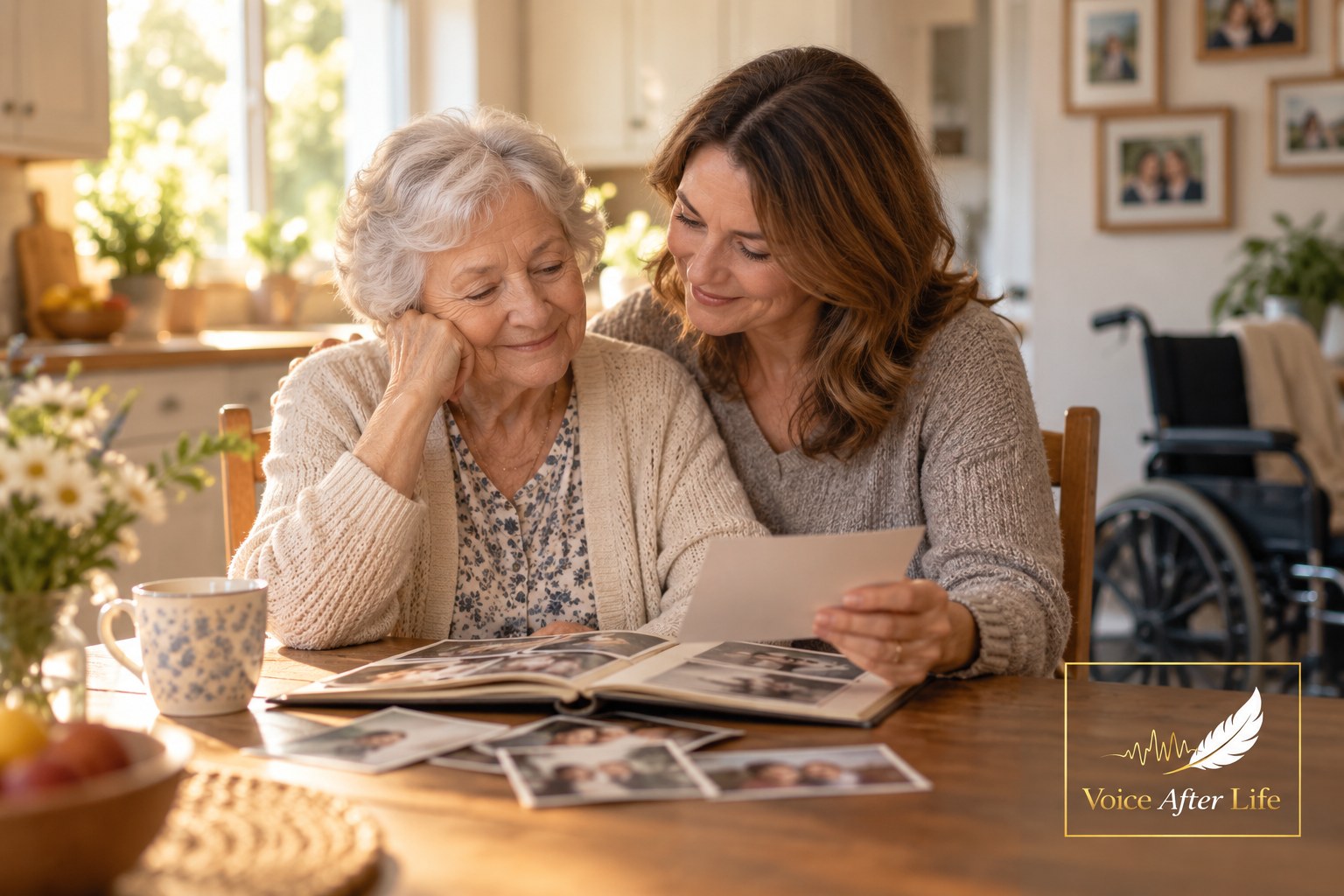
When You're the One Giving Care, Who Tells Your Story?
Sami and Nadia had been married for twenty-two years when her father moved in after a fall left him unable to manage stairs alone. Between his physical therapy schedule, Sami's job, and the ordinary noise of daily life, Nadia found that entire weeks passed where she never once talked about her own memories, her own childhood, or the small stories that had shaped who she was. Caregiving has a way of doing that — it fills the room so completely that the caregiver's own voice can start to fade into the background. For couples like Sami and Nadia, setting aside even a few minutes to record a memory or a message is exactly the kind of thing Voice After Life.com was built to make possible.
It's a quiet irony of caregiving: the people spending their days preserving someone else's dignity, routines, and comfort are often the least likely to think about preserving anything of their own. Their story keeps getting pushed to "later."
The Weight Caregivers Carry Alone
The scale of this is larger than most people realize. According to the AARP and National Alliance for Caregiving's 2025 report, approximately 63 million adults in the United States provided care to an adult or child with a medical condition or disability. Many of them are doing this while still working and raising families of their own: recent survey data shows many family caregivers are balancing work and caregiving, with 64% reporting that they also have full- or part-time jobs in addition to caring for elderly loved ones. Nearly one-half are members of the sandwich generation, also caring for children or grandchildren under 18.
That load takes a toll. Recent survey findings indicate more than three-quarters of caregivers experience feelings of burnout, with many describing it as a weekly or even daily occurrence. And burnout rarely arrives alone — it tends to travel with other kinds of strain. Research summarized by A Place for Mom notes that caregivers who report burnout also commonly experience emotional stress, disrupted sleep, changes in social connection, and financial pressure, underscoring that stress often spans multiple areas of daily life at once.
Beyond exhaustion, something subtler can happen: the caregiver's sense of self can start to blur into the role itself. Long-standing research published in The Gerontologist describes this as "loss of self," a loss of identity that comes about as a result of engulfment in the caregiver role, found to be more common among spouses, females, and younger caregivers. The same body of research found this pattern related to limited social contact and lack of social roles outside that of caregiver. In plain terms: when caring for someone else becomes the only story you're telling, your own story can quietly go untold.
Why Your Own Story Still Matters
There's a natural instinct, in the middle of caregiving, to treat your own memories as a luxury for another season of life. But research on reminiscence — the practice of recalling and reflecting on one's own life experiences — suggests the opposite may be true. Studies in psychology and gerontology have found that reminiscing about worthwhile experiences from the past may provide a sense of purpose and fulfillment, and reflecting on how one dealt with past difficulties can increase a sense of mastery and self-confidence.
This isn't only theoretical. A recent qualitative study of seriously ill parents who recorded audio life stories for their children found the process itself brought unexpected comfort. Participants described the recordings as "a bit of relief that I did it; that I was able to do it," and many felt, by the end, that they had accomplished something valuable. Caregivers are not facing the same circumstances as the seriously ill parents in that study, but the underlying idea translates directly: putting your own voice and memories into a lasting form can be grounding, even healing, in the middle of a hard season.
Small Windows, Real Moments
No one caring for a parent, spouse, or other loved one has hours of free time to sit down and narrate their life story from start to finish. That's not the goal. The more realistic approach is to treat it the way experts recommend treating respite itself — in small, regular doses rather than one grand gesture. Family Caregiver Alliance advises that getting respite before you experience burnout is the key to taking care of yourself, and respite is most effective if it's used early and regularly. The same logic applies to recording your own story: a few minutes here and there, captured consistently, add up to something real.
For Nadia, that might mean recording a short voice memo about the summer she learned to drive, while her father naps in the next room. For Sami, it might be a few sentences about how he and Nadia first met, saved during a quiet moment after dinner. These fragments don't need narration, editing, or a finished script. Over time, small, unhurried recordings like these can become a lasting archive of a person's own voice and memories — not just the story of the person being cared for, but of the caregiver too — which is part of why families turn to a dedicated place to record and preserve them rather than letting them scatter across old phones and forgotten folders.
A Story Still Worth Telling
Caregiving asks a great deal of the people who take it on, often quietly and without much recognition. But the fact that someone is spending their days caring for another person doesn't mean their own life, memories, and voice stop mattering. If anything, the research on identity and reminiscence suggests the opposite: staying connected to your own story may be part of what helps sustain you through caregiving, not a distraction from it.
Sami and Nadia are still in the middle of their caregiving season, and it will likely continue for some time. But somewhere in the busy in-between — a car ride, a quiet evening, a pause between appointments — there is still room for their own voices to be recorded, even briefly. That, too, is worth preserving.
- Voice After Life.com
Sources
- Caring for the Caregiver: Why It Matters — Atrius Health
- 2026 Caregiver Burnout and Stress Statistics — A Place for Mom
- Caregiving: Role Engulfment and the Loss of Self — The Gerontologist / PubMed
- Respite Tips: Taking a Break From Giving Care to Someone in Need — Family Caregiver Alliance
- Benefits and challenges of recording biographical audiobooks by incurably ill parents to their children — SAGE / Palliative Care Journal
- Exploring the Design of Generative AI in Supporting Music-based Reminiscence for Older Adults — arXiv