Recording While You Still Sound Like Yourself
For a young mother newly diagnosed with a degenerative illness, the window to record her natural voice is wider than it feels — here's what the research says about timing.
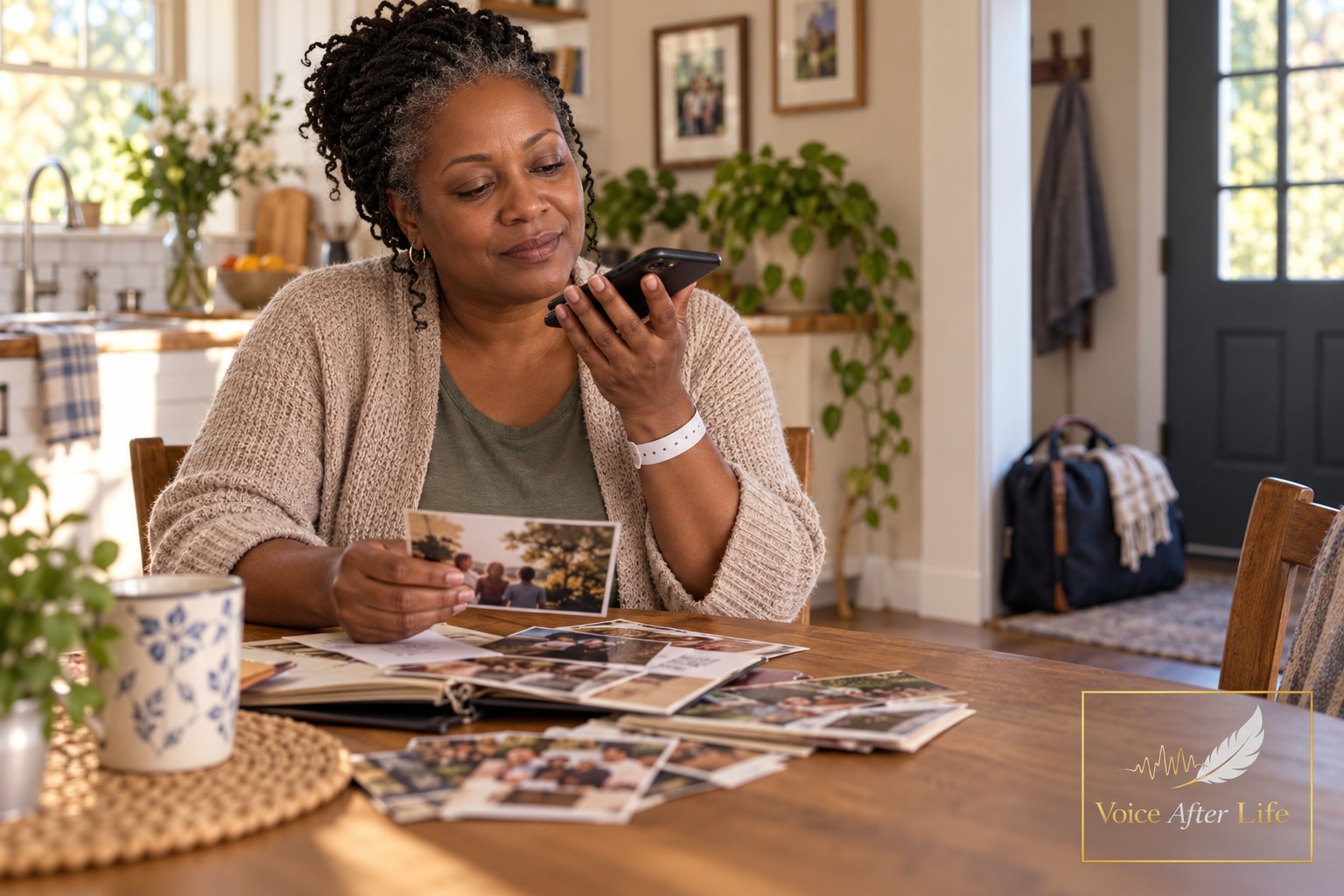
A Newborn, a Diagnosis, and a Voice That Still Sounds Like Her Own
She's in her late twenties, her newborn asleep against her chest, when the word from the neurologist finally settles in. A degenerative diagnosis changes the shape of every ordinary moment that follows — including the sound of her own voice reading a bedtime story. In the weeks after news like this, many families start asking the same quiet question: how much time is there to capture a voice before it changes? For parents in exactly this position, Voice After Life.com exists to help turn that question into something gentle and doable, rather than one more source of panic.
The honest answer is that the timeline depends enormously on the specific condition and its course. But for many degenerative diseases that affect speech — ALS being the most studied — research gives a clearer picture than most people expect, and that picture often includes more time than families fear.
Why Voice Changes Can Arrive Before Anyone Expects Them
Speech and voice symptoms don't always follow diagnosis — sometimes they come first, and sometimes they're barely noticeable for a long while. For about one-third of people with ALS, changes with speech or voice are among the first noticeable symptoms. In some cases, the changes are measurable well before anyone notices them in conversation: speech impairment may begin up to three years prior to diagnosis of bulbar-onset ALS, and research suggests artificial intelligence (AI) may be able to detect early, often imperceptible, changes in speech and voice. Nevertheless, regardless of ALS type, 80% to 95% of people with ALS will, at some point, no longer be able to be understood with the use of natural speech.
It's worth noting that this isn't only a disease of later life. ALS also can afflict people in their 20s and 30s, or even younger. A diagnosis at this stage of life — one that overlaps with early parenthood — carries its own particular weight, and its own particular reason to think early about preserving a voice while it's still unmistakably hers.
The Window You Actually Have
The pace of change varies a great deal by the type and pattern of onset. Once the first bulbar symptoms occur, speech may remain adequate for roughly 18 months on average. Longitudinal research on speech decline backs this up with more specific numbers: the time to speech loss was 23 months based on speaking rate less than 120 words per minute and 32 months based on speech intelligibility below 85% in individuals with bulbar-onset ALS. For other onset patterns, the window is considerably longer — functional speech was still maintained at 60 months since disease onset for most patients with spinal onset.
Because of this variability, clinicians generally recommend acting sooner rather than later. It's ideal to begin voice banking as early as possible after an ALS diagnosis, before voice changes occur. Speech-language pathologists echo this guidance in clinical practice: a comprehensive communication assessment done early in the diagnosis establishes a baseline of speech intelligibility, even when minimal speech deficits are noted.
Two Related but Different Ideas: Voice Banking and Message Banking
Families often hear these terms used interchangeably, but they describe different approaches. Voice banking tries to create a synthetic voice that sounds like the individual's voice mixed with a computer, while message banking records one's actual voice before the disease progresses, preserving specific phrases that are unique to that person. One approach builds a tool for future speech; the other preserves exact recordings — a laugh, a lullaby, the particular way she says her baby's name — that can be kept and revisited precisely as they were spoken.
For a new mother, this distinction matters. A synthetic voice built from careful recordings can eventually help her communicate functional, everyday needs. But recordings made now, in her own unaltered voice, become something a child can return to for a lifetime — not for function, but for connection. Decisions about what to preserve, and in what form, are personal, and this is where thoughtfully organizing and safeguarding those recordings for the long term — through a resource like this approach to preserving a voice for the next generation — becomes part of the planning conversation rather than an afterthought.
Bringing It Up With the Care Team
It can feel premature to mention recording a voice when speech still sounds completely normal. Clinically, though, this is exactly the right time to raise it. Guidance for speech-language pathologists working with newly diagnosed patients is explicit on this point: beginning work with a speech therapist familiar with ALS at the earliest sign of speech or voice changes, and even prior to changes, can be invaluable. That early conversation often naturally includes banking the voice itself: beginning message and voice banking so that one's own voice can be used in a speech generating device or text-to-speech app if ever required.
Asking a neurologist or speech-language pathologist directly — "Should we start recording now, and what should we prioritize?" — is a reasonable, well-supported question at any stage after diagnosis, not a sign of jumping ahead of the disease.
What to Record First
For a parent of a newborn, the instinct is often to think years ahead — birthday messages, graduation words, advice for a wedding day. Those are worth planning for, but speech-language guidance suggests starting with what's natural and immediate: reading the books already on the nursery shelf, singing the lullaby that's already part of the bedtime routine, narrating an ordinary afternoon out loud. The goal in these early recordings isn't performance. It's capturing cadence, laughter, the small verbal habits that make a voice recognizably someone's own — the things a synthetic voice or a written letter can't quite replicate.
As a practical starting point, many families simply begin recording short, unscripted moments on whatever device is already in the house, with no pressure to get it right. The structure and preservation can come later; the voice itself, while it still sounds unmistakably like her, cannot be recreated once it's gone.
Holding Both Things at Once
A diagnosis like this asks a new mother to hold two realities together: the ordinary, exhausting, joyful work of caring for a newborn, and the extraordinary task of thinking ahead for a child who won't remember these early months on their own. Recording a voice now, while it still sounds like hers, doesn't mean giving up on treatment, therapy, or hope. It means making sure that whatever the future holds, her child will always be able to hear her say good morning in her own words.
- Voice After Life.com
Sources
- Speech Devices Improve Communication When ALS Affects the Voice — MDA Quest
- How ALS Affects Speech — Target ALS
- Rate of speech decline in individuals with amyotrophic lateral sclerosis — PMC/National Library of Medicine
- Bulbar onset ALS: Symptoms, causes, outlook, and more — Medical News Today
- FYI: Suggestions and Information about Speech Changes & Augmentative Alternative Communication (AAC) — The ALS Association
- ALS And Speech Therapy: A Helpful Guide For SLPs — The Adult Speech Therapy Workbook
- Message Banking Technology Helps ALS Patients Regain Their Voice — MobilityWorks
- What doctors want patients to know about ALS — American Medical Association