Recording a Grandparent Whose First Language Your Children Do Not Speak
When a grandparent's native language skips a generation, recording their voice becomes a bridge between what was said and what can still be understood.
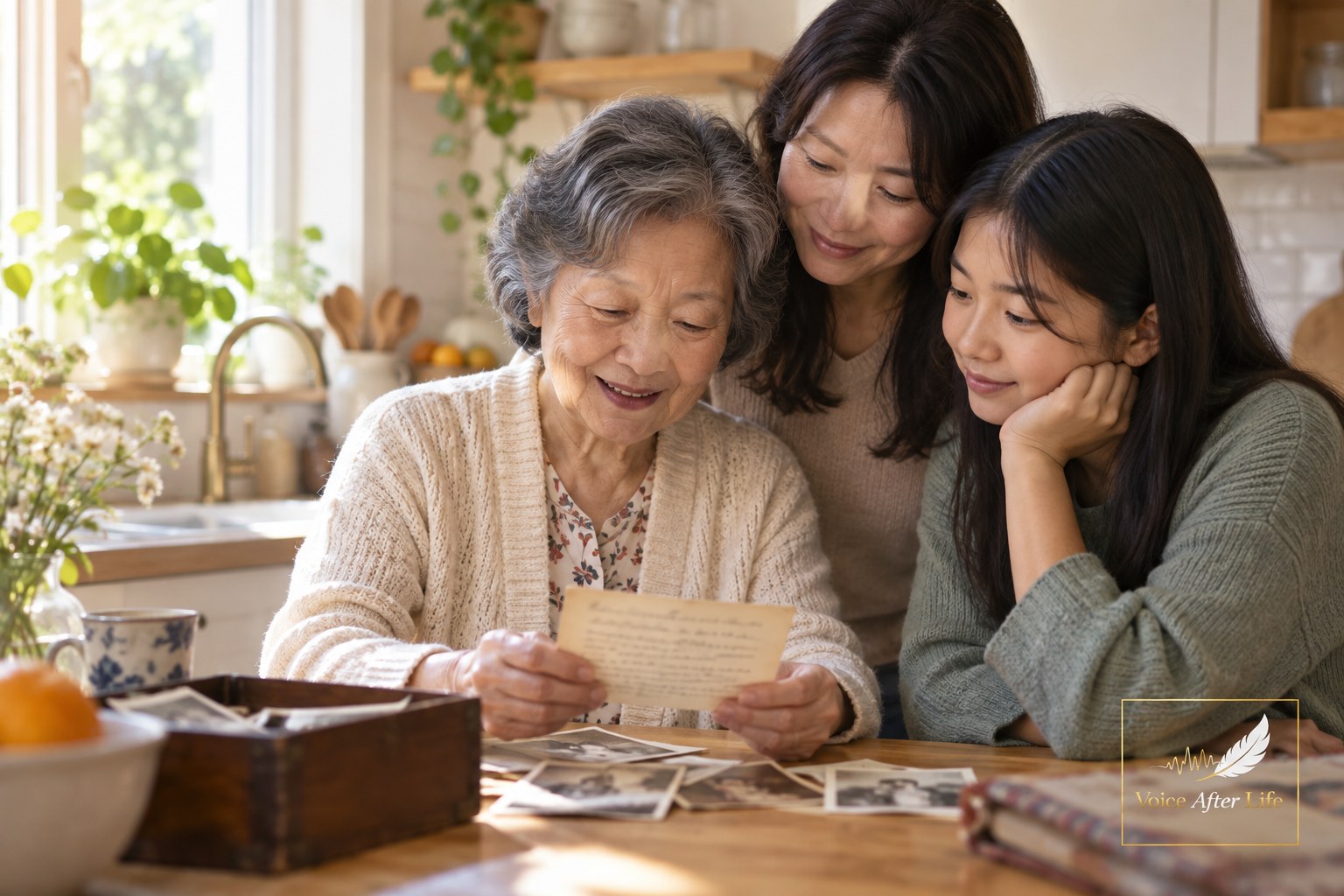
When the Words Don't Translate, But the Love Does
Sarah was folding laundry when she heard her grandmother, Nonna Teresa, humming an old Italian lullaby to her two-year-old. Her daughter didn't understand a single word, but she was completely still, listening. Sarah realized in that moment that her children would likely never speak the language her grandmother dreamed in, argued in, and prayed in — and that the window to capture that voice, in that language, was closing faster than she wanted to admit.
This is a common crossroads for families where a beloved elder's first language didn't make it to the next generation. Recording that voice — the actual sound of it, the rhythm of a language that may otherwise disappear from a family entirely — is one way to make sure something essential isn't lost. Preserving these recordings, along with the stories and context that surround them, is exactly the kind of work Voice After Life.com was built to help families do.
Why the Language Gap Happens So Fast
Researchers who study immigrant and heritage-language families have found a strikingly consistent pattern across cultures and countries. Fishman first identified this pattern among immigrants to the U.S. in 1964, demonstrating that the first generation will be fluent, followed by the second generation whose fluency is diminished, and by the third generation, there is significant loss, such that the dominant language is the individual's first language and they have limited-to-no fluency in their heritage language. A study out of the University of Alberta found something similar: children of immigrant families often struggle with their parents' language and culture, and by the third generation many children can't speak their native tongue at all.
What's notable is when the shift actually happens. The literature says that by the third generation the language is lost, but the shift that you're worried about happens in the second generation, because when parents immigrate, they often speak to their children in English instead of their first language, wanting their children to adapt and get ahead — and this is when heritage languages are often lost. In other words, by the time grandchildren arrive, the language may already be mostly gone from daily conversation, even if grandma or grandpa still dream in it.
It's More Than Sentimental
It's easy to file this away as a sweet-but-minor loss — grandkids who can't chat with grandma in her native tongue. But researchers suggest the stakes are higher than nostalgia. Children who can speak or are more familiar with their heritage language are more likely to have a stronger connection to their cultural values and participate frequently in cultural activities. And the disconnect can be felt personally well into adulthood; as one young adult who lost his heritage language put it, "Not speaking the language has created a slight disconnect."
Cognitive researchers have also weighed in on what's at stake when a language isn't actively passed down. Bilingualism researcher Ellen Bialystok at York University found that children who actively maintain two languages show stronger attention and cognitive flexibility than monolingual children. Even if your own children won't grow up bilingual, recording your grandparent speaking their first language preserves a piece of that richness for them to encounter later — as a story, a sound, a piece of who they come from — even if they can't converse in it themselves.
How to Record When You Can't Translate in Real Time
If you don't speak your grandparent's first language fluently yourself, recording them can feel intimidating. You may worry about missing context, mispronouncing names, or not knowing what to ask. A few practices can help:
Let Them Speak Naturally, Then Add Context Later
Oral history professionals generally agree that the recording itself — not a polished transcript — is the most important artifact. The primary record of an oral history interview is the audio recording, and transcripts provide a verbatim guide to the audio recording, reflecting the actual words, speech, and thought patterns of the interviewee. Don't worry about capturing perfect grammar or getting every word right in the moment. Let your grandparent talk in the language most comfortable to them, and plan to add translation, notes, or context afterward with the help of a relative, a professional translator, or even careful use of transcription technology built for multiple languages.
Ask Simple, Open Questions
You don't need fluency to ask good questions. Simple prompts — "Tell me about your mother," "What was your street like as a child?", "Sing me the song you used to sing" — work in any language, especially if a bilingual family member can help translate the question beforehand so your grandparent knows what you're asking.
Capture the Non-Verbal Along With the Verbal
Oral historians recommend paying attention to more than just words. When recording an oral history, it's a good idea for the interviewer to jot down the interviewee's non-verbal cues — shrugging, smiling, crying, or body language — along with whatever they were saying at that time, so those cues can later be added to that person's oral history. A laugh, a pause before a hard memory, the particular way someone says a name — these carry meaning even across a language barrier.
Resist the Urge to "Clean Up" the Recording
If you do eventually create a transcript or subtitle the recording, transcription specialists caution against smoothing over the way someone actually speaks. The goal is to capture the speaker's meaning, voice, and context without "cleaning up" the person's story too much, so the transcript is accurate, readable, transparent about uncertainty, and faithful to how the narrator speaks. The accent, the code-switching, the words that don't have an English equivalent — all of that is part of the record, not a flaw in it.
Giving the Recording a Future
Once you have the recording, the next question is what to do with it so it actually reaches your children — not just as a file sitting on a phone, but as something they can return to as they grow, ask questions about, and eventually understand more fully with translation and family context attached. This is where thoughtful preservation matters as much as the recording itself; a voice saved without a plan for how it will be explained, translated, and passed along can become as inaccessible to your children as the language itself. Many families choose to organize these recordings alongside written context, translated notes, and family stories in one place through Voice After Life, so that a grandchild who doesn't speak the language today can still find their way into it later.
A Small Act With a Long Reach
You don't need to fix the language gap in your family to do something meaningful about it. Recording your grandparent — imperfectly, in whatever language comes most naturally to them — is an act of care that outlasts fluency. Someday, your children may not be able to speak the words back, but they'll be able to hear them, in the actual voice of the person who spoke them first.
- Voice After Life.com
Sources
- Mind the generation gap: Heritage language often lost by third generation — University of Alberta, Faculty of Rehabilitation Medicine
- Effects of Language Status, Community Advice, and Parent Practices — Portland State University
- Heritage Language — Why Diaspora Families Are Losing Their Mother Tongue And How To Stop It — All Language Resources
- Lost in Translation: Exploring Language Loss Among Generations of Immigrant Families — The Harvard-Westlake Chronicle
- Transcription - Oral History: Best Practices and Procedures — Guilford College Library
- Recording-and-transcribing-oral-histories — On Time Typing
- How to Transcribe Oral History Interviews: Best Practices for Accuracy — GoTranscript