Recording for Your Children When Your Work Carries Real Risk
For military, police, and fire families, preserving your voice for your children isn't morbid — it's practical, loving preparation alongside the paperwork.
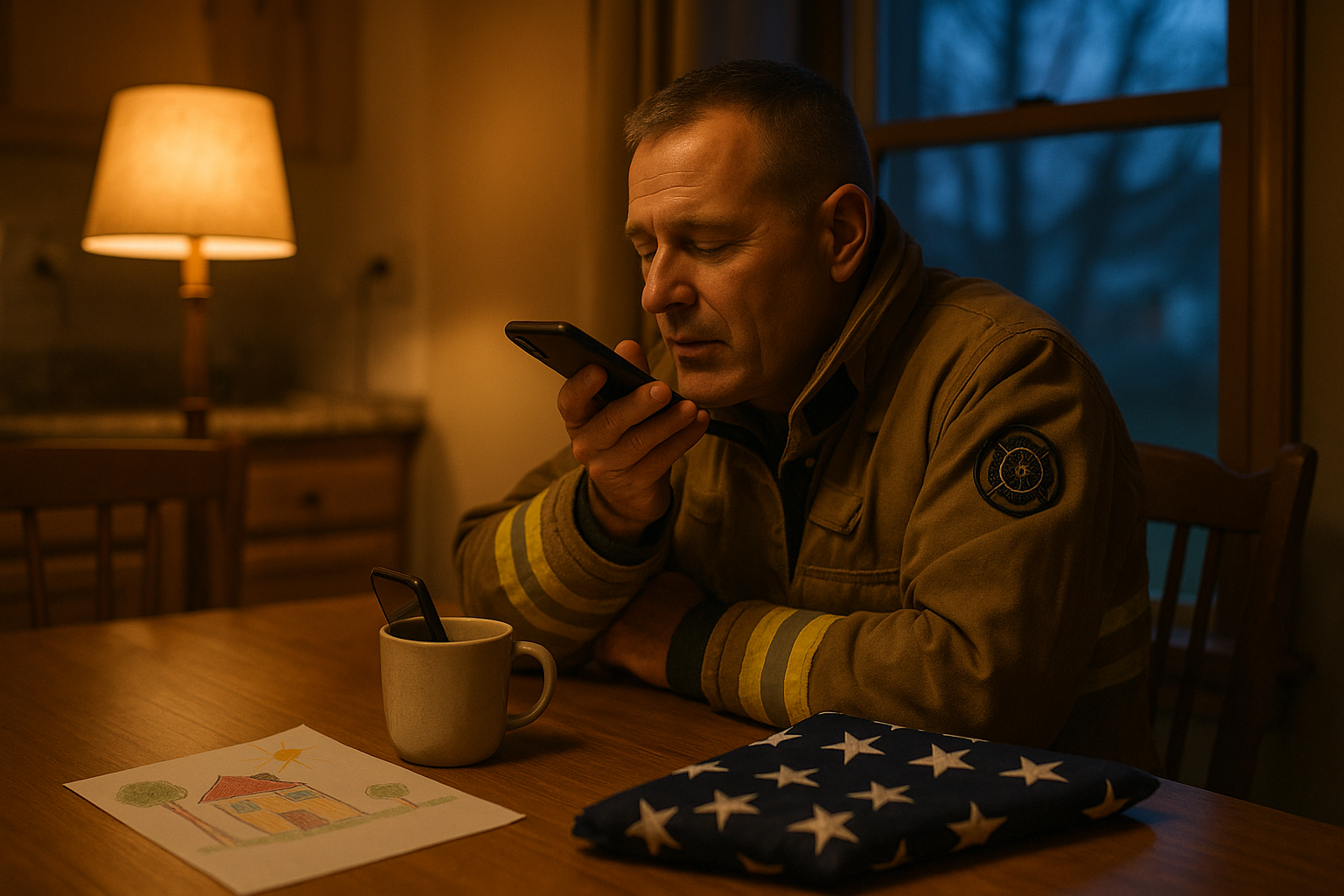
Recording for Your Children When Your Work Carries Real Risk
If you wear a badge, a uniform, or turnout gear, you already know something most families never have to think about: your job comes with a level of risk that touches your whole household, not just you. You've filled out beneficiary forms. You've maybe updated a will. But there's another kind of preparation that rarely makes it onto any checklist — leaving your children something in your own voice, just in case.
That kind of preparation doesn't require a studio or a script. Many military, police, and fire families quietly begin the process of recording birthday messages, bedtime stories, or simple "I love you, and here's what I want you to know" moments long before anything happens, and tools like Voice After Life.com exist specifically to help families in high-risk professions preserve those recordings safely for the children who may one day need to hear them. It's a small, human step that sits alongside — not instead of — the legal and financial planning your family should also have in place.
The Numbers Behind the Risk
It helps to be honest about why this matters. Even in a year the FBI called historically safe for officers, 53 officers were feloniously killed in the line of duty in 2025, fewer than the previous two years, though the rate of assaults against officers increased from 2023 to 2025 . Separately, the National Law Enforcement Officers Memorial Fund reported that the 111 line-of-duty deaths in 2025 represented a near-historic low, with the last comparable level occurring in 1943 . Even with that decline, the human cost is real: on average, officers left behind two children .
Firefighters have seen a similar trend. Sixty-two fatal firefighter injuries were recorded in 2024, 31 percent lower than the 90 deaths in 2023 , according to the National Fire Protection Association. Fewer losses is genuinely good news — but it doesn't erase the fact that families in these professions live with a level of uncertainty that most civilian households don't carry day to day.
What Benefits Cover — and What They Don't
Military families have access to a meaningful financial safety net. The SGLI benefit provides a maximum of $500,000 of coverage — in $50,000 increments — for a service member , and the FSGLI benefit provides up to $10,000 for each dependent child, with dependent children receiving free coverage . These programs, along with survivor benefits like DIC and SBP that families of retirees and veterans may access, are designed to soften the financial blow of a loss.
But financial planners who work with military families are quick to point out a gap. Survivor benefits like SBP, SGLI, and DIC pensions must be aligned with your broader estate strategy , and none of them replace the personal, irreplaceable parts of a parent — the sound of their laugh, the way they told a particular story, the specific words they'd want a child to carry into adulthood. Insurance can pay for college. It can't read a bedtime story.
The Paperwork That Protects Your Children
Before any recording happens, the legal groundwork matters just as much. For single parents and dual-military couples especially, a temporary guardianship designation ensures someone can make medical, educational, and daily care decisions for children in a parent's absence . Without a will naming a guardian, a judge will choose guardians for your children and determine who raises them — a decision families almost never want left to chance.
Many branches already require some version of this planning. Single parents and dual-military couples must maintain a family care plan designating who will care for dependents if both parents are unavailable, and units require this document before deployment . First responder families, while not always bound by a formal military requirement, benefit from the same discipline: a current will, updated beneficiary forms, and a clearly named guardian, revisited after every major life change.
What Words and Voice Can Do That Paperwork Cannot
Once the legal and financial pieces are in place, families in high-risk professions are increasingly turning toward something less formal but deeply meaningful: recorded voice and story. The military itself encourages this during deployment, recommending that families stay connected to their loved one by sharing postcards, texts, videos or voice recordings to strengthen bonds — a practice that translates naturally into longer-term legacy preservation.
Research backs up why this matters so much to children specifically. A peer-reviewed study on family audiobooks recorded by terminally ill parents for their dependent children found that this kind of narrated legacy work is a service that allows parents to narrate how they would like to be remembered, in their own voice , and almost all terminally ill parents felt eased to have recorded a family audiobook for their children. The comfort clearly extends to the children who receive it, giving them something steady to return to as they grow — which is exactly the kind of resource families can build over time at Voice After Life, long before it's ever needed.
Grief support organizations that specialize in this population understand why voice matters so much. The Tragedy Assistance Program for Survivors, founded in 1994 after a military plane crash, runs programs built around exactly this need — recognizing that children grieve very deeply, though it can be hard to recognize because they don't sustain strong emotions the way adults do, and often turn to avoidance instead . A recording a child can return to on their own terms, whenever they're ready, respects that reality in a way a single conversation at a funeral never can.
Where to Begin
You don't need a special occasion to start. A recording doesn't have to be dramatic or final-sounding — it can simply be you, talking about an ordinary Tuesday, telling your child what you hope for their life, or answering the questions you imagine they'll someday ask. Update it as your children grow. Keep your guardianship designation and beneficiary forms current alongside it. None of this is about expecting the worst; it's about making sure that if the worst does happen, your children aren't left with only paperwork.
Families who serve and protect already understand risk better than most. Turning that understanding into a few honest recordings — alongside the will, the insurance forms, and the guardianship papers — is simply one more way of showing up for your children, on a day you hope never comes.
- Voice After Life.com
Sources
- FBI Releases Officers Killed and Assaulted in the Line of Duty, 2025 Special Report — Federal Bureau of Investigation
- 2025 Year-End Officer Fatalities Report Reveals Law Enforcement Deaths Have Hit 80-Year Low — National Law Enforcement Officers Memorial Fund
- Fatal Firefighter Injuries in the US report shows 62 on-duty deaths in 2024 — National Fire Protection Association
- SGLI, Servicemembers' Group Life Insurance — Military OneSource
- Estate Planning Considerations for Military Families — Stars and Stripes Financial Advisors
- Estate Planning and the Military: What You Need To Know — FindLaw
- Estate Planning Information for the Military — Military OneSource
- Military Pre-Deployments to Reintegration — Military OneSource
- The usage of family audiobooks as a legacy for grieving children — Supportive Care in Cancer / NCBI
- Tragedy Assistance Program for Survivors (TAPS) — The White House Archives