Recording for a Family Spread Across Two Countries
When grandparents live an ocean and several time zones away, a recorded voice can hold a family together in ways a scheduled video call never quite can.
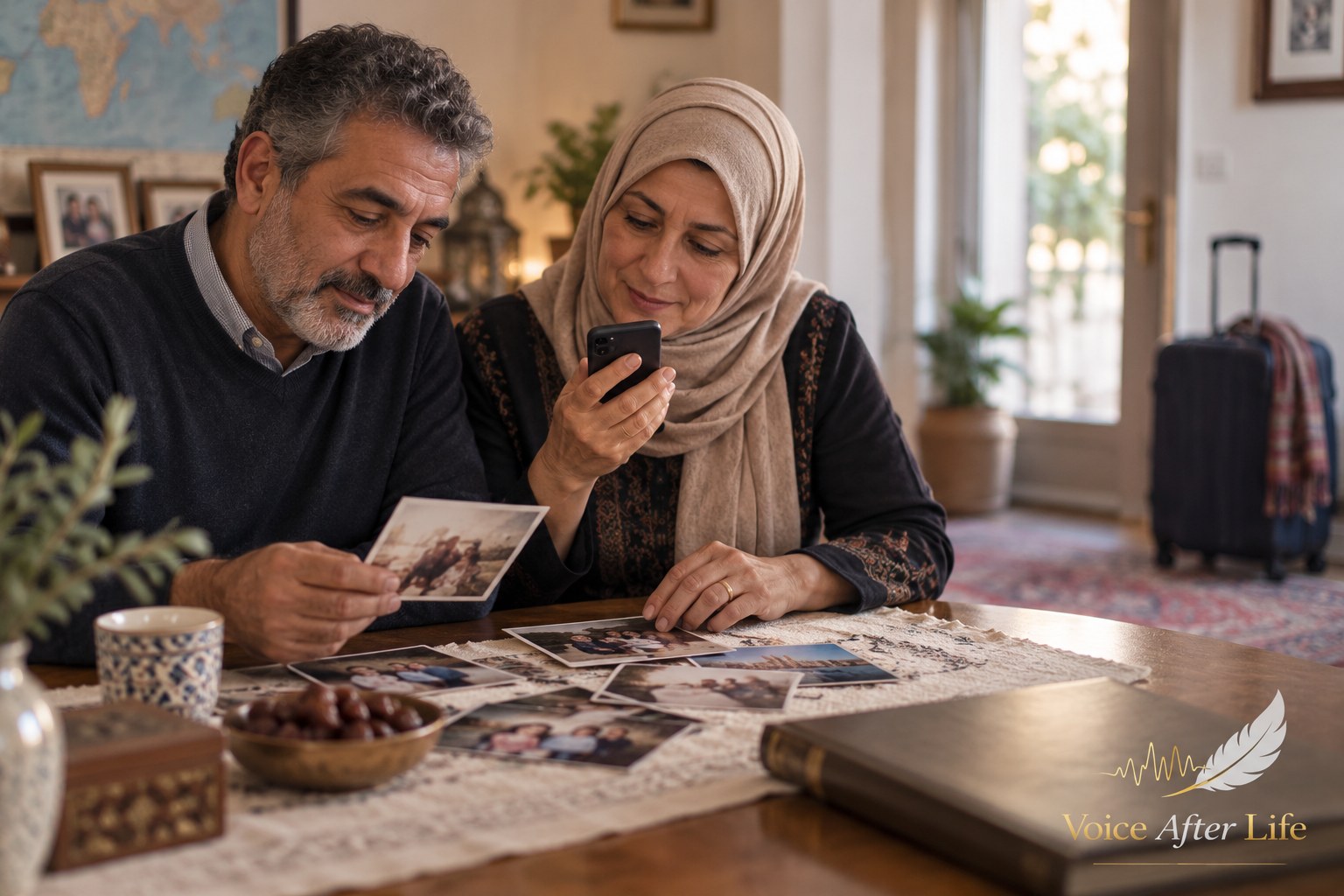
A New Father, Two Time Zones, and a Baby Who Doesn't Know the Difference
David became a father in the spring. His daughter arrived healthy and loud, and within a week he understood two things: he would never sleep the same way again, and his own parents — living several time zones away in another country — were going to miss almost all of it in real time. The first smile, the first time she gripped his finger and wouldn't let go, the sound she makes right before she falls asleep. His parents would hear about these moments secondhand, on a delay, filtered through a phone screen at whatever hour the two households could align their mornings and evenings. For families like David's, Voice After Life.com exists precisely for this gap — the space between a life happening now and the loved ones who are far enough away that they can only join it after the fact.
David's situation has a name in academic research: the transnational family. Researchers describe transnational families as kin groups living in multiple locales across nation-state borders but remaining connected—economically, socially, and symbolically. It's a clinical term for something that feels anything but clinical when it's your own mother hearing about her granddaughter's first laugh through a grainy video call at 6 a.m. her time.
When Love Lives in Two Time Zones
Distance changes the rhythm of a family, but it doesn't change the need to stay close. Researchers who study families split across time zones note that these time differences pose specific challenges for communication within the family and result in different communication practices to cope with them. Families end up negotiating who wakes up early, who stays up late, and how much spontaneity gets traded away for scheduling. One practical guide for cross-time-zone video calls suggests that if time differences exceed about 9 hours, alternate who initiates so no single household is always at an inconvenient hour.
That kind of scheduling discipline matters, but it also has a limit. A baby doesn't wait for a calendar invite to smile for the first time, and a grandparent halfway around the world can't be present for it no matter how well the call is timed. This is where distance-spanning families are increasingly turning to something that doesn't require both people to be awake at once: recorded voice.
Why a Recorded Voice Travels Farther Than a Phone Call
It isn't only sentiment that makes a grandparent's recorded voice matter — there's a physiological reason it lands differently than a stranger's. Researchers at University College London have found that using functional MRI to study how the brain responds to voices of differing familiarity, personally familiar voices — like those of a partner or close relative — can be recognized with extremely high accuracy in all sorts of situations, while less familiar voices are far more challenging to place. In other words, a grandparent's voice isn't just recognizable to a baby over time — it's processed by the brain in a fundamentally different, more attentive way than an unfamiliar one.
For David's daughter, that means every recorded lullaby, every rambling story her grandfather tells about his own childhood, is doing more than filling silence. It's laying down the groundwork for a voice she'll know as deeply as any voice in the room with her, even if that room is thousands of miles from where the recording was made.
The Quiet Cost of Distance Nobody Talks About
There's a second reason families spread across two countries lean into recording, and it has less to do with bonding and more to do with loss — specifically, the loss of language. Linguists who study immigrant and transnational families have documented a consistent pattern: heritage languages brought by immigrant families are often lost by the third generation. One widely cited thesis on the subject found that children of immigrant families often struggle with their parents' language and culture, and by the third generation many children can't speak their native tongue at all, with researchers noting the shift often begins even earlier than expected, in the second generation.
For a family like David's, where a grandparent's accent, expressions, and turns of phrase carry a whole history that a screen and a spotty connection can't fully transmit, recording isn't just nostalgic — it's preservation. A story told in a grandmother's native tongue, saved and replayed for a child who is still learning to speak at all, becomes a small act of resistance against a very well-documented pattern of forgetting.
Building a Bridge in Sound
The good news is that none of this requires elaborate equipment or technical skill. A recorded voice message, sent asynchronously, sidesteps the single biggest obstacle transnational families face: the impossibility of everyone being awake, available, and in the mood to talk at the same moment. It can be:
A Bedtime Story in a Grandparent's Own Voice
Recorded once, it can be replayed every night — no scheduling required, no missed call because of a nap that ran long.
A Running Letter, Not a Single Message
Rather than one grand recording, many families build a habit: a few minutes every week or month, so the archive grows alongside the child.
A Record of the Ordinary
The sound of a grandfather's laugh, the way a grandmother says a particular word, an aunt's off-key singing — these are the details that get lost first in memory and are exactly what a recording keeps intact.
Over months and years, this becomes something a video call never quite achieves: a permanent, replayable archive of voices that a child can return to long after they're old enough to understand what they're hearing. Families who want a structured, lasting way to gather these recordings — rather than scattering them across text threads and old phone storage — can build that archive at Voice After Life, where recordings are organized to be found and treasured for years, not just the week they were sent.
Starting Small
David didn't set out to build an archive. He started by asking his father to record himself reading one children's book, just once, on his phone. It took eleven minutes. Six months later, that recording is part of his daughter's bedtime routine three nights a week, in a voice she recognizes as clearly as she recognizes her own father's.
A family spread across two countries will always contend with time zones, visas, holidays that don't line up, and the simple ache of distance. But a voice, once recorded, doesn't need a time zone at all. It just needs someone willing to press record — and someone else, someday, willing to listen.
- Voice After Life.com
Sources
- Transnational Families entry, SAGE Encyclopedia of Children and Childhood Studies — SAGE Publications
- Understanding family communication across time zones — ResearchGate
- How To Video Call Your Child From Different Time Zones — Young Explorers Club
- New research reveals how the brain distinguishes familiar voices — UCL Faculty of Brain Sciences
- 2018 AARP Grandparents Study — AARP
- Preserving mother tongues: Why children of immigrants are losing their languages — Calgary Journal
- Mind the generation gap: Heritage language often lost by third generation — University of Alberta, Faculty of Rehabilitation Medicine