Simple Ways to Record Your Family's Oral History at Home: Low-Cost Gear and Prompts That Work
You don't need a studio to capture your family's stories. Here's the low-cost gear and gentle prompts that help you record a meaningful oral history at home.
Why Your Family's Voice Matters More Than You Think
Photographs show faces and documents share facts, but neither can capture the pause before a good story, the laugh in the middle of a memory, or the particular way a grandparent says your name. Photographs show faces. Documents share facts. Oral histories give you the soul of a person. That's the quiet power of oral history: it preserves not just what happened, but how it felt.
The good news is that you don't need a podcast studio, a journalism degree, or a big budget to start. With a smartphone, a few dollars of gear, and a handful of thoughtful questions, you can create a recording your family will treasure for generations.
Start With What You Already Have
Your smartphone is a perfectly capable recorder. Modern smartphones can record interviews with surprisingly good quality—making field recording easy for kids. The bigger factor in audio quality usually isn't the device — it's the room.
Choose a Quiet Space
Before you press record, take a lap around the house. No matter what kind of recording device you are using, any background noise and interference will have a deleterious effect on your final product. Choose a quiet location in the home or office where you are conducting the interview—away from heating or air-conditioning vents, a humming refrigerator, or windows overlooking noisy streets.
Position the Microphone Thoughtfully
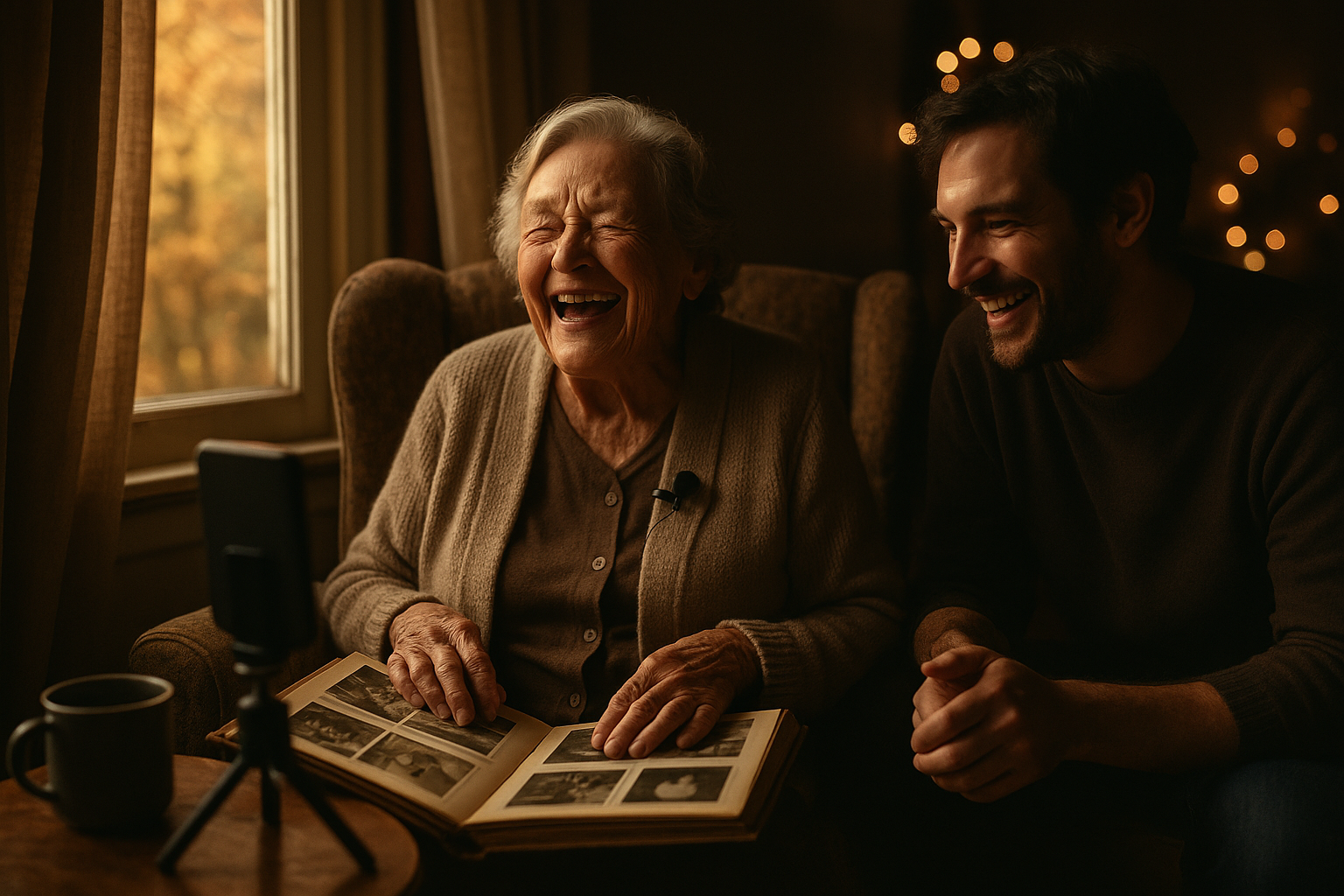
If you're using just a phone, don't hand-hold it. Place the phone on a stable surface between you and the person you're interviewing, with the microphone facing them. A stack of books or a small tripod works fine.
Low-Cost Gear Worth Considering
You can absolutely conduct a beautiful interview with nothing but a phone. But if you'd like to level up the sound quality without a big investment, a clip-on lavalier microphone is the single best upgrade. These small mics attach to a shirt collar, keeping the microphone close to the mouth regardless of how someone shifts in their chair, and many budget models plug directly into a phone's charging port or connect wirelessly. When shopping, look for options with a simple plug-and-play connection so there's no app-fumbling in the middle of a meaningful conversation — the goal is technology that disappears, not technology that becomes the story.
A basic desktop tripod or even a stack of sturdy books to prop the phone up, a set of earbuds so you can monitor sound as you go, and a portable charger to make sure the conversation isn't cut short by a dying battery round out a setup that costs less than a nice dinner out.
Do a Practice Run
Before the real interview, record 30 seconds of yourselves talking and play it back. When you start your interview, make sure to test your recording equipment and make sure it has plenty of power or battery life. This single step catches most problems — a muffled mic, a loud vent, a low battery — before they cost you an irreplaceable story.
Setting the Stage Emotionally
Good oral history isn't an interrogation; it's a conversation. Recording family oral history projects foster connection between generations, give voice to elders, and preserve cultural legacies, and can be empowering and meaningful for older family members who may otherwise feel isolated, helping them share wisdom and remain connected to family identity.
If the person you're interviewing seems nervous, ease them in. Start with light, fun topics—favorite meals, hobbies, or family pets—before diving deeper. And if their memory feels foggy on details, don't force it. Use props like photos or music from their era. Memories often return with sensory cues.
It's also worth saying out loud, gently, why you're doing this. Let them know this is about preserving their memories, not a formal test.
Prompts That Open Real Conversation
One of the biggest mistakes first-time interviewers make is starting with a blank slate. You can't just put down a recorder in front of someone and say, "Talk." Are there specific things that you want to know? For example, would your family member recall a specific time in their life or a moment in history that affected them?
Here are prompt categories drawn from oral history best practices, organized so you can pick a few that fit your family:
Childhood and everyday life
- What did a normal Sunday look like when you were young?
- Who lived on your street, and what were your neighbors like?
Turning points and people
- Was there a teacher or teachers who had a particularly strong influence on your life? Tell me about them.
- If you could interview anyone from your life living or dead, but not a celebrity, who would it be and why?
Family heritage and traditions
- Tell me about some traditions that have been passed down through our family. When and how did they get started?
- Can you tell me where your family came from? What do you know about your history?
Wisdom and legacy
- If you were to give advice to me or my children, or even children to come in our family, what would it be? What have you learned from life? The most important things?
- For generations listening to this years from now, is there any wisdom you'd want to pass on to them? What would you want them to know?
During the conversation, resist the urge to script every follow-up. Ask follow-up questions which require your interviewee to be more descriptive or analytical, such as "Tell me more" and "Describe what it was like" — be creative with your questions, since there are no "bad" or "dumb" questions in oral history. And when the conversation wanders somewhere unplanned, follow it. Don't be afraid to let the conversation drift into another area — you don't need to keep strictly to your questions list, since many times important and interesting information comes out of an interview that you weren't expecting.
The Formalities That Protect Your Recording
A few small procedural steps at the start and end of your session will make the recording far more useful later. Begin by stating who is speaking, the date, and the location — for instance: "This is Dawn Roode interviewing my grandmother, Virginia Miller—V-I-R-G-I-N-I-A, M-I-L-L-E-R, on this March 22, 2022, at my home in Brooklyn, New York," which may feel unnecessarily formal, but it's critical.
Always get clear consent before you begin. Get consent: always ask permission to record and explain how the recording will be used.
After the Interview: Don't Let It Get Lost
The interview itself is only half the job. Immediately download the digital recordings, name them, and save them in more than one place — the sooner you do these things, the better. It's a common heartbreak among family historians: thinking you'll remember what a recording on your phone is, only to press 'play' later and have no recollection of the interview details.
Backing up in multiple places matters, too. Backing up audio files in two places (like a phone and cloud storage) helps protect precious memories for years. Beyond a phone and a cloud drive, some families choose a dedicated home for their recordings — a private, organized space built specifically to hold voices and stories for future generations, such as a digital legacy platform like Voice After Life, where messages can be preserved securely and revisited whenever they're needed most.
There's No Perfect Time — Only Now
It's tempting to wait for a more organized moment: better equipment, a quieter house, a more "important" occasion. But oral historians consistently point to one truth: life moves fast, and memories fade — every day we wait is a missed opportunity to capture voices and stories that make our families unique.
You don't need perfection. Do a short practice session and keep backups — perfection isn't the goal; connection is. A slightly imperfect recording made this weekend will always be worth more than the flawless one you meant to make someday.
A Gentle Place to Begin
If sitting down with a formal list of questions feels intimidating, start smaller. Ask one question over Sunday dinner. Record a grandparent describing their favorite childhood meal while you cook it together. Oral history doesn't have to be a project with a beginning, middle, and end — it can simply be a habit of listening closely, with a recorder quietly running nearby.
Sources
- A Guide to Recording and Preserving Oral Histories — The Family Archivists
- Record oral history - Fun at-home activities for Kids — DIY.org
- Best practices for recording family history interviews at home — Modern Heirloom Books
- Family Reunion Month: Seven Simple Tips to Begin Recording Your Family's Oral History — Baylor University
- How to Record an Oral History Interview Before It's Too Late — The Family Heart
- How to Record a Family Oral History Project — Clara Home Care
- Great Questions List — StoryCorps Archive
- Great Questions — StoryCorps
- Great Conversations Start with Great Questions — StoryCorps
- Some guidelines on how to conduct a good oral history interview — StoryCorps Archive
- Preserving and Sharing Projects - Getting Started with Oral History — Boston Public Library