Preserving Family Recipes as a Living Legacy
A new mother's first Thanksgiving with her baby is a reminder that family recipes carry more than ingredients — they carry the voices behind them.
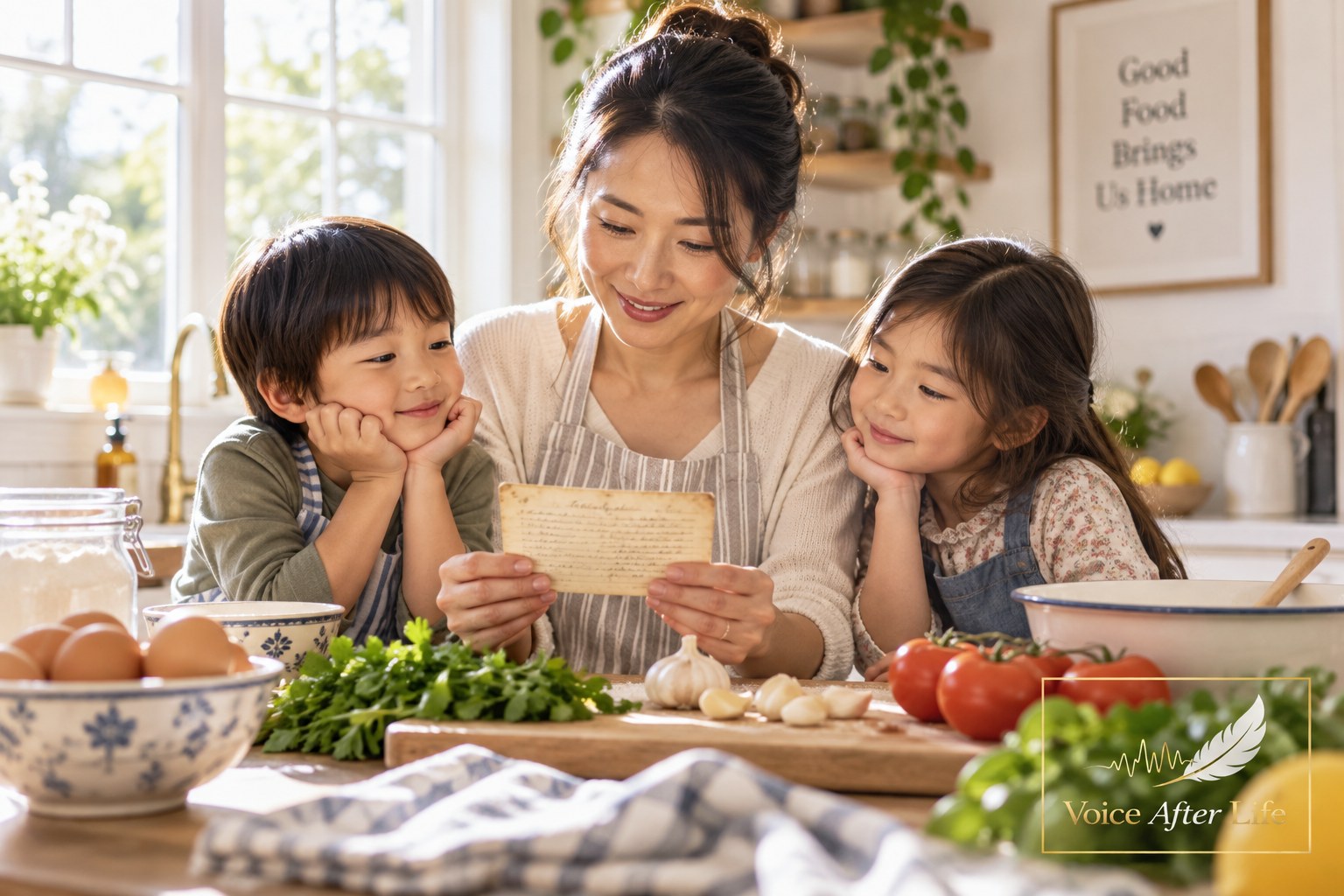
A Newborn, a Recipe Box, and a Question About Time
She is sitting in the kitchen with her newborn asleep against her shoulder, one hand resting on a stack of index cards her grandmother wrote decades ago. The cards are stained with vanilla and butter, the handwriting looping and familiar. For the first time, she isn't just reading her grandmother's pot roast recipe — she's wondering what her own daughter will inherit, and whether the recipe alone will be enough to carry the whole story forward.
It's a question new parents ask more often than they might expect, usually in quiet moments like this one. Recipes are one of the most common ways families try to hold onto the people who raised them, and preserving the story behind a dish — not just the ingredient list — is exactly the kind of legacy work that Voice After Life.com was built to support.
Why Family Recipes Carry More Than Ingredients
Researchers who study genealogy and food history point out that a recipe is rarely just a recipe. According to genealogy specialist Gena Philibert-Ortega, "So many of our family recipes are stored in the heads of our family members. Write the recipe down so it can be re-created by others." That single piece of advice explains why so many treasured dishes eventually disappear — not because families didn't care, but because cooking is a physical act, and many recipes are done by memory and go unwritten, which presents a real challenge to family historians wanting to preserve memories across generations.
Genealogists who work with food history describe recipes as something closer to documents. For genealogists, recipes are more than instructions for preparing food. They are clues. They are cultural records. They are edible memories. A handwritten card for "Nana's Polish Pierogi" or "Grandpa's Swedish Meatballs" can point toward an entire migration story, a region, or a language that shaped a family long before anyone thought to write it down.
How Oral Tradition Shaped What We Cook Today
Long before recipe cards existed, families relied entirely on spoken instruction to pass dishes forward. Historically, family recipes were passed down orally, with each generation teaching the next how to prepare beloved dishes, and this oral tradition ensured that the nuances and personal touches of each recipe were preserved. That method worked as long as someone was in the room to teach the next cook — a grandmother standing beside a granddaughter, correcting the pinch of salt by feel rather than measurement.
The challenge, of course, is that oral tradition depends on proximity and time, two things families can't always guarantee. As one food-documentation study puts it, one of the most common methods of cultural food documentation is through oral histories, since in many cultures recipes and cooking techniques are passed down through generations by word of mouth, often within families or close-knit communities. When that spoken link breaks — through distance, illness, or simply the passage of years — the recipe often survives, but the story behind it doesn't.
Turning a Recipe Box Into a Family Archive
Food historians who study genealogy often describe cookbooks and recipe collections as a form of family record-keeping. A handwritten recipe card, a stained church cookbook, or a favorite holiday dish can reveal where a family came from, how they lived, what they valued, and how traditions moved from one generation to the next, and creating a family cookbook is one of the most meaningful ways to preserve that information. The value isn't only in the finished dish — it's in the context that surrounds it: who taught whom, what occasion it was made for, and what it meant when times were hard or worth celebrating.
That context is often the first thing lost. A recipe can specify two cups of flour, but it can't tell a great-grandchild that the dish was made every year for a holiday that no longer exists, or that the recipe changed after a family moved across the country and could no longer find the same ingredients. Capturing that surrounding story — in a grandmother's own words, in her own voice — is what turns a recipe from a set of instructions into a piece of family history.
Capturing the Voice Behind the Dish
For the young mother rocking her newborn over that stack of index cards, the real urgency isn't the recipe itself — it's the voice that could explain it. A written recipe can survive a house fire or a computer crash, but it can't answer a question, laugh at a memory, or say a name the way the person who wrote it once did. This is where preserving an actual recording of a relative — their voice, their explanation of why a dish matters, their laugh when they admit they never measure the sugar — becomes as valuable as the recipe card itself. Families who want that voice to reach a child not yet old enough to ask for it can begin that process through Voice After Life, which was built around exactly this kind of preservation.
Starting Small: One Recipe, One Story, This Week
Preserving a family's culinary history doesn't require finishing an entire cookbook in a weekend. A practical starting point, echoed across food-history research, is to choose a single dish and record the memory attached to it before moving to the next. Ask the person who makes it best to walk through the recipe out loud, in their own words, including the parts that never made it onto paper — the substitution made during a hard year, the ingredient swapped because a store closed, the reason the dish only appears at certain times of year.
For a new parent, this work often takes on a different weight. The newborn asleep in her arms will not remember learning to make her great-grandmother's pot roast by watching it done — she'll only have it if someone records it now, in words and in voice, while there's still time to ask the questions that matter.
A recipe box is a beginning, not an ending. The measurements can be copied by hand or scanned into a digital file, but the story — the why behind the what — depends on someone taking the time to capture it while the voice that holds it is still here to tell it.
- Voice After Life.com
Sources
- 7 Ways to Save and Celebrate Family Recipes — Family Tree Magazine
- Family Recipes and Genealogy: How Food Brings Ancestors to Life — The Family Cookbook Project
- The Connection Between Family Recipes and Ancestral Heritage — Genealogy Voyage
- Cultural food documentation: Preserving culinary traditions for future generations — Allied Academies