The Prayers, Blessings and Sayings a Family Loses First
The bedtime prayers and mealtime blessings a family repeats every day are often the first pieces of faith and memory to fade. Here's why, and how to keep them.
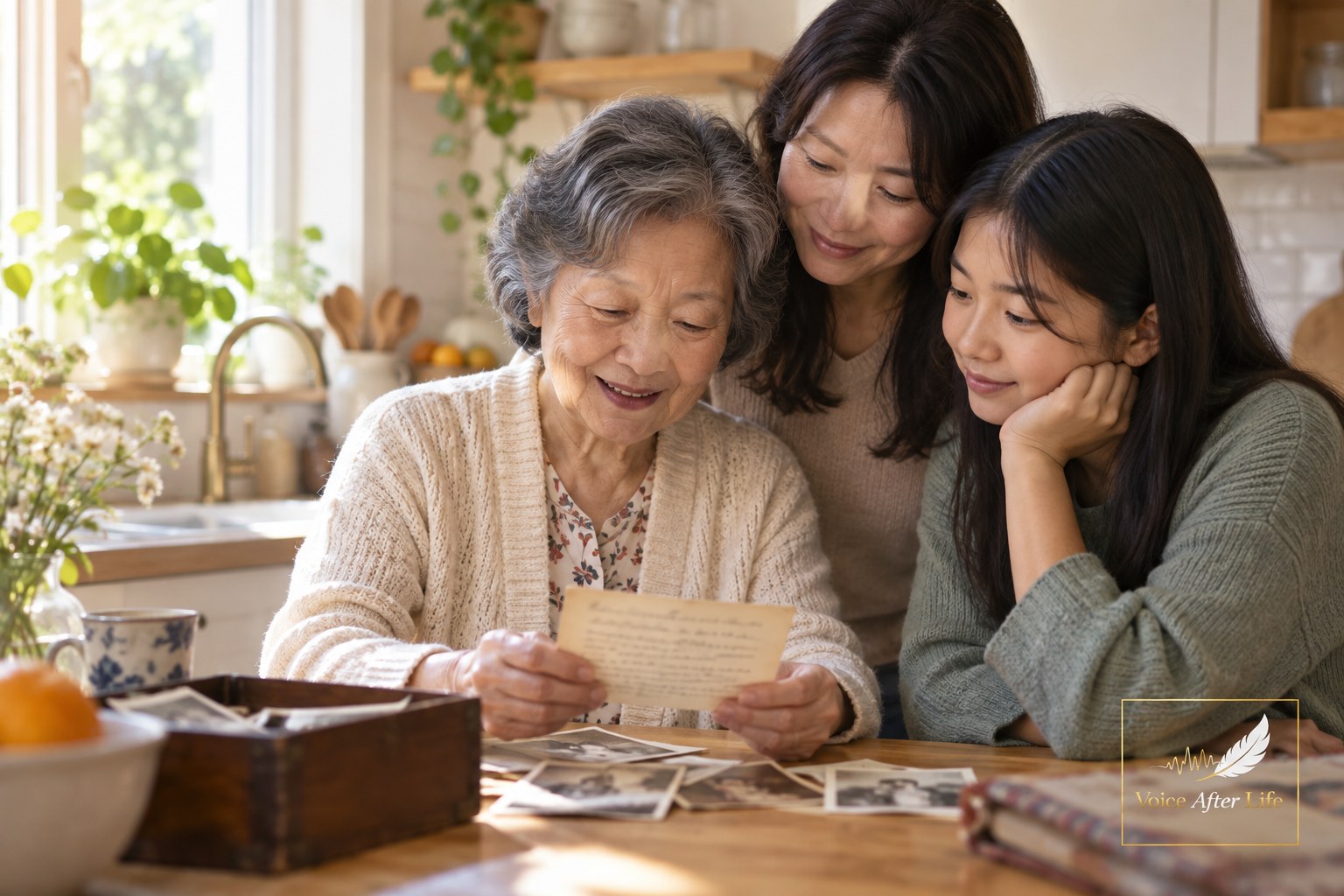
The Blessing You Almost Forgot the Words To
It happens at the kitchen table on an ordinary Tuesday. A young mother, two small children fidgeting in their booster seats, starts the grace her own grandmother used to say before every meal. She gets halfway through and stalls. Was it "bless this food to our bodies" or "bless this food for our bodies"? Did Grandma say "amen" twice, or was that just how it felt? The children wait, patient in the way small children are when they don't yet know something has been lost.
This is how it usually happens — not in a dramatic moment of grief, but in a quiet blank spot where a familiar phrase used to live. Long before photographs fade or letters yellow, it is often the smallest, most repeated words — a grace before dinner, a blessing whispered over a sleeping child, a line borrowed from a grandmother's evening prayer — that slip away first, precisely because they feel too permanent to ever need writing down. That quiet vulnerability is part of what Voice After Life.com is built to address: helping families capture not just the big milestones, but the small, sacred phrases that make up a household's daily language of faith.
Why These Words Disappear First
Prayers, blessings, and family sayings belong to what scholars call oral tradition — knowledge that lives in speech rather than in text. Oral traditions and expressions include of many spoken forms, and the oral traditions and expressions include of many spoken such us riddles, proverbs, folklore, tales, legends story, myths, epic songs and poems, charms, prayers, chants, songs, dramatic performances and more. Because these words are carried in a voice rather than on a page, they depend entirely on someone continuing to say them — and on someone else being present, listening, and eventually repeating them back.
That dependency is fragile. A generation that grows up hearing a blessing said every night at bedtime is not automatically a generation that will remember it word for word thirty years later. And in busy households with two small children, a rotating cast of routines, and very little quiet, it is easy to assume the words will simply keep being there — until the person who said them best isn't.
What the Research Shows About Faith, Family, and Memory
Research on religious transmission suggests that most families do successfully pass on some form of faith to the next generation. Most parents pass along religious and political affiliations, and they do so at similarly high rates, according to a new analysis of several surveys. But transmission is uneven, and sociologist Vern Bengtson's long-running Longitudinal Study of Generations found that the families who succeed tend to share specific habits. Among them, a high degree of religious involvement that is integrated with daily family life, especially in the area of religious education stands out — the kind of involvement that looks less like formal instruction and more like a grace said at every dinner or a blessing repeated every bedtime.
Even simple household rituals carry weight beyond the words themselves. Family home evenings and similar weekly practices matter partly because, as one family-life researcher put it, it's a powerful religious ritual that gets parents and children talking to each other about their faith. The repetition itself becomes part of the inheritance.
The broader research on family storytelling reinforces this. Psychologists at Emory University's Family Narratives Lab have found that families that are more elaborative, with each family member contributing to the ongoing narrative and sharing their perspectives and opinions, have children with higher levels of self-esteem and emotional well-being. More recent work from the same lab confirms the pattern holds over time: dozens of research studies have confirmed that individuals, especially adolescents and young adults, who know more stories about their parents and grandparents' lives, and tell these stories in more coherent and elaborated detail, show all kinds of positive outcomes. A remembered blessing is, in this sense, a small but sturdy thread of that larger fabric.
The Small Rituals Most Likely to Slip Away
Certain categories of family language seem especially prone to disappearing:
Mealtime graces
Grace before meals is one of the most common household rituals, and its value is often less about theology than about rhythm. As one faith writer describes it, saying grace is more than just a tradition; it's an opportunity to acknowledge the blessings of nourishment and the love that surrounds us. Yet because it is said so often, its exact wording is rarely written anywhere.
Bedtime blessings
The specific phrase a parent or grandparent uses to bless a child before sleep — sometimes a formal prayer, sometimes a made-up line unique to that family — is almost never recorded on paper.
Sayings tied to specific moments
Words spoken over a sick child, before a long trip, at a holiday table, or at a graveside. These are occasion-specific and easy to forget between the rare times they're needed.
The particular voice and cadence
Even when a family remembers the words, they often lose the tune of them — the pause a grandfather took before "amen," the way a grandmother's voice softened on certain syllables. The text can be preserved as a written note; the voice usually can't be, unless someone thought to record it.
Capturing the Words Before They're Gone
For a young family with small children, the most useful step is often the least complicated one: writing down, exactly as spoken, the blessings and sayings currently in use, and asking the older relatives who taught them where those words came from. A grandmother asked directly, "What did your mother say before meals?" will often produce not just a phrase but a story attached to it.
Recording the actual voice saying the prayer — not just the transcribed words — preserves something a page cannot: tone, rhythm, the small imperfections that make it recognizably that person's blessing and no one else's. This is precisely the kind of everyday, sacred material that families are now choosing to preserve as audio and video keepsakes rather than trusting to memory alone, and it's one of the reasons many turn to a service built specifically for capturing a loved one's voice rather than relying on scattered phone recordings that get lost in a shuffle of devices over the years.
A Small Practice for This Week
For any family with young children, faith and ritual are still being written in real time. A simple starting point: this week, ask whichever grandparent, parent, or elder taught the family's current bedtime blessing or table grace to say it aloud, slowly, while it's written down word for word. Ask where they learned it. Ask if the words have changed over the years. Then say it together, out loud, as a family — not as an assignment, but as the ordinary practice it has always been.
The prayers a family says every night rarely feel like history while they're happening. They only become history once someone realizes they can no longer quite remember how it went.
This article is for general educational and informational purposes only and does not constitute religious, legal, tax, or medical advice. Families with specific questions about faith practices, estate matters, or memory-related health concerns should consult their clergy, an attorney, a tax professional, or a qualified healthcare provider as appropriate.
- Voice After Life.com
Sources
- Most U.S. parents pass on their religion and politics to their kids — Pew Research Center
- Families and Faith: How Religion is Passed Down Across Generations (Part 1 of 3) — Word on Fire
- Faith in the family: How belief passes from one generation to the next — Deseret News
- Family Narratives — Emory University Family Narratives Lab
- Why Sharing Family Stories is Vital — Psychology Today
- The Power of #OralStorytelling in #History, #Reading, and #Writing — Jean Lee's World
- 30 Sample Prayers Before Meals and Blessings to Say Grace — Christianity.com