The Objects in Your House That Mean Nothing Without the Story
A grandmother's coffee cups, a father's prayer beads — heirlooms only carry meaning when someone can still explain why they mattered.
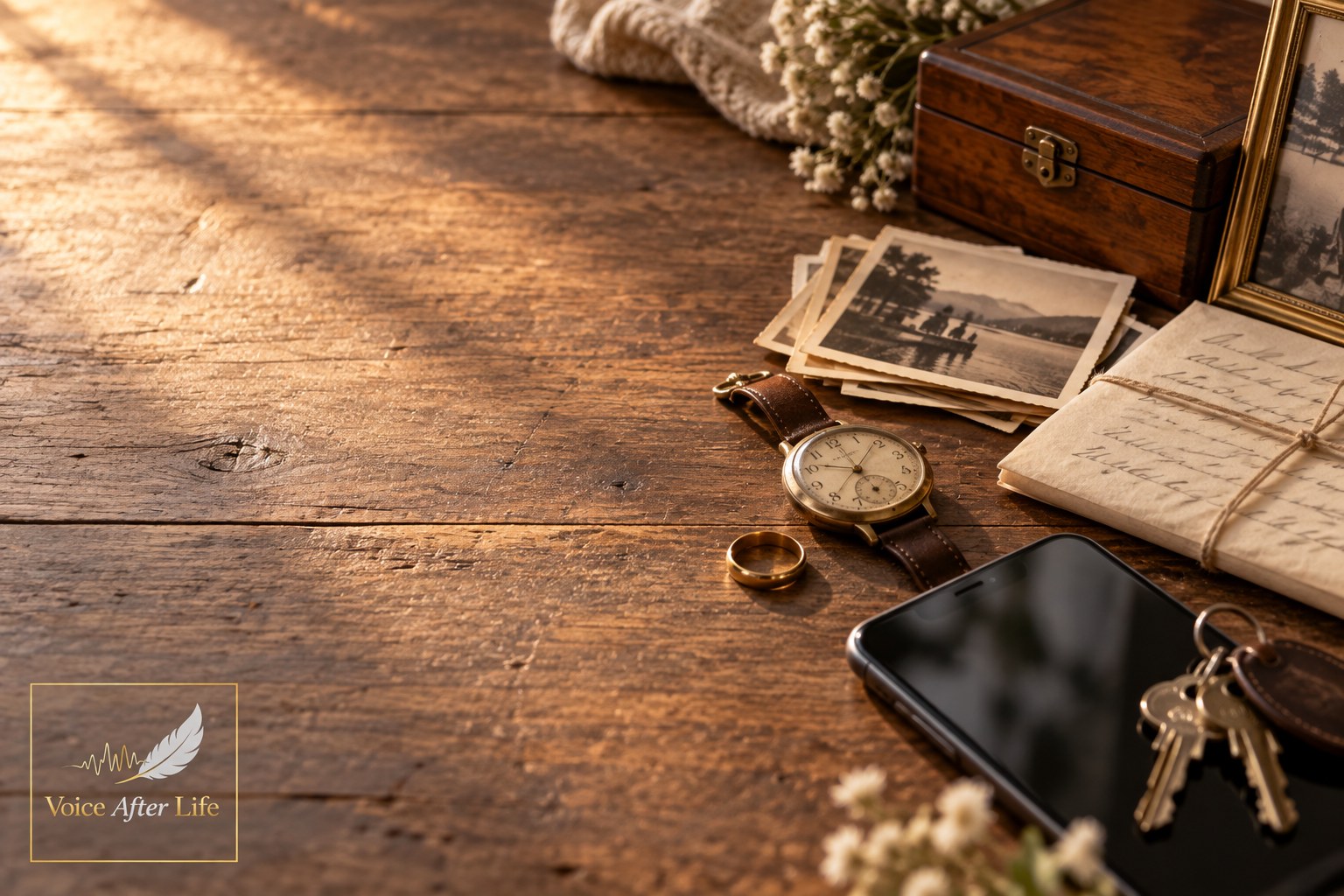
A Box in the Hallway Closet
Samir and Layla had lived in the same house for almost twenty years when they finally decided to clear out the hallway closet. Inside were things neither of them had looked at in a long time: a set of small brass coffee cups wrapped in a dish towel, a string of worn prayer beads, a folded piece of embroidery, a photograph of a wedding neither of their children had ever asked about. Layla could still recall who had given her each item and why. Her children, she realized, would someday hold the same cups and feel nothing at all.
That moment — standing in a hallway holding something precious and suddenly unexplainable — is more common than most families expect, and it's part of why the stories behind these objects are worth preserving somewhere more permanent than memory, which is the kind of work Voice After Life.com was built to support. An heirloom, after all, rarely earns its place in a family because of what it's worth. It earns that place because of what it holds.
Why an Object Needs a Story to Matter
Researchers who study family heirlooms consistently find that the objects themselves are usually unremarkable. Rather than priceless possessions, heirlooms are mostly ordinary objects, such as photographs and gardening tools. What transforms an ordinary object into something a family protects for generations isn't its price tag — it's the explaining, the remembering, and the retelling that happens around it.
This idea shows up again in psychological research on attachment to possessions. Scholars describe a concept sometimes called "essence" — the belief that an object can absorb the spiritual presence or unique quality of its owner through physical contact and use. That's part of why a father's worn pen or a mother's cooking pot feels different from an identical item bought new at a store: research has shown that heirlooms that were actively used by a loved one are valued more highly than those that were simply owned.
But that essence doesn't live in the object on its own. It has to be activated, again and again, by someone willing to say what it means. The significance of family heirlooms can be analyzed through the lens of semiotics — within this framework, an heirloom functions as a complex signifier, pointing to concepts such as lineage, identity, resilience, and love, and its meaning is not inherent in the object itself but is constructed and reinforced through the telling of family narratives.
What Families Actually Lose When the Story Isn't Told
The quiet risk in every household is that the person who holds the context eventually isn't there to share it. A review of psychological research on possessions and aging found that the link between a possession and the memory it holds can become lost over time, tied specifically to aging and forgetting around heirlooms. Put simply: once the person who could tell the story is gone, the object is just an object.
And yet most people don't prioritize writing these stories down. One industry study on generational wealth transfer found that only 8% of boomers and 3% of elders named family traditions, rituals, and stories as the single most important thing to pass on, even though undocumented sentimental possessions became the very thing families fought over most. The things people most assumed would simply be understood turned out to be the things causing the most confusion and conflict later.
The Legal Side: Documenting Intentions, Not Just Items
Estate planning professionals see this pattern play out often. According to Fidelity's Advanced Planning team, the biggest mistake is being silent and not putting anything down in writing — generally speaking, you don't see legal disputes and major arguments when things are written down. One advisor described siblings who ended up in a costly dispute over an antique simply because no one had specified which one of them should inherit it, and the resulting legal battle between them was costly, both monetarily and emotionally.
Many estate attorneys recommend a tool sometimes called a personal property memorandum — a document, separate from a will or trust, that lists specific items, who should receive them, and often the reasoning behind that decision. One law firm notes that this kind of memorandum must be signed by the testator, describe the items and devisees (heirs) with reasonable certainty, and must be referred to in the will. It won't replace a will, and it isn't a substitute for sound legal advice about your specific state's requirements — but it is a structured place to put the "why" that so often goes unsaid.
Capturing the Story Itself
Documentation handles the legal side of who receives what. It rarely captures the sound of someone's voice describing why an object mattered to them in the first place — the pause before they laugh, the detail they only remember when asked directly. Several estate-planning resources now recommend going a step further than a written note. One firm advises families to consider making short audio or video recordings, or writing notes to keep with each item, because these personal touches keep your voice and values attached to the things you leave behind.
That's where many families find it helpful to sit down together, name the object out loud, and simply let someone talk — a conversation that can be recorded, organized by item, and kept for whoever inherits that coffee cup, that ring, or that photograph years from now, which is exactly the kind of family archive you can build at Voice After Life over time, a little at a time, long before it's urgent.
A Simple Starting Point for Your Own Home
You don't need to catalog an entire house in one afternoon. A reasonable place to begin:
Pick three objects
Choose a few things in your home that matter to you — not necessarily the most expensive, but the ones you'd be upset to see thrown away without question.
Say why, out loud
Explain where it came from, who gave it to you, and what it meant. Let someone else hear it, or record it, so the explanation doesn't live only in your memory.
Write down who it's for, and why
If you already have a sense of who should receive an item, note that down along with your reasoning. As multiple estate planners point out, explaining these decisions' significance and emotions can help prevent future conflict, and the reasons behind the gift are often just as important as the gift itself.
Revisit it
Stories and wishes change. A personal property memorandum, unlike a will, is often easy to update as your thinking evolves.
None of this requires getting everything perfect the first time. It simply requires starting before the explaining has to happen from memory alone, pieced together by people who were never in the room to hear it firsthand.
- Voice After Life.com
Sources
- Situating Heirloom Presence Within the Family Narrative — Duquesne University Scholarship Collection
- Why Are Family Heirlooms so Meaningful to People? — Sustainability Directory
- The Story Behind Family Heirlooms Matters More Than the Price — MyEnd
- Passing on heirlooms without passing on drama — Fidelity
- How to Pass on Heirlooms Without Causing a Feud — Roulet Law
- How To Pass on Family Heirlooms Without Causing Conflict — Loughlin Law
- How To Pass Down Family Heirlooms Without Sparking Conflict — Joiner Law Firm