The Life Advice Grandparents Wish They Could Pass Down
Explore the timeless themes grandparents most want to share—and simple, research-backed ways families can capture that wisdom before it's lost.
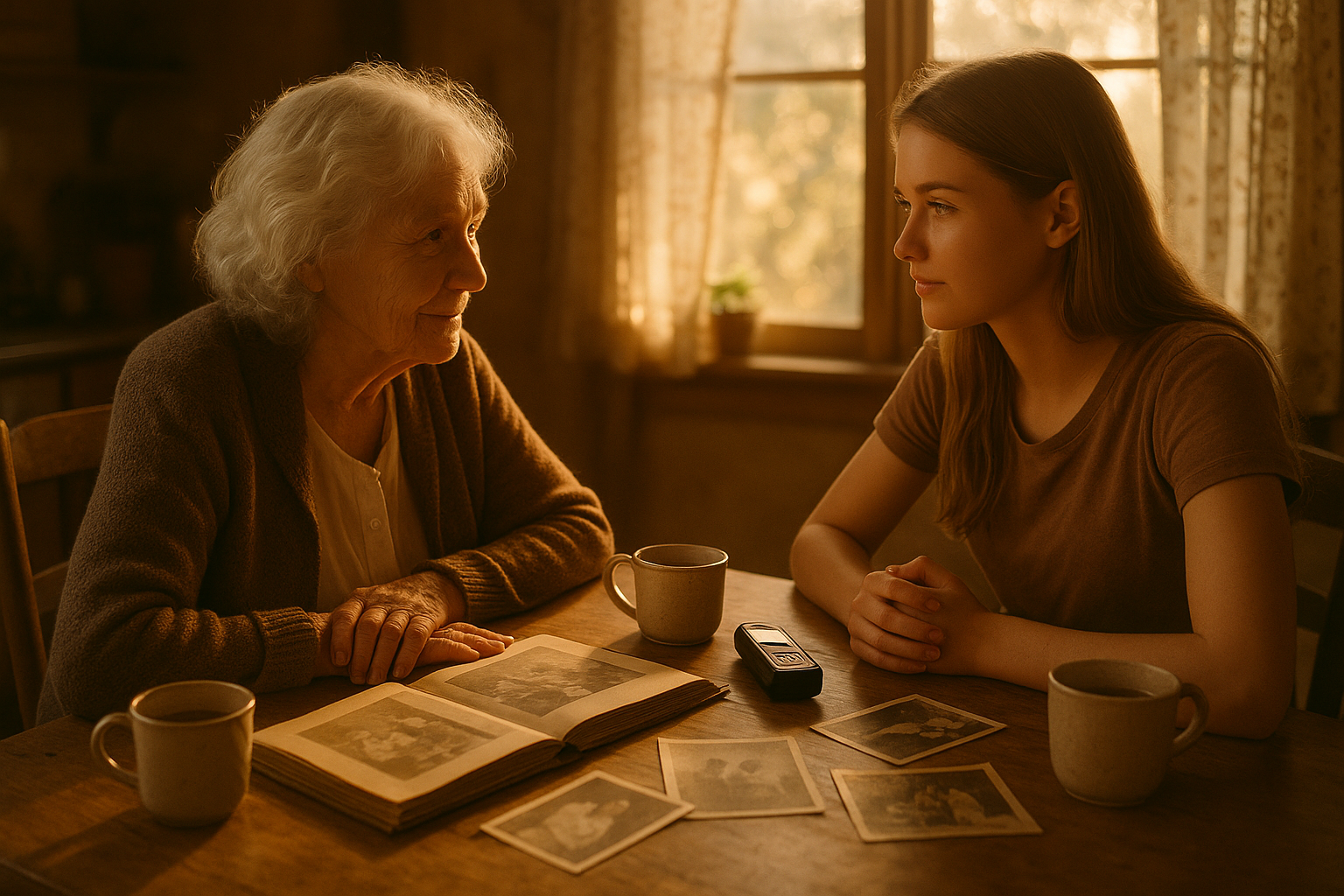
The Wisdom We Almost Lose
Ask anyone who has lost a grandparent what they'd give for one more conversation, and you'll hear a familiar refrain. Family history writers note that Almost everyone who has lost a grandparent says a version of the same thing: I wish I had asked more questions, not about anything dramatic, about the ordinary things. It's rarely the big biographical facts people crave most—it's the texture of a life: what their grandmother's kitchen sounded like, how their grandfather knew he'd found the right partner, the small rule they lived by that quietly shaped everything else. For families wondering how to hold onto that texture before it fades, Voice After Life.com exists specifically to help capture these everyday reflections in a loved one's own voice, before the chance passes.
The good news is that grandparents generally want to share this wisdom. Researchers studying grandparent-grandchild storytelling found that one of the clearest themes to emerge from these conversations is transmission of wisdom and life lessons, reflected the intergenerational sharing of career guidance, practical life advice, perspectives on resilience, and strengthened appreciation for personal circumstances. The challenge isn't willingness. It's simply making the time, and knowing what to ask.
Why This Matters More Than It Seems
This isn't just a sentimental nicety. Psychologists Marshall Duke and Robyn Fivush at Emory University spent years studying what makes families resilient, and their findings are striking. Using a set of family-history questions they called the "Do You Know?" scale, they discovered that the more children knew about their family's history, the stronger their sense of control over their lives, the higher their self-esteem and the more successfully they believed their families functioned. This wasn't a minor correlation—later analysis found that the 'Do You Know?' scale turned out to be the best single predictor of children's emotional health and happiness.
Even more compelling: the benefit held up under real-world stress. When researchers followed up with the same families after the September 11 attacks, those who knew they had a place in a larger family story were more resilient than those who scored low on what they knew about their families. Knowing your grandmother survived hard times, made mistakes, and kept going seems to give children and grandchildren a template for their own resilience. Researchers who study this describe it as an "oscillating narrative"—and have found that families that share an "oscillating narrative"—stories that include both the triumphs and the failures—raise children who are more resilient, grounded, and confident.
The Themes That Come Up Again and Again
When families do sit down to record these conversations, certain themes surface consistently, whether through formal oral history projects or a Sunday afternoon on the porch.
Work and perseverance. Stories about first jobs, hard bosses, and the discipline it took to build a career or raise a family under difficult circumstances. One writer reflecting on her own grandparents recalled that her grandparents were strict but loving, and demanded hard work, respect, and discipline.
Love and partnership. How they met, how they knew, what kept a marriage or partnership going through decades of change. StoryCorps, the national oral history nonprofit, includes prompts under "Love & Relationships" asking interviewees to tell me about the love of your life, and what have you learned from your wife/husband/partner.
Faith, values, and identity. What they believed, how those beliefs were tested, and what they hope endures. StoryCorps' interview guides regularly ask what are the most important lessons you've learned in life.
Practical, hands-on wisdom. Recipes, repairs, gardening, and other everyday skills that carry as much meaning as any spoken advice. One family-focused writer observed that grandparents often pass down practical skills and knowledge that are invaluable in everyday life, from gardening and cooking to woodworking and sewing, hands-on expertise honed over years of practice.
A message for those not yet born. Many oral history frameworks end with a version of the same question: thinking of future generations, is there advice they'd want to pass along. StoryCorps phrases it this way: for future generations of your family listening to this years from now, is there any wisdom you'd want to pass on to them? What would you want them to know?
A Tradition With Deep Roots
The impulse to formally capture this kind of guidance isn't new. For centuries, families have used what's known as an ethical will, or legacy letter—a personal, non-legal document meant to pass down values rather than assets. As one legal resource explains, ethical wills are personal documents through which individuals convey their ethical values, wisdom, and heartfelt messages to their heirs, focusing more on imparting life lessons, memories, and personal philosophies rather than distributing assets. The practice traces back thousands of years and has its roots in ancient Jewish culture, evolving from oral traditions into written forms over centuries, and has since been embraced by various cultures, including Christian and Muslim communities.
What's changed is the medium. Where an ethical will was once written by hand, families today increasingly recognize that it can take the form of a letter or a video, preserving one's voice, beliefs, and life experiences for future generations. A written letter carries meaning, but a recorded voice carries something a page cannot: the pause before a hard memory, the laugh in the middle of a story, the exact way someone said "I'm proud of you."
How to Start the Conversation
You don't need a formal project to begin. Oral historians who've conducted these interviews for years suggest starting small and specific rather than broad. As one guide built on decades of interviewing puts it, the goal is questions that are organized by life chapter, from childhood to legacy, and written the way oral historians actually ask: open-ended, specific, and impossible to answer with "fine" or "I don't remember."
A few ways to open the door:
- Ask about a single ordinary day rather than a whole decade — a summer evening, a first apartment, a Sunday routine.
- Ask what they wish someone had told them at your age.
- Ask about a mistake, not just a triumph — the honest stories are the ones that stick.
- Ask directly: is there anything you want the people who come after you to know?
StoryCorps founder Dave Isay, whose organization has recorded hundreds of thousands of these conversations, has said that the format itself gives people permission to go deeper than they normally would, noting that the microphone can give you the license to ask questions that you might otherwise shy away from asking.
Making Sure the Advice Isn't Lost
The hardest part is rarely the conversation itself—it's the follow-through. Notes get misplaced, recordings sit unlabeled on old phones, and the urgency fades until it's too late. This is where a structured, lasting approach matters. For families ready to move from a good conversation to a preserved one, capturing these stories in a secure, shareable audio archive turns a single afternoon of listening into something grandchildren and great-grandchildren can return to for decades.
The life lessons grandparents carry were never meant to stay locked inside a single generation. They were meant to travel—through a story told at dinner, a letter tucked in a drawer, or, increasingly, a recorded voice that can be played back long after the room has gone quiet. The themes are usually simple: work hard, love well, forgive quickly, remember where you came from. What takes intention is making sure someone actually asks, and that someone is listening when the answer comes.
- Voice After Life.com
Sources
- 101 Questions to Ask Your Grandparents About Their Life — VoiceWeave
- Grandparent–Grandchild Reminiscence Program for Asian American Families — Behavioral Sciences (peer-reviewed journal)
- The Power of Intergenerational Wisdom: What We Can Learn from Our Grandmothers — Medium
- Learning from Grandparents: A Source of Wisdom and Inspiration — Emma Reed
- Want A Happier Family? Tell Your Family History — ImpactParents
- The Importance of Offering Children an Intergenerational Identity — Parent.com
- Family Stories—Making Resilient Children! — Not Your Grandmother's Family History Blog
- The 'Do You Know?' Exercise: Connecting Your Family's History to Its Future — leafplanner
- Ethical Wills (Legacy letters) — EBSCO Research Starters
- What Is an Ethical Will? Sharing Your Legacy from the Heart — Knott Law
- Great Questions List — StoryCorps Archive
- Great Questions List (2017 Great Thanksgiving Listen) — StoryCorps
- Great Questions - StoryCorps — StoryCorps
- This Thanksgiving, Try StoryCorps' Oral History Project — NPR
- Great Questions List (2019 Great Thanksgiving Listen) — StoryCorps