Keeping Family Traditions Alive Across Generations
Family traditions do more than fill the calendar—research shows they build resilience and identity. Here's how families can keep them alive for generations to come.
Why the Little Rituals Matter So Much
Every family has them: the pancakes on a certain morning, the same silly toast before dinner, the way Grandpa always tells the story of how he met Grandma. These moments can feel small in the middle of a busy week, but researchers who study family life have found they carry real psychological weight. According to a review of family ritual research, family rituals—those repeated, meaningful activities that families engage in together—are crucial in promoting mental and physical health among family members, and consistent practices, such as shared meals, celebrations, and everyday routines, foster emotional stability, enhance interpersonal bonds, and instill a sense of security and identity, particularly in children.
As families spread across cities, time zones, and generations, holding on to these rituals takes more intention than it once did. Recording the stories behind a tradition—who started it, why it mattered, what it meant to the people who kept it going—is one way to make sure the why survives along with the what, and it's part of the reason families turn to Voice After Life.com when they want a tradition's history preserved in a loved one's own voice, not just written down secondhand.
What the Research Actually Shows
Family traditions aren't just nostalgic—they're one of the more studied topics in family psychology. Work published in the American Psychological Association's Journal of Family Psychology has found that family traditions and rituals are still a prevalent thread that makes up the tapestry of families in our society, and they are associated with "marital satisfaction, adolescents' sense of personal identity, children's health, academic achievement, and stronger family relationships". The same body of research describes traditions as "powerful organizers of family life that offer stability during times of stress and transition".
One of the most striking findings comes from the Emory University Family Narratives Project, led by psychologists Marshall Duke and Robyn Fivush. Their team developed a simple "Do You Know?" scale—questions like whether a child knows how their parents met or where their grandparents grew up—and discovered that children who learn they are part of a larger ongoing narrative have a greater sense of confidence and of belonging, with a strong "intergenerational self," knowing they are part of something bigger than themselves. Remarkably, this held up under real stress: two months after the study, the September 11 tragedy happened, and when the researchers went back to reassess the children after that shared national trauma, those who knew more about their families proved to be more resilient.
Broader reviews of this research area confirm the pattern. A summary of intergenerational storytelling studies notes that adolescents who know more about their family history tend to have less anxiety, higher self-esteem, more locus of control, better family functioning, and less behavioral problems, and that adolescents whose families share more narratives tend to have higher emotional wellbeing overall.
Traditions Don't Have to Be Elaborate
It's tempting to think a "real" tradition needs to be a big production—a holiday feast, a cross-country reunion, a religious ceremony. But child development experts point out that the size of the tradition matters far less than its consistency. According to one child psychology resource, rituals do not have to be elaborate or expensive; in fact, the simplest ones are often the most enduring. A Friday pizza night or a bedtime song can carry as much weight as an annual gathering, because, as the same source explains, a Friday pizza night, a seasonal family hike, or even a simple song sung before bedtime communicates, "This is who we are, and this is how we belong together."
Family therapists also draw a distinction between routines and rituals. As one clinical review puts it, rituals are different from routines—while routines are regular activities that we do without much thought, rituals are more intentional and meaningful. The intention behind the activity, not its scale, is what turns a habit into something a family remembers.
The Voice Behind the Tradition
Long before anything was written down, families relied on spoken word to carry their history forward. Oral tradition scholars describe this as one of the oldest human practices: oral tradition refers to the practice of passing down cultural legacies, history, and knowledge through spoken word, encompassing stories, myths, songs, and poetry, and it played a crucial role in preserving law, religion, art, and cultural identity long before the advent of written languages. Even in an age of texts and social media, that oral thread hasn't disappeared—it's simply competing with more distractions than it used to.
Across many cultures, specific family members have historically carried this responsibility. Research on storytelling traditions notes that the figures charged with preserving a family's lineage and heritage have often been women—elders, mothers, grandmothers, and aunts. That pattern shows up in more recent family studies too: the Emory Family Narratives Project found that family stories seem to be transferred by mothers and grandmothers more often than not, typically passed during family dinners, family vacations, and family holidays.
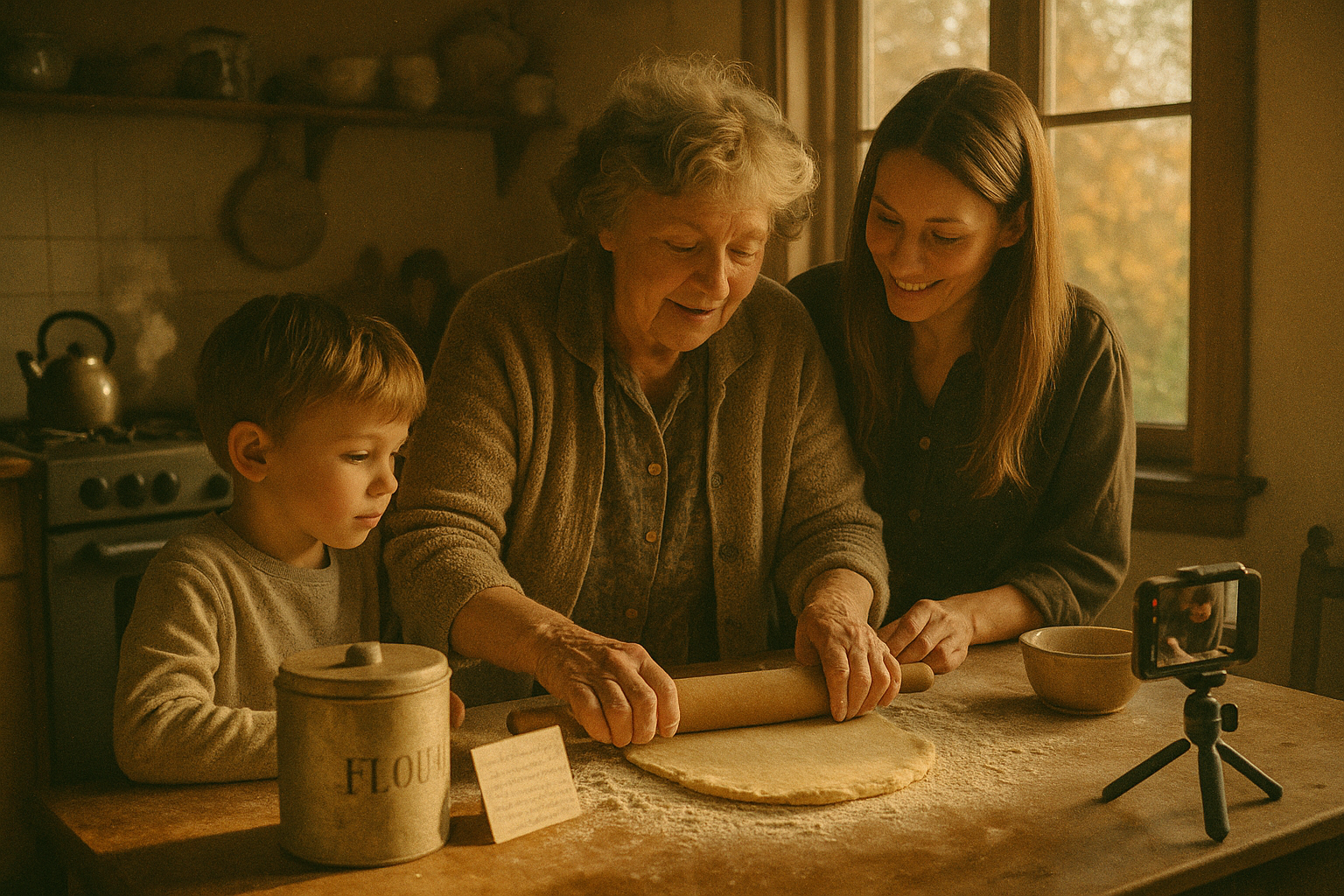
What's easy to lose in translation, generation after generation, isn't the fact of the tradition—it's the voice that explained why it mattered. A recipe card can tell you the ingredients for a holiday dish, but it can't tell you about the kitchen it was first made in, or the person who insisted on doing it a certain way. This is where a recorded voice becomes different from a written note or a photograph; it carries tone, laughter, hesitation, and warmth that text can't hold onto. Preserving that voice—not just the memory of a tradition but the sound of the person explaining it—is central to the work families do at Voice After Life, where a grandparent's own retelling of a family story can be kept for grandchildren not yet born.
Starting or Reviving a Tradition in Your Own Family
If your family's traditions have faded—through moves, busy schedules, or simply time—know that rituals can be restarted. Family psychology writers note that some rituals disappear for a while and reappear, as when one mother who had made a pumpkin pie with her own mother every Thanksgiving for about 20 years stopped, then chose to restart the tradition with her young son years later. The break in continuity didn't erase the meaning; it just waited to be picked back up.
For families building something new, experts suggest starting small rather than trying to manufacture instant meaning. One family mental health resource advises: if your family doesn't have many traditions yet, start small—choose one activity you can realistically commit to and invite your children to help shape it. Giving children a hand in creating the ritual matters, because when kids take part in creating a tradition, they feel a sense of ownership and pride.
Why This Work Is Worth Doing Now
Family traditions connect us to people we've lost and to people who haven't been born yet. Psychology Today's coverage of family narrative research puts it simply: these stories connect children to their unique family constellation and its history, grounding them in the story of where they come from, who they are, and what they do. That grounding doesn't happen automatically—it happens because someone took the time to tell the story, and someone else took the time to listen, and ideally, to keep it.
Whether your family's tradition is a holiday recipe, a bedtime story, a song, or the way someone always answered the phone, the details are worth capturing while the people who hold them are still here to share them in their own words.
- Voice After Life.com
Sources
- The Power of Family Traditions: Count the Ways — Psychology Today
- The Enduring Power of Family Traditions — Psychology Today
- The Importance of Family Traditions — Youth First
- Beyond Tradition: How Family Rituals Enhance Health and Connection — Sam Goldstein, Ph.D.
- Family Traditions as Anchors: Why Rituals Matter for Emotional Security — Institute of Child Psychology
- The Lasting Positive Impact of Family Traditions — St. John's United
- Oral tradition | Social Sciences and Humanities Research Starters — EBSCO
- The Power Of Oral Traditions: Stories Passed Through Generations — ROCK & ART
- Do You Know? How Family Stories Benefit Children and Adolescents in Myriad Ways — The Covenant Foundation
- The Stories That Bind Us — National Storytelling Network
- The Stories of Our Families: How Much Do We Truly Know? — Dr. Robert Brooks
- The Secret Sauce to Keeping your Family Together? — Bill High
- The role of intergenerational family stories in mental health and wellbeing — PMC / National Institutes of Health