How to Record Your Family Story Before It Is Lost
Family stories fade fast once a storyteller is gone. Here's what genealogists and oral historians recommend for capturing them well, and for good.
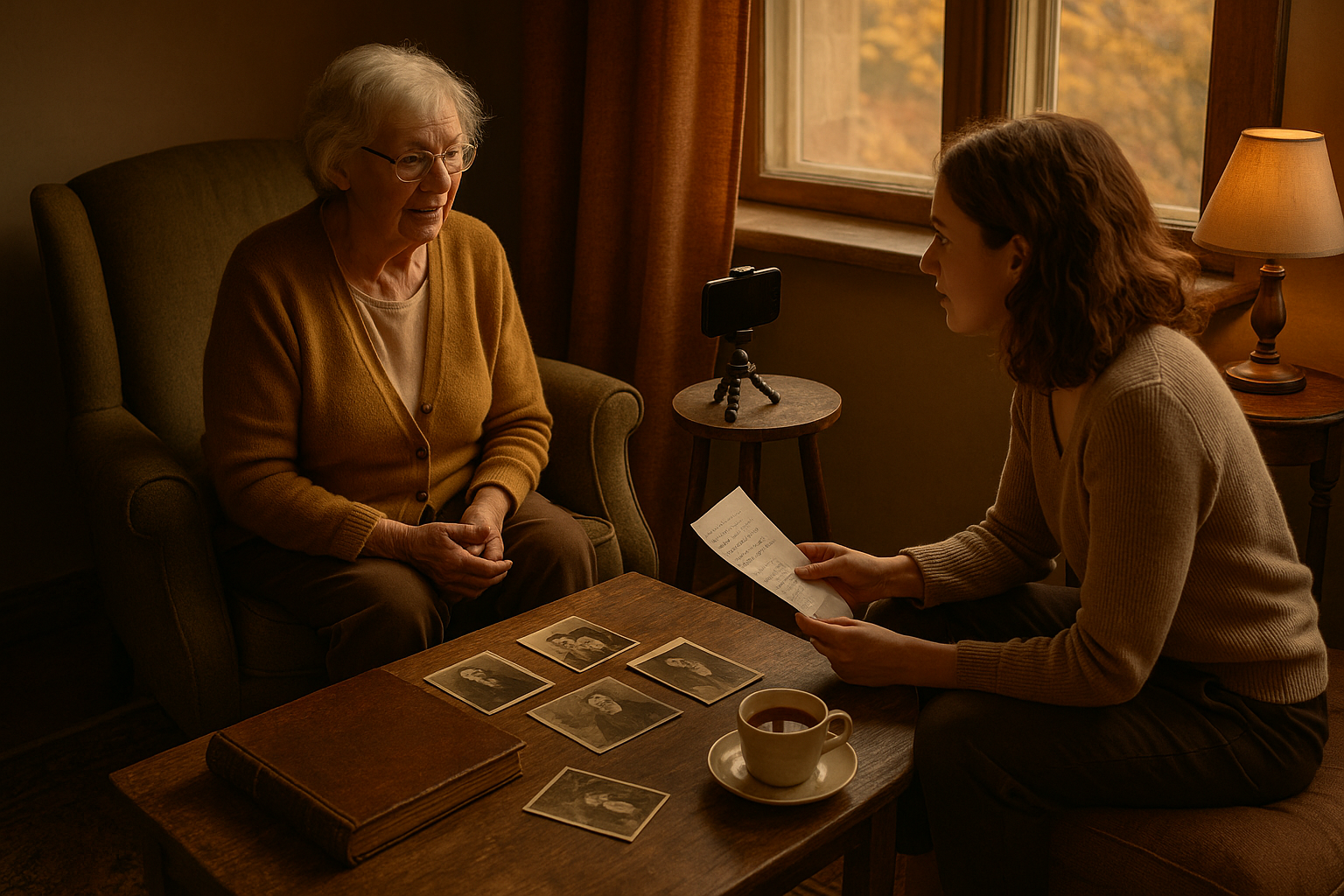
Why Family Stories Disappear So Quickly
Most of what we know about our grandparents and great-grandparents lives in memory, not in documents. That makes it fragile. Aaron Holt of the National Archives and Records Administration has explained that "it only takes three generations to lose a piece of oral family history," and that a story "must be purposely and accurately repeated over and over again through the generations to be preserved." In other words, the stories your grandparents tell at holiday dinners are not guaranteed to reach your grandchildren. Without deliberate effort, they simply evaporate.
This is why more families are choosing to sit down with a recorder, a phone, or a laptop and simply ask. It's also why a growing number of people are turning to purpose-built tools like Voice After Life.com to capture a relative's actual voice telling those stories, rather than relying on secondhand retellings decades later. A written note can preserve facts, but a voice carries something else entirely — cadence, laughter, the particular way someone pauses before the punchline of a favorite story.
The Cost of Waiting
Gerontologists who work closely with older adults describe this loss in stark terms. Gerontologist Sam Cradduck has said older adults serve as "living, breathing history books of society," and that "when one of those elderly pass without being read, we're not losing just a person, we're losing a library of stories." A widely cited African proverb captures the same idea more simply: "When an elder dies, a library burns to the ground," and oral history "enables us to capture the wisdom of our living libraries before they pass away."
Aging-well professionals also note a quieter kind of loss that written records can't fill. Aging expert Amy O'Rourke has described missing the sound of her mother's voice after she died, despite having written records and pictures, saying "if I could have just had a tape recorder... She wrote everything down and we have pictures, but somehow the voice was missing." Photographs and journals matter, but they don't recreate the sound of someone's laugh or the particular way they told a story.
What Oral Historians Say Actually Works
Professional oral historians and genealogists generally agree on a few core practices, whether you're recording a parent, a grandparent, or yourself for future generations.
Prepare before you press record
Experienced interviewers recommend doing some homework first. Oral history trainer Ina Navazelskis advises that preparation is the key to a meaningful interview, recommending that people "write out your goals ahead of time" and "do your research by reading background information about the time period or people involved, and creating timelines." You don't need to be a professional historian to do this — even a short list of names, places, and approximate dates can help jog a relative's memory during the conversation.
Ask open-ended questions and let the story breathe
The Smithsonian's guidance on oral history suggests giving your relative a rundown of topics, people, or places that may be mentioned so they can jog their memory of stories they want to tell. The goal isn't a rigid interrogation. It's a relationship. As one museum guide puts it, oral history is fundamentally about connection between the person asking and the person remembering.
Include more than one voice
Family historians who have run group projects point out that different relatives remember the same events differently, and that's a feature, not a flaw. Longtime activist Maggie Kuhn advised family interviewers to brainstorm with as many family members as possible before starting, to "get the family signed on to it," and to find out what people think the key stories, landmarks, sayings, and traditions are . Once you begin, it helps to include as many viewpoints as possible, since people have different memories of the same event and the family needs to feel represented fairly.
Don't shy away from the hard chapters
Research on family storytelling suggests that the difficult parts of a family's history matter as much as the celebratory ones. Author Bruce Feiler has argued that sharing family stories, even the less flattering ones, makes for more cohesive family units, noting it's "extremely important to talk about the downturns in your family, the challenges that you faced and how you overcame them."
Practical Basics for Recording at Home
You don't need studio equipment. Modern smartphones are more than capable, and with smartphones boasting high-quality cameras and microphones, and editing programs widely available, the tools to create a family oral history are at everyone's disposal . A few basics recommended by institutional oral history programs are worth borrowing for a home project:
- Test before the real conversation. Guidance from the Boston Public Library's oral history program recommends conducting a 30-second test recording and playing it back before the formal interview, to make sure the recorder works and the microphone is picking up voices well.
- Keep the microphone close. Simple positioning — pointing the device toward the speaker — makes a bigger difference in clarity than expensive gear.
- Save more than one copy, in more than one place. Archival best practices call for interviewers to transfer the original recording, make redundant digital copies, and store those copies in different physical locations as soon as possible after the interview .
- Label everything clearly. A simple, consistent file-naming system — name, date, topic — saves enormous confusion years later when a family member is searching through old recordings.
Turning a Recording Into a Lasting Family Resource
Once a conversation is recorded, the work isn't quite finished. Interviews are most useful to future generations when they're organized, described, and stored somewhere durable rather than left on a single phone or laptop that may eventually be lost, damaged, or simply replaced. This is precisely the gap that thoughtful, voice-centered preservation can close — giving families a dedicated, lasting home for a parent's laugh, a grandmother's advice, or a grandfather's account of where the family came from, so that it can be revisited and shared for years to come at voiceafterlife.com.
Starting the Conversation
If there's a relative whose stories you've always meant to record, the honest answer is that there is rarely a perfect time. Genealogist Jim Ison has described being motivated by a simple, unsettling question posed at a genealogy conference: "What will your great-grandchildren wish you had done?"
You don't need a formal project, a long list of questions, or professional equipment to begin. A phone, a quiet room, and genuine curiosity about someone's life are enough to start. The stories are still there, waiting to be asked for — but as oral historians consistently remind us, that window doesn't stay open forever.
- Voice After Life.com
Sources
- Oral Family History Fades in Just Three Generations — FamilySearch
- Preserving history: Importance of recording older loved ones' family stories — KY3 / Aging Untold
- Capturing Your Family's Oral History — National Museum of African American History and Culture
- Create an Oral Family History by Documenting Stories and Genealogy — AARP
- The Importance of Oral Histories — Legacy Tree Genealogists
- How to Record Your Family's History — TIME
- Oral History Equipment - Getting Started with Oral History — Boston Public Library
- Oral History Best Practices — Oral History Association