How to Record Your Family Story Before It Is Lost
A practical guide to capturing an elder's voice and memories before they fade—what to ask, how to record, and why the effort matters more than perfect equipment.
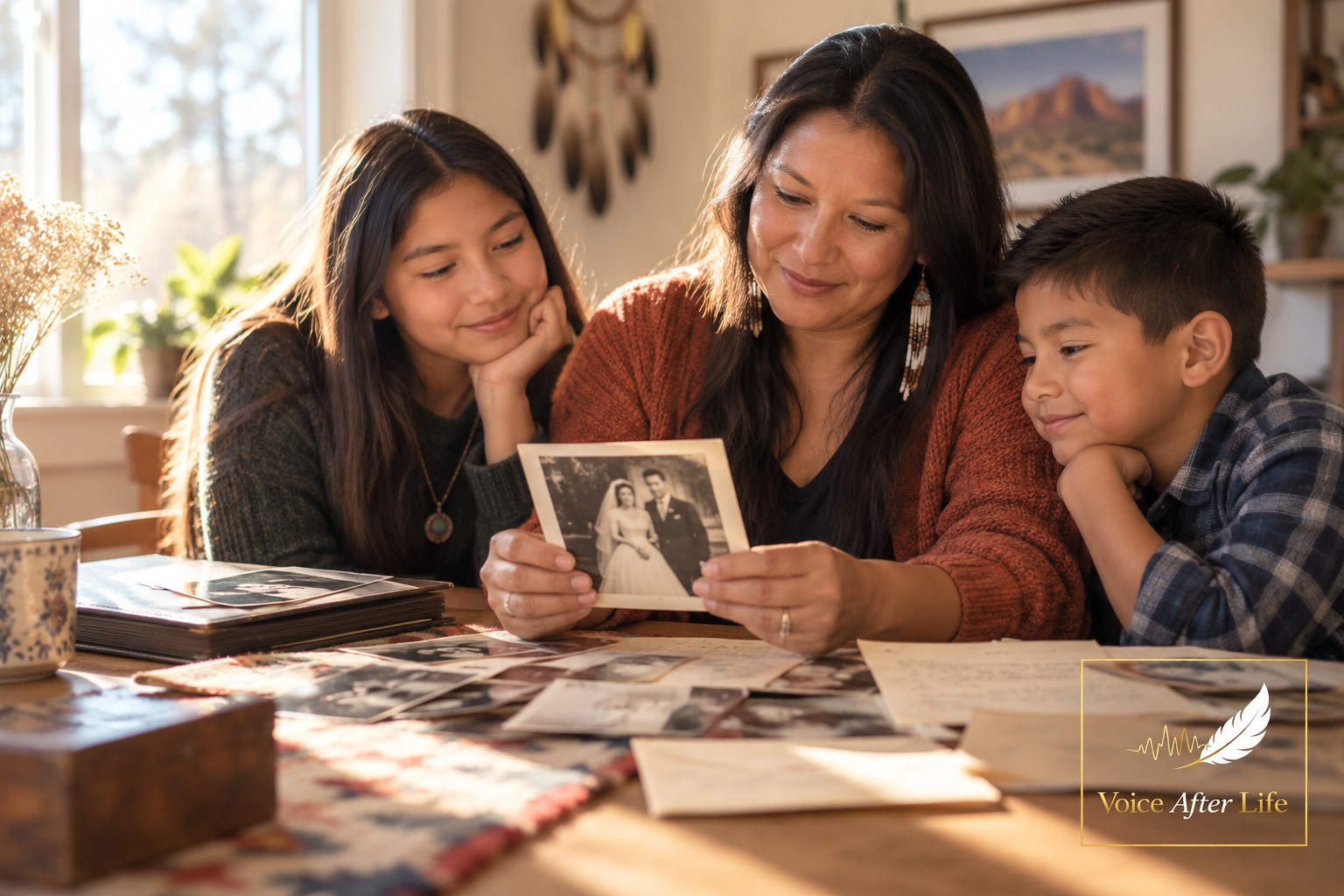
The Afternoon That Almost Wasn't Recorded
Mei-Lin had always meant to ask her mother about the ship crossing—the one her mother made as a young woman, carrying almost nothing but a single photograph and a language she barely spoke yet. For years the story surfaced only in fragments, usually at holiday dinners, usually cut short by someone changing the subject. It wasn't until her mother's 88th birthday that Mei-Lin finally set a phone on the kitchen table, pressed record, and asked her to start from the beginning.
That one afternoon is the kind of moment Voice After Life.com was built to help families capture and keep—not just the facts of a life, but the voice telling it. Family history is often treated as a genealogy project: names, dates, a chart with branches. But the details that make a story feel alive—the hesitation before a hard memory, the laugh at an old joke, the specific words someone chooses—rarely survive in a spreadsheet. They survive in a recording, if someone thinks to make one in time.
Why Waiting Is the Biggest Risk
It is easy to assume there will be another visit, another holiday, another chance to ask. Genealogists and oral historians who work with families every day describe this differently: every day, irreplaceable stories disappear, and when an elderly relative passes away, they take with them firsthand accounts of historical events, family traditions, and personal wisdom that can never be recovered. The same guidance notes something worth sitting with: the average person loses two grandparents by age 30, and most people never think to record their stories until it is too late.
A gerontologist quoted in recent coverage of family caregiving put it plainly, describing older adults as "living, breathing history books of society." The same report offered a stark way to think about the stakes: "When one of those elderly pass without being read, we're not losing just a person, we're losing a library of stories."
The good news is that it is rarely too late until it is truly too late. As one guide to family oral history projects notes, it is never too late to record family history as long as your relative can communicate, and even brief recordings of five or ten minutes are profoundly valuable.
Starting the Conversation
You do not need a professional studio or a journalism background. Expensive equipment is not required for oral history interviews—an inexpensive video or tape recorder and microphone are usually all you need. Many families now simply use a smartphone, and that is enough: you almost certainly already own the most important piece of equipment in your phone, since modern smartphones record surprisingly good audio and video.
A few small choices make a bigger difference than the equipment itself:
- Pick a quiet room. Choose a quiet location in the home or office, away from heating or air-conditioning vents, a humming refrigerator, or windows overlooking noisy streets.
- Schedule it like an appointment. Schedule the oral history session in advance rather than showing up on a person's doorstep unexpectedly.
- Time it for their best hours. Many older adults have a window—often mid-morning—when they are sharpest and most talkative, and building the interview around that window respects their energy rather than fighting it.
- Bring photographs or objects. Physical prompts can loosen memories that a direct question might not reach.
- Ask for permission clearly. If you want to use a recorder, make sure you get prior permission from the person you're interviewing.
Asking Questions That Open Doors, Not Close Them
Mei-Lin's first instinct was to ask her mother for a timeline—dates, ports, paperwork. It was only when she asked what her mother had been most afraid of that the real story came out. Oral historians generally advise starting broad and following the storyteller's lead. Preparing fifteen to twenty open-ended questions per session while holding them loosely tends to produce the best recordings, because the strongest results happen when the interviewer follows the storyteller's lead—if a relative mentions someone who taught her something, that thread is worth pulling.
It also helps to remember the tone you are going for. When recording an oral history, you are an interested relative rather than a hard-nosed reporter, and the experience tends to go best when it is enjoyable for everyone involved.
Don't limit the project to the oldest generation only. While the priority is often the oldest generation, interviewing parents, siblings, or even children can be valuable too, since their perspectives on family life matter to future generations as well. A useful way to decide where to begin: ask yourself whose stories you would most regret losing, and start there.
What Happens to the Recording Afterward
A recording that lives only on one relative's phone is one lost or dropped device away from disappearing. This is the point in the process where many families realize they need a plan not just for capturing a story, but for keeping it—labeled, backed up, and accessible to the people who will want it in ten or twenty years. Some families choose to build that ongoing archive using Voice After Life, treating the recording session as the beginning of a keepsake rather than the end of a task.
Simple habits protect the work you have already done. Label and save files properly, naming recordings clearly with dates and interviewee names for easy retrieval. It is also worth knowing that national organizations have been doing this at scale for two decades. Since 2003, one major oral history initiative has recognized the value of preserving these oral histories, and has been recording and archiving them through the Library of Congress for future generations. That archive alone now holds nearly 370,000 interviews captured, from heartwarming family memories to firsthand accounts of historic moments. Your family's recordings will not join that specific collection, but the scale of it says something important: this instinct to preserve a voice is not sentimental overreach. It is a widely shared, well-documented practice.
Closing the Loop
Mei-Lin's mother has since passed. What remains is forty minutes of audio: a description of the ship's railing, the smell of salt air, the exact phrase her mother used for "homesick" in her first language. None of it would exist if that one afternoon at the kitchen table had been postponed again.
The stories in your family are not waiting for a perfect moment. They are waiting for someone to ask, to listen, and to press record.
- Voice After Life.com
Sources
- How to Record Your Family History (Complete Guide) — Secured Memories
- Creating Oral Histories — FamilySearch
- Best practices for recording family history interviews at home — Modern Heirloom Books
- Example Questions for Oral Histories — Genealogy.com
- How to Record an Oral History Interview Before It's Too Late — The Family Heart
- Preserving history: Importance of recording older loved ones' family stories — Aging Untold / WIS-TV
- StoryCorps: Oral Histories Collected by Loved Ones — American Historical Association
- Inside StoryCorps: A Peek Inside the StoryCorps Archive — StoryCorps