How to Record Your Family Story Before It Is Lost
Family stories fade fast without effort. Here's what research says about oral history loss and practical steps to capture your family's voice before it's gone.
Why Family Stories Disappear So Quickly
Most of us assume the stories our grandparents told will simply pass down the family line on their own. They don't. According to genealogists at FamilySearch, Aaron Holt of the National Archives and Records Administration says that it only takes three generations to lose a piece of oral family history, and that a story must be purposely and accurately repeated over and over again through the generations to be preserved. In other words, memory alone is not a reliable archive. Without deliberate effort, the details of a grandmother's childhood, a father's wartime service, or the reason a family settled in a particular town can vanish within a single lifetime. That is exactly the gap that a dedicated place to capture and safeguard those recollections, like Voice After Life.com, is designed to help close for families who don't want their history reduced to a handful of names and dates.
This isn't just a genealogist's concern. Researcher Bruce Feiler's widely cited 2013 work found that children who knew the most about their forebears — who they were, where they grew up, illnesses they struggled with, and tough trials they went through — had the greatest self-confidence and dealt with personal stress better. Family history, it turns out, isn't just nostalgia. It shapes identity and resilience in the generations that come after.
The Three-Generation Problem
The pattern researchers describe is fairly predictable. Parents and grandparents carry rich, detailed memories of their own parents and grandparents. Those details often survive one retelling, become vaguer in the next, and disappear almost entirely by the third. As one family history resource puts it, oral accounts "become more tales or legends and can contain many errors" the further they travel from the original source, even though most of the time there is some basis of truth in each story. The stories most at risk aren't necessarily the ones from centuries ago — they're often the ones from just one or two generations back, the everyday recollections that nobody thought to write down because they seemed too ordinary to lose.
Start With a Simple Interview
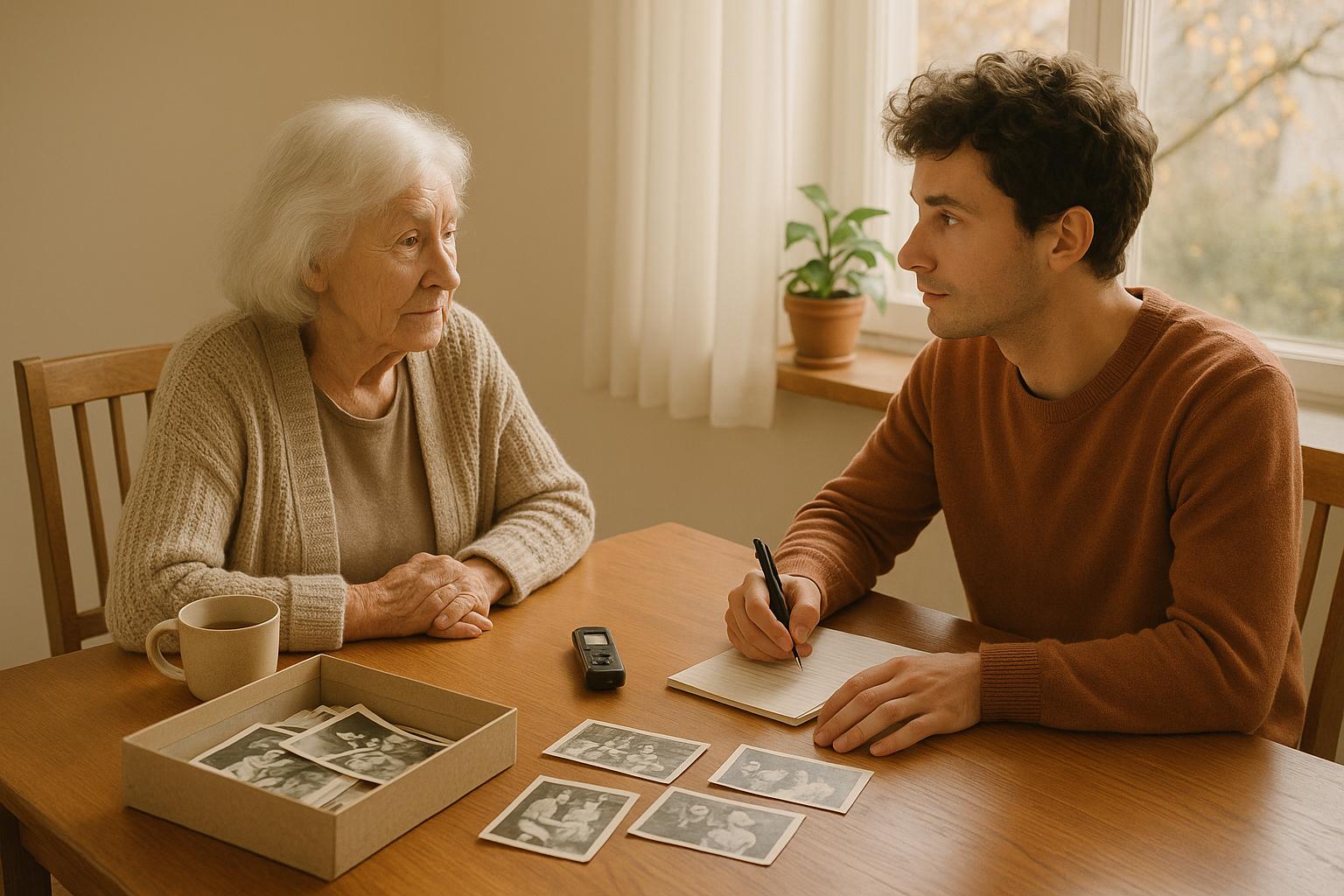
You don't need training as a historian to begin. Organizations that specialize in genealogical research recommend a straightforward approach: brainstorm a list of questions to ask, and think of questions that will encourage your family member to tell stories and share memories of the past. A useful opening line, suggested by American Ancestors, is to simply say you'll start with someone's earliest memories and move forward chronologically through their life.
A few practical habits make these conversations go more smoothly:
Prepare and Schedule Thoughtfully
Genealogy researchers advise that you schedule a convenient time to talk with your family member, and consider that you may be in different time zones if relatives live far apart. Sending a few sample questions in advance can also help someone who isn't used to being interviewed feel more prepared and open up more freely.
Ask Open-Ended Questions
Oral historians consulted by public broadcaster KQED recommend asking questions in an open-ended manner, so that people can answer in their own way, while also having a few specific questions ready, since very broad prompts can sometimes feel intimidating. Asking someone to "set the scene" — what a particular day, house, or job actually looked and felt like — often unlocks more vivid detail than a simple factual question.
Give the Conversation Room to Breathe
The National Trust for Historic Preservation suggests planning for one to two hours for an interview, which allows space for the conversation to flourish, sometimes moving in unexpected directions as you build rapport with the person you're interviewing. Rushing an interview to fit a tight schedule often means missing the tangents where the best stories live.
Record It, Don't Just Remember It
Whichever method you choose, capture the conversation rather than relying on your own memory of it afterward. Family history guidance from FamilySearch notes that you should use a phone or some sort of recording device, or at the very least write down the answers as they're given. A recording preserves not just the words but the tone, the pauses, and the emotion behind them — details a written summary can never fully capture.
Learning From National Preservation Efforts
The value of firsthand recorded accounts is recognized well beyond individual families. The Library of Congress's Veterans History Project, created by an act of Congress in 2000, exists specifically because its mission is to collect, preserve and share the personal stories of U.S. military veterans from World War I through current conflicts and peacekeeping missions. As of a recent count, the project had gathered over 121,000 individual collections, encompassing audio and video interviews, original photographs, letters, diaries, memoirs, 2-D artwork and other materials. The urgency behind that effort is sobering: when the project launched, organizers noted that almost 19 million war veterans were living in America at the time, but more than 1,600 were dying each day, creating an urgent need to preserve their stories.
That same urgency applies quietly inside every family. The relatives who remember the most — a grandmother's maiden name, the name of the ship an ancestor immigrated on, the joke your father always told at Thanksgiving — are not always going to be available to ask. Setting aside even one afternoon to record their voice can matter more than a stack of documents.
Beyond the Interview: Preserving What You Collect
Once you've gathered a recording, a transcript, or a handful of stories, the next question is where it lives. Notes stored on a single phone or hard drive can be lost just as easily as memories. Historical preservation organizations often recommend choosing a repository — physical or virtual — that would be the best way to preserve your oral history and make it accessible, whether it is a library, archive, or online resource. For families who want their recordings to remain accessible and organized for children and grandchildren rather than scattered across old devices, preserving those recordings in one lasting place can make the difference between a story that's found later and one that's forgotten entirely.
Small Steps, Lasting Impact
You don't need to interview every relative or capture every memory in a single sitting. Start with one person, one conversation, one recording. Ask about their childhood, a hard year they lived through, or the story behind a family photograph. Write down or record what they say, and share it with the younger members of your family so the story gets repeated — because as the National Archives' own research suggests, repetition across generations is what keeps a story alive at all.
The stories sitting in your family right now — in a grandparent's memory, an aunt's old letters, a parent's recollections of a childhood home — are a finite resource. They can be gathered, recorded, and passed on, or they can quietly disappear the way so many family stories already have. The choice, and the opportunity, is still yours to make.
- Voice After Life.com
Sources
- Oral Family History Fades in Just Three Generations — FamilySearch
- Oral story telling — FamilyTree.com
- Conducting a Family History Interview — American Ancestors
- How to Conduct an Oral History Interview — National Trust for Historic Preservation
- How to Interview Your Family Members Like an Oral Historian — KQED
- Veterans' Stories: The Veterans History Project — Library of Congress
- Library of Congress's Veterans History Project Honors Veterans Nationwide — Library of Congress