How to Record a Grandparent Sharing Their Memories
A practical, research-backed guide to preparing, conducting, and preserving a meaningful recorded conversation with a grandparent.
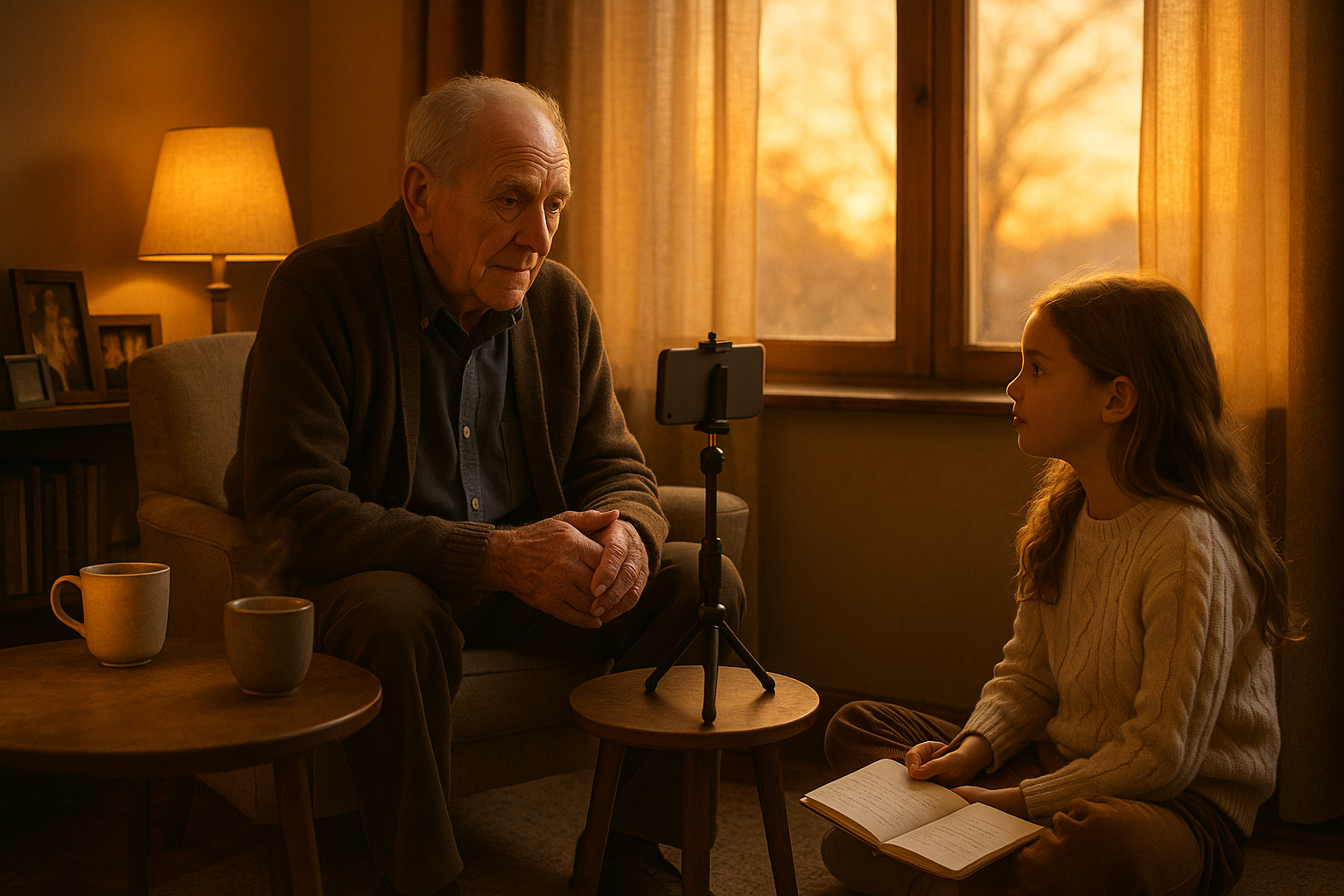
Why This Conversation Matters More Than You Think
There is a particular kind of urgency that comes with realizing your grandparent's stories exist only in their memory. The way they describe the smell of their childhood kitchen, the sound of a train they rode as a young adult, or the exact words their own mother used to comfort them — none of it is written down anywhere. It lives only in them, and in whatever gets passed along before it's too late. Setting aside an afternoon to ask, listen, and press record is one of the simplest and most valuable things a family can do, which is exactly the kind of moment that Voice After Life.com was built to help families capture and keep safe for generations.
Research backs up what most families feel instinctively: these conversations matter for more than nostalgia. Psychologists Marshall Duke and Robyn Fivush at Emory University spent years studying what holds families together, and their work found that family stories provide a sense of identity through time, and help children understand who they are in the world. In their research, questions included things like whether children knew where their grandparents grew up or where their parents met, and results showed that the more children knew about their families, the higher their self-esteem was as well as their sense of control over their lives. Duke's broader body of work has focused on the development of a child's intergenerational self and how family narratives can help build resilience in children and teens. In short, recording a grandparent isn't just an act of preservation — it's a gift to everyone who comes after them.
Before You Start Recording
Choose the Right Time and Setting
Good recordings start long before anyone presses record. According to guidance from StoryCorps, the national oral history nonprofit, a quiet, cozy room with a door and rug works best, and it helps to turn off everything noisy in the room beforehand, including TVs, fans, and radios. Soft surfaces matter too: rooms without strong acoustics are better, since carpets, furniture, and soft surfaces absorb noise, while large empty rooms or public places with unpredictable sounds should be avoided. Once you're settled, physical closeness helps the conversation feel natural — sit close to the person, and look at them when speaking.
It's also worth being upfront about your intentions. Oral history guides consistently recommend that you schedule the session in advance rather than showing up unexpectedly, and that you get prior permission before turning on any recording device. A grandparent who knows what to expect, and why it matters to you, will almost always relax into the conversation more fully.
Prepare Thoughtful Questions
The biggest shift in producing a rich recording is moving away from fact-finding and toward feeling. As one longtime oral historian put it, instead of asking who, where, and when, the better approach is asking why, how, and what. A simple example: rather than "When were you born?" try something like an open-ended question such as, 'What is your favorite memory from childhood?' Sensory prompts work especially well for pulling out vivid detail — questions like what it felt like to be the eldest of six children, or what the smell and taste of a parent's cooking was like tend to unlock memories that a plain factual question never would.
General interviewing best practice reinforces this. Prepare your topics ahead of time, but phrase questions so they're open-ended and prompt your subject with phrases like 'tell me about' or 'explain to me,' rather than questions that invite a simple yes or no. It also helps to stay neutral and avoid leading questions that make your subject feel like there's a right or wrong answer.
During the Interview
Let the Conversation Breathe
Once you begin, resist the urge to control the pace too tightly. If your grandparent drifts into a tangent, follow them there — some of the richest material comes from unplanned detours. Keep a small notebook nearby, since experienced interviewers suggest you keep notes as you talk in case your recording equipment fails, and notes can also help you come up with follow-up questions. When your grandparent mentions something interesting only briefly, gently draw it out — avoid dead-end questions that can be answered with a simple yes or no, and instead ask follow-ups like 'tell me more' or 'describe what it was like'.
Approaching Sensitive or Difficult Topics
Not every memory is a happy one, and that's alright. Many family historians encourage interviewers not to shy away from harder subjects, noting that you shouldn't skip tough questions if your loved one is willing to answer them, since elderly family members have often lived through difficult experiences worth understanding. Let your grandparent set the boundary — if they'd rather not go somewhere, follow their lead and move on without pressing.
If your grandparent is living with memory loss or cognitive changes, patience becomes even more important. Family history resources note that if your grandparents have dementia, take extra care to be respectful and patient. Shorter sessions, familiar surroundings, and simple prompts often work better than long, structured interviews in these cases.
After the Recording: Preserving It for Generations
Once the conversation is over, the real work of preservation begins. Save the file in more than one place immediately, label it clearly with names and the date, and resist the temptation to heavily edit out pauses or imperfect sentences — those small, human moments are often what make a recording feel alive decades later. Many families choose to organize recordings by theme or by generation so that future relatives, including grandchildren not yet born, can navigate them easily. For families who want a dedicated, lasting home for these recordings rather than a scattered collection of phone files, voiceafterlife.com offers a place built specifically for storing and organizing voice memories so they remain accessible for the family members who will treasure them most.
However you choose to store it, the goal is the same: making sure a grandparent's voice, laugh, and way of telling a story survive well beyond the afternoon you sat down together.
A Conversation Worth Having Today
There is no perfect time to have this conversation — only the choice to have it sooner rather than later. A quiet room, a few thoughtful questions, and a willingness to listen without rushing are really all it takes to begin. The rest is simply showing up, pressing record, and letting a grandparent tell their own story in their own words.
- Voice After Life.com
Sources
- Interviewing Mom and Grandma: Oral History Tips — Genealogy.com
- How to create an oral history with your grandparents – don't delay and come equipped — The Conversation
- Conducting a Family History Interview — American Ancestors
- How to Create an Oral Family History with Grandparents — Senior Helpers
- Resources for Oral History — Columbia University Middle East Institute
- Good Questions to Ask Your Grandparents — FamilySearch
- Example Questions for Oral Histories — Genealogy.com
- Do You Know? How Family Stories Benefit Children and Adolescents in Myriad Ways — The Covenant Foundation
- EveryDay Strong: Teaching kids about family history helps increase resilience — Daily Herald
- Children Benefit if They Know About Their Relatives, Study Finds — Emory University
- No time for small talk: tips for recording your own StoryCorps-style family stories this holiday — Salon
- The StoryCorps App — StoryCorps
- Story Corps / Getting Started — City of Smyrna, GA