How to Preserve a Loved One's Voice and Messages After They Are Gone
Why a voice matters so much after loss, and practical, research-backed ways to find, save, and protect recordings of the people you love.
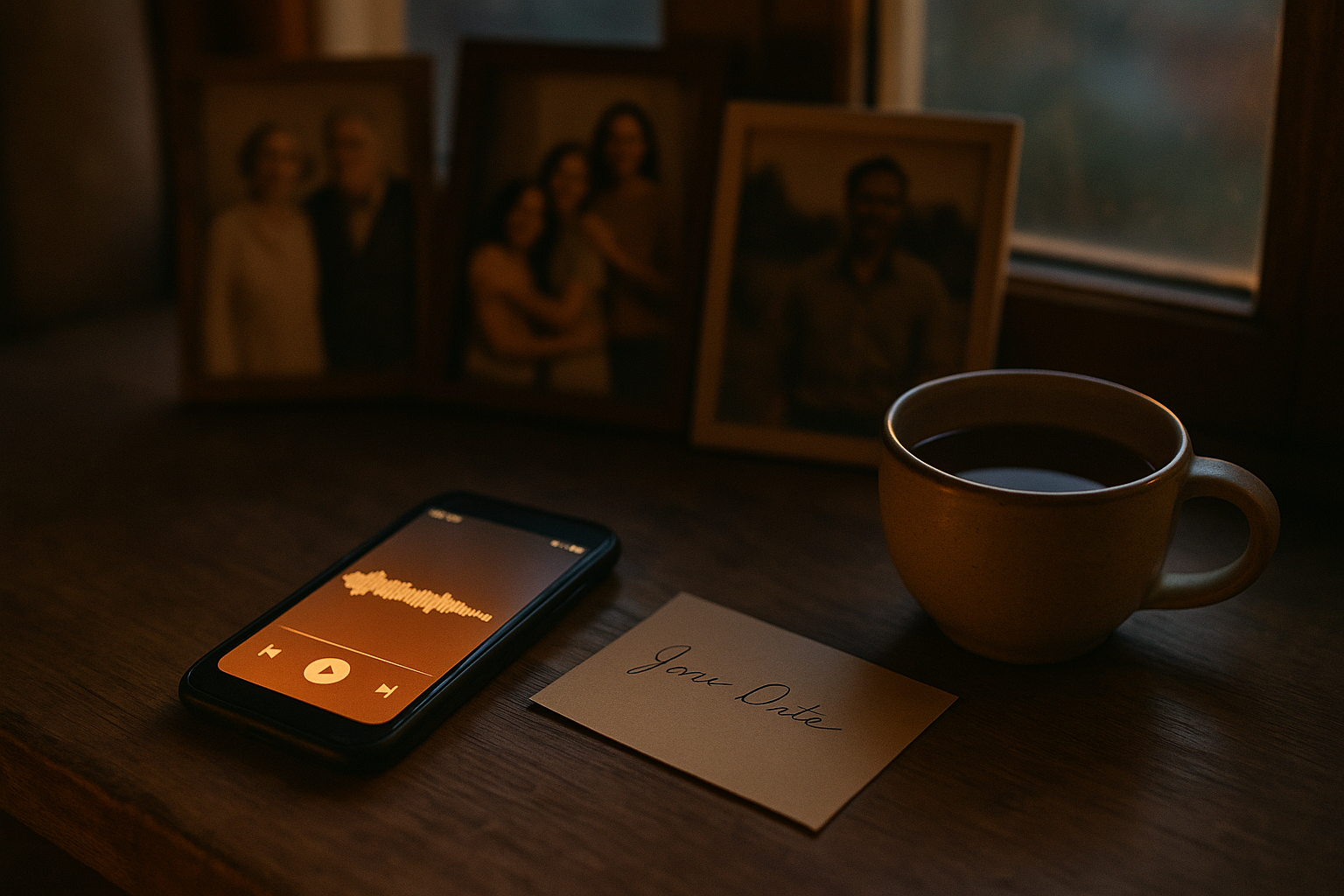
When a Voice Becomes the Thing You Miss Most
After someone dies, most people expect to miss their face, their laugh, their presence in a room. What often catches families off guard is how badly they miss a sound. A voicemail. The way a name was said. The particular rhythm of "hello?" on the phone. Bereaved people frequently describe a distinct pattern: the fear of forgetting a sound often feels more acute than the fear of forgetting other aspects of a person. Some search the house for a recording that no longer exists, and others realize months later that they can no longer summon a loved one's exact voice from memory alone.
That is why so many families now treat voice preservation as its own category of remembrance, distinct from photographs or written keepsakes, and why guidance on how to find, save, and protect these recordings has become part of grief support and estate planning alike. Anyone beginning that search, or wanting to start one before a loss occurs, can find a starting point for organizing this work at Voice After Life.com, where the focus is specifically on capturing and protecting a voice for the people who will want to hear it later.
What the Research Says About Voice and Grief
For much of the twentieth century, grief theory held that healthy mourning meant detaching from the deceased and moving on. That model has been substantially revised. Contemporary grief research, building on the continuing bonds model set out by Klass, Silverman and Nickman in 1996, holds that keeping an ongoing connection to someone who has died is not a sign of stalled or unhealthy grief but a normal part of adapting to the loss. The theory reframed decades of clinical assumptions and is now widely taught in bereavement counseling.
Voice appears to occupy a special place within that ongoing connection. Auditory memory behaves differently than visual memory, and not in the way most people would guess. In a University of Iowa study published in PLOS ONE, memory for sounds fell off far more sharply over time than memory for images or textures, which held roughly steady. A separate comparison of the two memory systems found a plainer explanation: auditory memory tends to be coarse and gist-based, while visual memory keeps fine detail. In practical terms, most people can still picture a parent's or spouse's face years later, but the precise timbre, cadence, and inflection of their voice is the detail most likely to fade first, and often without warning.
Start by Looking for What Already Exists
Before assuming a voice is lost, it is worth searching thoroughly. Recordings often exist in places families overlook: old voicemails on multiple phones, video calls that happened to be saved, home videos, answering machine tapes, and voice messages sent through messaging apps. Ask other family members, too — a sibling, a grandchild, or an old friend may be holding onto a recording without realizing its value to others.
Act Quickly on Voicemail
Voicemail is the most common source of an unplanned recording, and it is also the most fragile. Wireless carriers do not store voicemail indefinitely. AT&T keeps basic voicemail 14 days, T-Mobile says deleted messages "cannot be retrieved," and Verizon won't take the blame even for ones you saved. A saved message is not necessarily a permanently stored one; carrier retention policies apply to saved and unsaved voicemail alike, so exporting any meaningful recording to a personal device or file as soon as possible is worth doing before assuming it is safe.
Recording New Messages While You Still Can
For families with a living parent, grandparent, or spouse facing illness or advanced age, there is an opportunity that grief itself cannot offer after the fact: the chance to record something intentional. This does not need to be elaborate. A short voice memo answering a few questions, a recorded phone call, or a video message addressed to specific people can become one of the most treasured possessions a family holds. Some people feel self-conscious being recorded, so it often helps to keep the moment low-pressure — a short message rather than a formal interview, and reassurance that the recording is for family, not for public sharing.
Protecting What You've Preserved for the Long Term
Once a recording exists, the work shifts from finding it to keeping it usable for decades. Archival institutions that manage sound recordings professionally follow a few consistent principles that apply just as well to a family's private collection. The National Archives provides practical guidance on preserving a variety of audio recordings, and digital archiving guidance from research libraries recommends a straightforward backup discipline: follow the 3-2-1 Rule when making backup copies — your central computer can count as one copy, but you should make two additional copies in case more than one backup fails, and rather than rely on the endurance of one type of storage media, make at least one of your copies in another storage format.
In practice, that means avoiding a single point of failure: don't leave a irreplaceable recording only on a phone, only in one cloud account, or only on one hard drive. Keep original files intact rather than only compressed copies, label files clearly with names and dates, and revisit the archive every so often to confirm files still open and play correctly. Family members who want a single organized place to store and share these recordings — rather than scattered voice memos across several devices — can bring them together through Voice After Life, which was built around exactly this kind of long-term, shareable preservation.
A Living Archive, Not a Single File
There is no perfect recording, and no amount of preparation removes the pain of a loss. But treating a voice with the same intention families already bring to photographs — searching for it, saving it properly, and protecting it over time — turns something fragile and accidental into something durable. For many families, that recording becomes less a static artifact and more a living part of how they continue to feel connected to someone they love.
If you are earlier in this process, with a living parent, spouse, or grandparent whose voice you want to preserve, the best time to start is simply now, in an ordinary conversation, before there is any urgency attached to it at all.
This article is for general educational purposes and does not constitute legal, financial, or medical advice. For guidance specific to your situation, consult a qualified attorney, financial advisor, or grief counselor.
- Voice After Life.com
Sources
- People who keep every voicemail from a parent long after that parent has died aren't holding on unhealthily — Silicon Canals
- Continuing bonds — Wikipedia
- Your carrier deletes voicemails automatically. Save the ones that matter tonight. — Komando.com
- Audio Guidance — National Archives (NARA)
- Storage - Digital Archiving - Research Guides — University of Michigan Library