How to Capture the Stories Only Your Family Can Tell
Practical, research-backed guidance for recording the family stories that live only in memory—before they're lost for good.
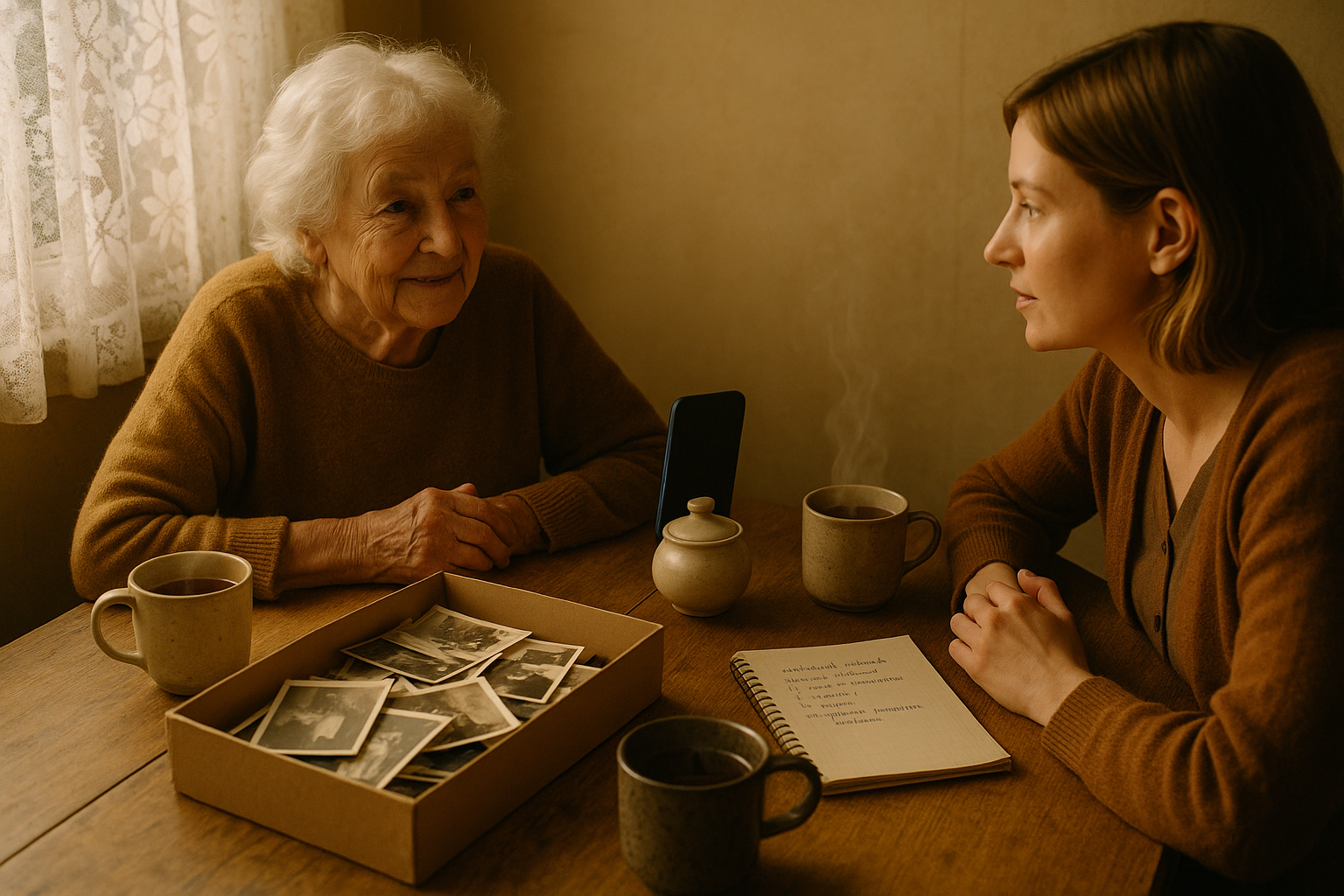
The Stories That Only Exist in One Voice
Every family has them: the story of how your grandparents met during a blackout, the nickname nobody remembers the origin of anymore, the recipe that was never written down because "you just know when it's right." These are not stories you'll find in a genealogy database or a box of old photographs. They live in one place only—inside the people who lived them—and when that person is gone, the story usually goes with them.
That urgency is exactly why so many families are turning their attention to intentional story-capture rather than hoping memories survive on their own. Projects built for exactly this purpose, like Voice After Life.com, exist because families keep discovering, often too late, that the stories they assumed would always be there were never written down or recorded at all.
Why These Conversations Matter More Than We Realize
It's tempting to think of story-gathering as a nostalgic nice-to-have. Research suggests it's more than that. Reminiscence work—the act of recalling and reflecting on past experiences, especially with a companion—has been studied for decades in gerontology and psychology, and prior studies in psychology and gerontology have demonstrated various functions and benefits of reminiscence for older adults, including the enhancement of psychological well-being, cognitive function, and overall quality of life . A systematic review and meta-analysis of reminiscence therapy involving over 1,700 older adults found that reminiscence therapy can significantly reduce depressive symptoms and improve life satisfaction .
There's a psychologist's name behind much of this thinking. Life review, as a concept, traces back to Robert Butler, who initially introduced the concepts of life review and reminiscence as tools to help older adults comprehend their current circumstances by establishing connections with past experiences . For families, that means the act of sitting down and asking a parent or grandparent to tell their story isn't just gathering material for the future—it can be genuinely good for the person telling it.
Start With Curiosity, Not a Script
Organizations that specialize in oral history agree on one thing above all: the best interviews feel like conversations, not interrogations. The Smithsonian Institution Archives recommends that interviewers start with easy questions, such as their name, where and when born, names of family members , before working toward more emotionally layered material.
StoryCorps, the nonprofit responsible for one of the largest oral history archives in the world, takes a deliberately loose approach. StoryCorps conversations are meant to be spontaneous, authentic, and unscripted, though the organization has developed a list of great questions to inspire conversation . The goal isn't a perfect transcript—it's a real exchange. Since its founding, StoryCorps has facilitated over 630,000 participants in sharing life experiences through facilitated interviews, many conducted between family members or close relations , and those recordings are now archived at the Library of Congress for future generations to access.
Practical Steps for Your Own Family Interview
You don't need professional equipment or training to do this well. A few guidelines drawn from established oral history practice can make a real difference:
Plan ahead, but don't over-plan. The National Trust for Historic Preservation suggests you plan on scheduling one to two hours for your interview , which allows space for the conversation to flourish, sometimes moving in unexpected directions as you build a rapport and relationship with the narrator .
Let silence do its work. Pauses can feel awkward, but they often precede the most meaningful answers. As one guide on oral history interviewing puts it, narrators might be quiet for a moment until they are ready to continue again—remember, you are recording their story .
Ask open-ended questions. Instead of yes-or-no prompts, invite detail. FamilySearch, the genealogy organization affiliated with the Church of Jesus Christ of Latter-day Saints, notes that family history interviews are also one of the best ways to preserve a wealth of stories, testimonies, thoughts, and feelings .
Bring photos as memory triggers. The Smithsonian's guide recommends interviewers bring photographs and a personal name and term list, and chronology —visual cues that often unlock details a straightforward question never would.
Don't wait for a special occasion. Genealogy.com advises that you schedule the oral history session in advance rather than showing up on a person's doorstep unexpectedly , but the session itself doesn't need to be a formal event. A kitchen table and a phone with a voice memo app are enough.
Let the Story Wander
Some of the richest material comes from moments that don't fit the outline. Genealogy.com's guide on oral histories notes that interviewers should ask questions to start things off, but not be afraid to let the person talk off the subject, since you may get some of the best stories that way . If a question about a wedding day turns into a story about a long-lost sibling or a wartime memory, follow it. Redirecting too quickly can close a door that won't open again.
Preserving What You Capture
Recording the conversation is only the first step. A file sitting on an old phone, a cassette tape in a drawer, or a voicemail nobody backed up can vanish just as easily as an unrecorded memory. Families who take this seriously often think about format, storage, and access the same way they'd think about any other important document—except this one carries a voice, not just information.
That's the gap that story-preservation platforms are built to close: turning a recorded conversation into something durable and shareable across generations. Recordings, transcripts, and the small details a family wants remembered—an inflection, a laugh, the way someone told a joke—can be organized and safeguarded through a dedicated service like Voice After Life, rather than left to the fate of a misplaced device.
A Story Worth Starting Today
There's no perfect moment to begin. The people who hold your family's stories aren't waiting for you to have the right equipment or the right questions—they're simply waiting to be asked. Whether it's a single afternoon conversation or an ongoing series of shorter check-ins, the act of asking is what matters most. The stories only your family can tell deserve more than memory alone to carry them forward.
- Voice After Life.com
Sources
- How to Conduct an Oral History Interview — National Trust for Historic Preservation
- How to Do Oral History — Smithsonian Institution Archives
- Creating Oral Histories — FamilySearch
- Example Questions for Oral Histories — Genealogy.com
- Institute for Family - StoryCorps — StoryCorps
- StoryCorps — Grokipedia — Grokipedia
- Effects of reminiscence therapy on psychological outcome among older adults — NCBI/PubMed Central
- Exploring the Design of Generative AI in Supporting Music-based Reminiscence for Older Adults — arXiv
- Effectiveness on Quality of Life and Life Satisfaction for Older Adults: Life Review and Reminiscence Therapy — NCBI/PubMed Central