How to Capture the Stories Only Your Family Can Tell
Every family holds stories no book or search engine can replace. Here's how to start capturing yours before the details fade.
The Stories Sitting Right in Front of You
On a Sunday afternoon, a young couple sits on the living room floor while their toddler stacks blocks nearby. The couple isn't thinking about family history — they're just tired, happy parents watching their child play. But somewhere in the next room is a phone full of voice memos, a drawer of old photographs, and a grandmother who still tells the story of the drive she took the week she found out she was pregnant with their child's other grandparent. None of that is written down anywhere. It exists only because someone remembers it and is still willing to tell it.
That's the quiet urgency behind every family story: it usually lives in only one or two people, and it rarely announces when it's about to disappear. Thinking through which of those stories matter most, and how to actually get them down, is exactly what Voice After Life.com was built to help families work through, one conversation at a time.
Why These Stories Matter More Than You Think
It's tempting to think of family storytelling as a nice-to-have — something for scrapbooks and reunions, not something with real weight. Research suggests otherwise. Psychologists Dr. Marshall Duke and Dr. Robyn Fivush at Emory University developed a scale to measure how much children know about their family's history, and their findings showed that children who knew more family stories scored higher on self-esteem, academic performance, and social skills, and had fewer behavioral problems.
Interestingly, the kind of story matters too. Duke and Fivush found that the shape of the story matters: families that share what they called "oscillating narratives" — stories that move through hardship and recovery, rather than following a simple arc of triumph or steady decline — tend to give children the strongest foundation for resilience and identity.
A story that shows a grandparent struggling, adapting, and coming through the other side does more for a child's sense of what the family is capable of than a frictionless success story.
This isn't just about self-esteem scores, either. Separate research on parent-child storytelling — sometimes called elaborative reminiscing — found that when parents use more details and emotions when talking about past everyday events with their preschool-aged children, the children told more detailed and coherent narratives one to two years later. In other words, the way a parent tells a story today shapes how a child will one day tell their own.
Start With the Person, Not the Project
It's easy to treat a family history conversation like a research assignment — a list of dates, names, and facts to check off. But the people who study this professionally suggest flipping that order. Before sitting down with a relative, it helps to do your homework and learn as much about the person as you can before you start interviewing — including the small details, like a hobby or an instrument they once played.
That kind of preparation does two things. It shows the person you're talking to that you value their life enough to have thought about it in advance, and it gives you better follow-up questions than "tell me about your childhood." A young parent asking a grandparent about the year they got married will get further by knowing where that wedding happened than by asking a generic question and hoping for detail.
Ask Questions That Open Doors, Not Close Them
The single most repeated piece of advice across family-history guides is also the simplest: ask open-ended questions. It's best to ask open-ended questions rather than ones with yes-or-no answers, and to focus on people's memories and experiences. "Did you like your job?" invites a one-word answer. "What was a normal Tuesday like at that job?" invites a story.
Once someone starts talking, resist the urge to redirect too quickly. Ask open-ended questions without making any assumptions, and avoid going into the interview with a specific agenda or trying to lead anyone to a certain conclusion. The goal isn't to confirm what you already believe about a relative's life — it's to find out what you don't yet know.
Let Objects Do Some of the Talking
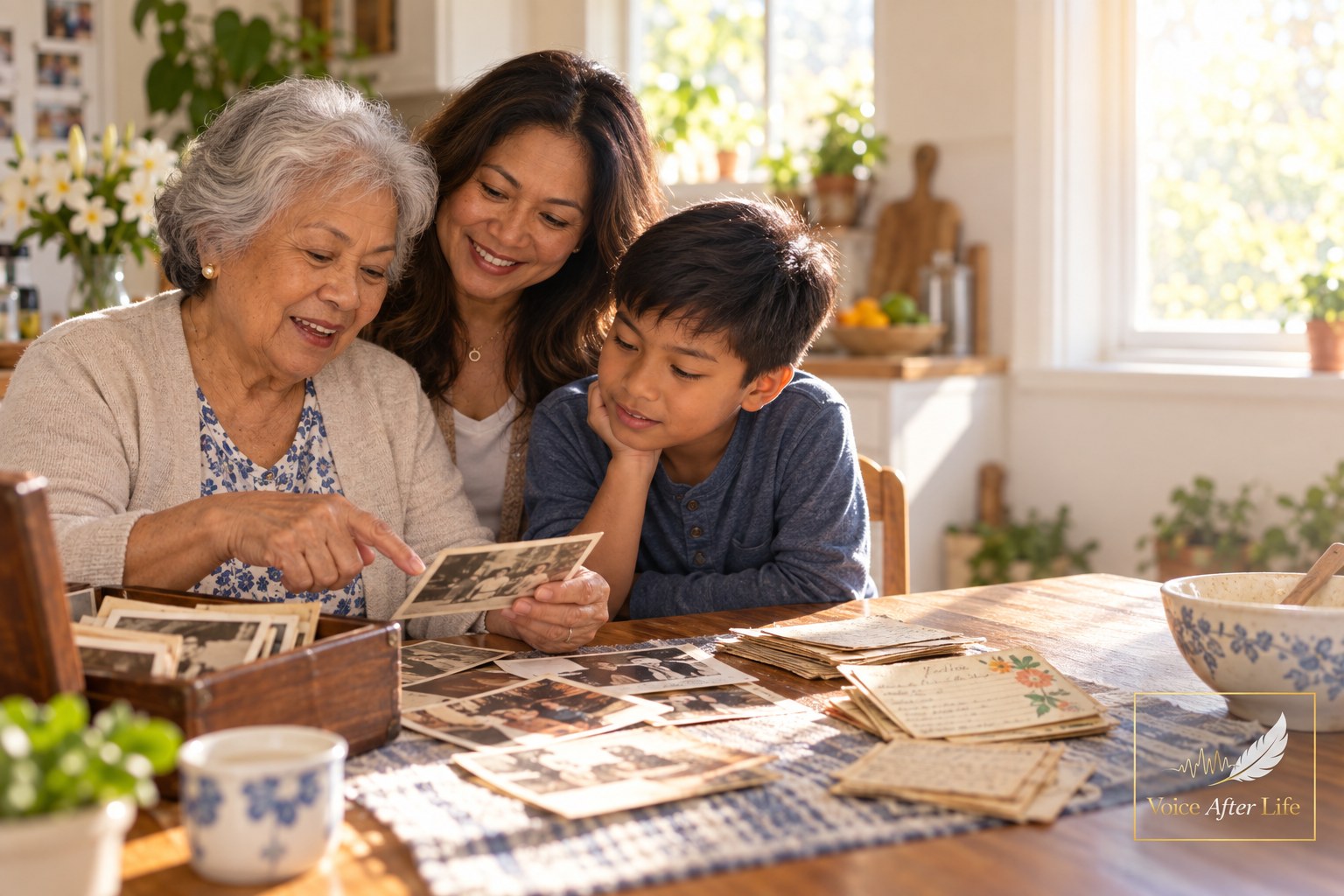
Not every story surfaces just by asking. Sometimes the fastest way into a memory is through something you can hold. Object-based questions — using photos, objects, and heirlooms as the basis for a question — can serve as an interesting way into an interview; for example, showing a photo and asking what the person knows about the people in it. A worn wedding ring, a recipe card, a child's old report card — each one is a door into a story that a direct question might never open.
For a young family, this can be as simple as pulling out a box of photographs during a visit and asking a grandparent to narrate what they see. The toddler in the room may not remember the conversation, but the recording of it will still exist when they're old enough to ask questions of their own.
Treat the Conversation as What It Is
However the conversation happens — over a kitchen table, on a phone call, during a long drive — it's worth remembering what's actually taking place. As the Smithsonian's National Museum of African American History and Culture puts it, an oral history interview is a sacred space based on trust and mutual understanding; the narrator is an authority on their own life, and your role is to engage with them and get clarity into their experience. That framing changes the dynamic from an interviewer collecting facts to a family member being trusted with a story.
Capturing the Story So It Lasts
Once a story has been told, the next question is how to keep it — not just the words, but the voice, the pauses, the laugh before the punchline. A written summary can capture what was said; it can't capture how it sounded. For families who want that voice itself preserved, not just paraphrased, Voice After Life offers a way to hold onto recordings so a grandparent's actual voice, telling their actual story, remains something future generations can listen to rather than only read about.
Starting Small, Starting Now
None of this requires a formal project, special equipment, or a perfect list of questions. It can start with one recorded phone call, one afternoon with a photo album, one honest question asked with real curiosity. The stories worth preserving are usually the ones already being told at the dinner table — they just haven't been captured yet. The parents on that living room floor with their toddler don't need to solve their whole family history in one weekend. They just need to ask one good question, and then really listen to the answer.
- Voice After Life.com
Sources
- The Value of Sharing Family Stories — Storyworth
- Family Storytelling and the Benefits for Children — University of Nevada, Reno Extension
- How to Plan and Host a Successful Family History Interview — Family Tree Magazine
- How to Interview Your Family Members Like an Oral Historian — KQED
- Family Reunion Month: Seven Simple Tips to Begin Recording Your Family's Oral History — Baylor University
- Creating Oral Histories — FamilySearch
- Capturing Your Family's Oral History — Smithsonian National Museum of African American History and Culture