How to Capture the Wisdom of Your Elders Before It Is Gone: Recording Prompts and Methods That Work
Learn proven interview prompts, recording methods, and gentle techniques to preserve your elder's stories, wisdom, and voice before memories fade.
Why This Conversation Can't Wait
There's a quiet urgency that settles over families once they realize a parent or grandparent holds stories that exist nowhere else. A gerontologist who studies aging put it simply: older adults serve as "living, breathing history books of society," and "when one of those elderly pass without being read, we're not losing just a person, we're losing a library of stories."
The risk isn't only mortality — it's memory itself. Elder-law and caregiving professionals note that even even when people are healthy, memories fade over time, which is why waiting for "someday" often means losing details that could have been captured today. For families navigating a loved one's cognitive decline, the stakes are even higher. One estate-legacy specialist recalled a project to document a grandfather's life that began too late: much of what he shared during the interviews was jumbled and lacked any basis in reality, and it was clear that dementia had already taken a significant toll. Sadly, the project was completed just two months before the man passed away.
The encouraging news is that remote memory often stays accessible far longer than short-term recall. Caregiving experts explain that Alzheimer's may cause impairments in short-term memory, however remote memory can be left relatively intact, meaning someone can remember public and personal events from many decades ago but is unable to recall what happened earlier in the day. That window — however narrow — is precisely why recording prompts and methods matter so much, and why starting now, imperfectly, beats waiting for the ideal moment.
Start With the Right Mindset
Before you press record, remember that you're not conducting a deposition. As genealogy researchers advise, when you record an oral history, remember that you're an interested relative, not a hard-nosed reporter. The goal is connection first, documentation second.
Experienced oral historians also recommend a little homework. According to interview specialists interviewed by KQED, you should learn as much about the person as you can before you start interviewing, since the more you know already, the more engaging your questions are for the person being interviewed. If you know your grandmother played an instrument in a band, or your grandfather worked a particular trade, lead with that specificity rather than generic questions.
It also helps to think about sequencing. As oral historian Richard Eardley-Pryor suggests, families should consider whether to start with the oldest person first, in the idea that they might be closer to passing on, so you want to capture their memories most.
Recording Prompts That Open Doors
The nonprofit StoryCorps has spent two decades refining questions that spark meaningful conversation. A few of their most effective prompts for capturing wisdom and legacy include:
- For generations listening to this years from now, is there any wisdom you'd want to pass on to them? What would you want them to know?
- If you were to give advice to me or my children, or even children to come in our family, what would it be? What have you learned from life? The most important things?
- Is there anything that you've never told me but want to tell me now? Are there things about me that you've always wanted to know but have never asked?
- If you could talk to a younger version of yourself, what would you say?
Other oral history guides suggest rounding out the conversation with reflective staples such as Who has been the most important person in your life? Can you tell me about them? What was the happiest moment of your life? The saddest? Who has been the biggest influence on your life? and What are the most important lessons you've learned in life? What are you proudest of?
StoryCorps also emphasizes sensory, specific questions over abstract ones. Their interview guide notes that questions that encourage vivid details can make the story special — invoke the senses by asking your partner to remember these details, for example: "What did your kitchen smell like when you were growing up?" or "What images stand out when you think about Granddad?"
And don't skip the harder territory. As one senior-care resource puts it, an oral history is more about why and how, rather than what, where and when — don't skip tough questions if your loved one is willing to answer them, since elderly folks have lived through and learned from their long life experience, and their perspective on getting through rough times is invaluable to younger generations.
Interview Technique: Let Them Drive
Good technique matters as much as good questions. Oral historian Nicole Wong describes the philosophy this way: oral history is about deep listening and deep empathy and hearing stories and memories, but also empowering a narrator to feel like they are in the driver's seat, because they should be.
Practically, that means:
Ask open-ended questions. StoryCorps' interview tips recommend you avoid questions that can be answered with a "yes" or a "no" — instead, use language like "Tell me about…" or "What was it like when…" which lets the storyteller steer you toward what is most important to them.
Use questions as a guide, not a script. As StoryCorps advises interviewers, be prepared to ask follow-ups or diverge from your list — use your selected questions as a guide, not a script, and if your partner goes off topic, go with it; you can redirect them to your original question later.
Provide context for future listeners. Since grandchildren and great-grandchildren may not know the cast of characters, remember that future listeners may not be familiar with the specific people and places you mention, so set up context where needed with questions like "Who was Uncle Steve?" and "Why was he such an influence on you?"
Know when to pull back. If a topic causes distress, family oral history guides recommend that if the person you are interviewing starts to become defensive or upset, do not press them – change the subject to more comfortable territory.
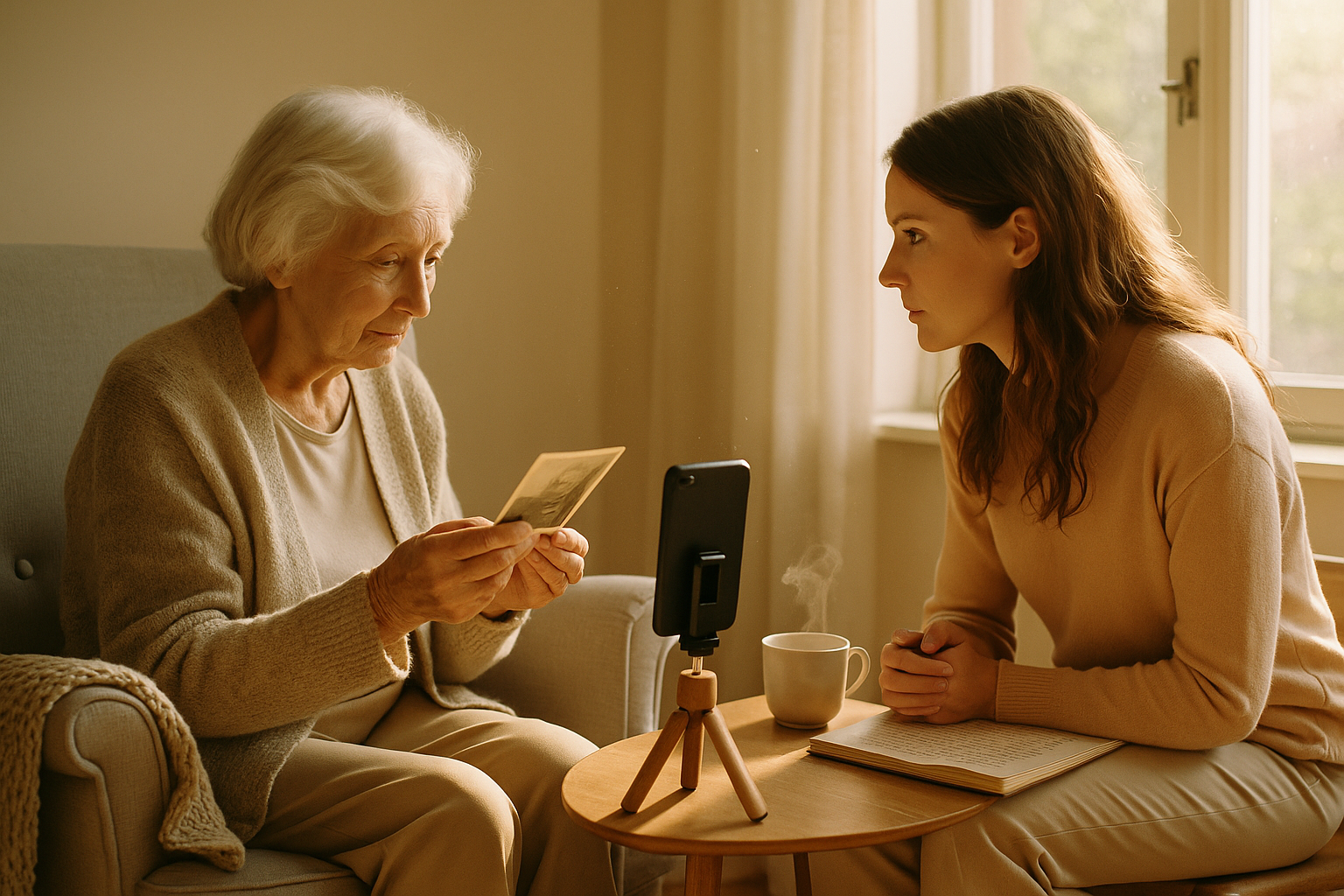
Bring props. Physical objects are powerful memory triggers. Genealogists suggest that if you have any old pictures or other items that you have questions about, bring them along. This is especially valuable for loved ones experiencing memory changes — caregiving resources note that when family heirlooms are discussed, the stories associated with them get handed down too, so if possible, have your family member share how the item was acquired, how long it has been in the family, and what makes it special.
Recording Methods: Getting Usable Audio Without Overthinking It
You do not need professional equipment to start. As one family-history guide reassures, one of the biggest myths about oral history recording is that you need expensive, professional-grade equipment — you don't. What you need is something that records clearly and reliably, and you almost certainly already own the most important piece of it: your phone.
A few practical adjustments make a real difference in sound quality:
- Choose a soft, quiet room. Audio specialists explain that rooms with carpets, rugs, pillows, clothing, or soft furniture help absorb sound and reduce echo — closets can be excellent recording studios, while large empty rooms with bare walls or hard surfaces should be avoided.
- Steady the device. Rather than holding the phone, avoid holding the phone; place it on a table to reduce handling noise, or use a phone stand to keep it steady.
- Mind the microphone. Whatever device you use, be sure that your phone case and/or fingers don't cover the microphone when recording, and point the microphone toward the person or conversation you want to record.
- Check your settings. On iPhone, note that you can check your settings by going to Settings > Voice Memos > Audio Quality and changing it to "Lossless."
- Do a test run. Interview professionals recommend that once you've settled on a location, you do a brief "dry run" if possible — go there and record a similar conversation, checking for audio interference like neighbor noises, loud traffic, equipment buzzing, and regular interruptions.
For families who want the recording itself to become a lasting keepsake — something siblings, grandchildren, and future generations can revisit for decades — services like Voice After Life exist specifically to help preserve a loved one's actual voice and stories in a secure, accessible format, turning a single afternoon's conversation into an heirloom rather than a forgotten file on a phone.
Structuring a Session Without Making It Feel Like Work
Don't attempt an entire life story in one sitting. StoryCorps facilitators note that most participants are able to get through about six questions during a 40-minute interview, so it's worth selecting six to eight questions in advance — and keep in mind that sometimes the best questions are the ones you've always wanted to ask.
A simple structure that tends to work well:
- Warm up with easy, orienting questions such as "Where were you born?" or "Can you describe the first time we met?"
- Go deeper into formative memories, hardships, and turning points.
- Close with legacy and reflection, saving the most meaningful prompts for last. StoryCorps suggests you keep an eye on the timer so you're aware of when there are 10 and 5 minutes left, ending your interview with reflective questions, such as "What legacy would you like to leave?" or "What advice would you give me about being a parent?"
If your elder is comfortable, StoryCorps also recommends a closing gesture that often becomes the most treasured part of the recording: simply turn the tables and tell the person you're interviewing what they've meant to you.
A Practice Worth Repeating
Capturing an elder's wisdom rarely happens in one perfect session — it's a practice you return to over holidays, Sunday dinners, or quiet afternoons. Each recording, however short, adds another chapter to a family archive that grows more valuable with time. The stories don't need to be polished or complete; they need only to exist, in the person's own voice, so that the wisdom they carried doesn't disappear with them.
Start with one question this week. The rest of the conversation will follow.
Sources
- Conduct an Oral History Interview With Seniors — Visiting Angels
- SAMPLE ORAL HISTORY QUESTIONS — National Underground Railroad Freedom Center
- How to Create an Oral Family History with Grandparents — Senior Helpers
- How to Interview Your Family Members Like an Oral Historian — KQED
- Example Questions for Oral Histories — Genealogy.com
- Tips for a Great Conversation — StoryCorps
- 10 Conversation Tips for Your StoryCorps Interview — StoryCorps / ACF
- Great Questions List – StoryCorps Archive — StoryCorps
- Great Questions — StoryCorps
- StoryCorps Connect Instructions/Questions List — StoryCorps
- Preserving legacy: Why document family stories before it's too late — Crain Currency
- How to Capture Memories with a Dementia Diagnosis — Home Instead
- Preserving history: Importance of recording older loved ones' family stories — Aging Untold
- Tips for Recording Audio on a Phone — University of Dayton Libraries
- Interview Recording Tips For an Easier Workflow — Rev
- How to Record an Oral History Interview Before It's Too Late — The Family Heart
- Tips for making audio recordings — Ask A Biologist, Arizona State University