How to Capture the Stories Only Your Family Can Tell
Practical, research-backed guidance for recording the family stories, voices, and memories that history books will never hold.
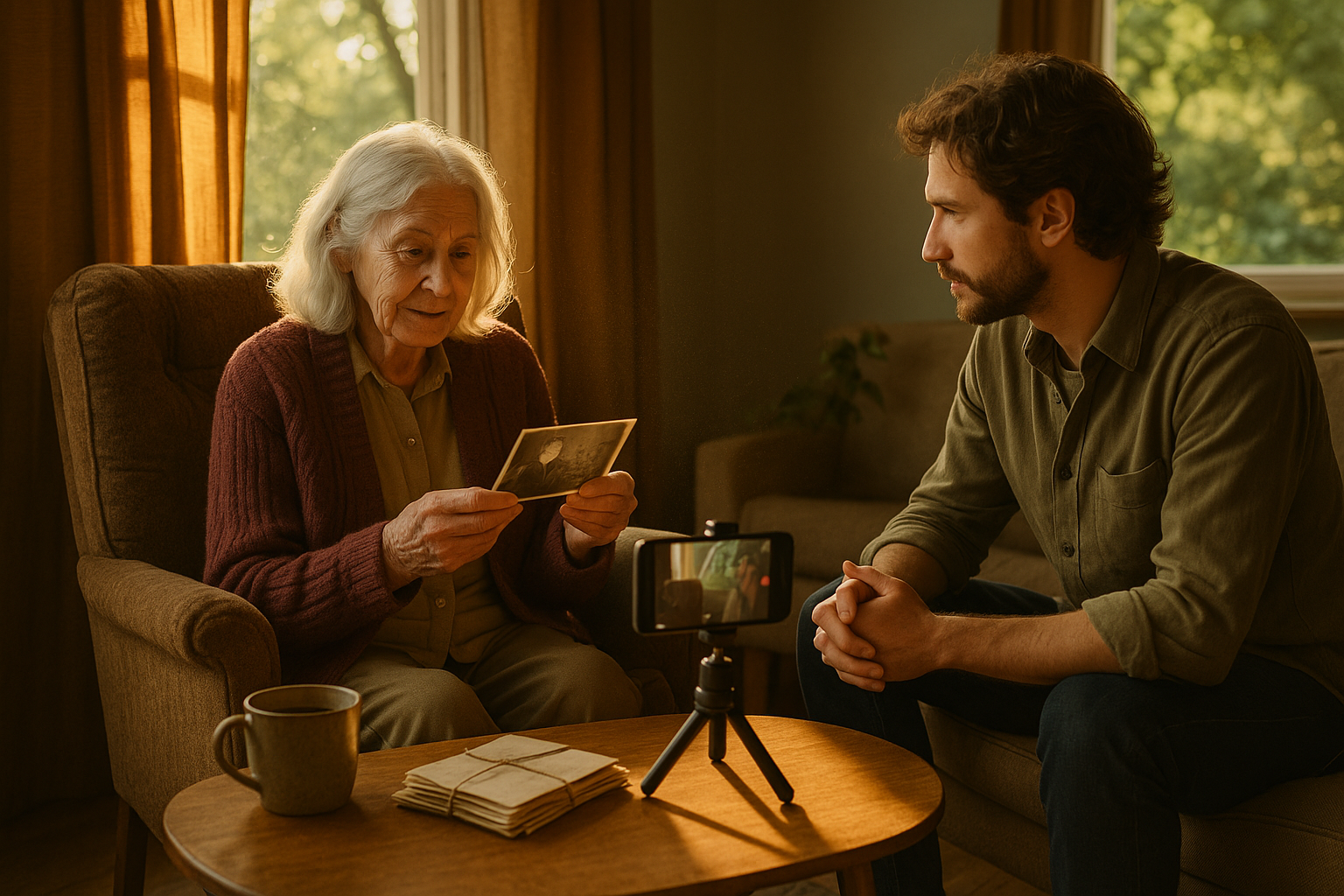
The Stories That Live Nowhere Else
Every family carries a private archive that no library, database, or search engine will ever hold: the way your grandmother described meeting your grandfather, the exact cadence of your father's favorite joke, the recipe your aunt never wrote down because she "just knew" the measurements. These stories exist only in memory and, if we're lucky, in the voices of the people who lived them. Oral historians at the Smithsonian Institution note that a good interview reworks the question outline, making it relevant to this interviewee, deleting topics that don't pertain to them, and adding areas, such as organizations they were involved in — in other words, the best family history isn't generic, it's specific to the person in front of you.
That specificity is exactly why so many families wait too long, and why thinking through a plan now — including where the recordings will actually live once you have them, whether that's a shared drive, a printed transcript, or a dedicated archive like Voice After Life.com — matters as much as the interview itself.
Why These Conversations Matter More Than We Realize
Researchers and archivists who study family narrative consistently point to the same benefit: the exchange itself is as valuable as the content. As one guide from American Ancestors puts it, interviewing relatives gives you a chance to spend time together and ask questions. It is not always easy, but it can be extremely rewarding. You can connect with relatives in the present moment while preserving valuable stories and memories for future generations. It also works both directions across generations — older family members can relive past experiences and accomplishments, and younger family members can learn new things about themselves, their heritage, and even their place in history.
The nonprofit oral history organization StoryCorps, whose recordings are archived at the Library of Congress, has built an entire movement around this idea. Since 2003, StoryCorps has given over half a million Americans the chance to record interviews about their lives, and the organization preserves the recordings in its archive at the American Folklife Center at the Library of Congress. That scale reflects something simple: people are hungry to be heard, and families are hungry to keep what would otherwise disappear.
Preparing Before You Press Record
A meaningful interview starts well before the recording begins. The Library of Congress recommends deciding whether there is a family member whose life you'd like to know more about, or whose stories you want to preserve and share with others, then prepare a list of questions. A few preparation habits show up again and again across archival guides:
Set the Scene
- Schedule ahead of time. Genealogy.com advises interviewers to schedule the oral history session in advance and not just show up on a person's doorstep unexpectedly.
- Explain your purpose. The National Trust for Historic Preservation suggests you make it clear to your narrator what the purpose of the interview is, and how the transcript or recording will be used.
- Test your equipment first. Simple advice, but essential: if you use a tape recorder, be sure to test the recorder as well as the tape to make sure that each is working.
Ask Open Questions, Then Get Out of the Way
Columbia University's oral history resources recommend that interviewers phrase questions so that they are open-ended and don't elicit a "yes" or "no" answer, and prompt subjects with phrases such as "tell me about…" or "talk to me about your feelings on…". Once the conversation is moving, resist the urge to steer it. The Smithsonian's guide is direct on this point: allow the interviewee to tell "the story" — most interviews have a favorite story, and they will fit it in somehow, so let it happen.
Letting the Conversation Wander — On Purpose
Some of the richest material comes from tangents you didn't plan for. The National Trust notes that you shouldn't interrupt your narrator and break their flow — it's all right to steer them back on track if they go off on a tangent, but listen and see where that tangent is going first, because you could end up with a gem of a story. Genealogy.com echoes this: ask questions to start things off, but don't be afraid to let the person you're interviewing talk "off the subject" — you may get some of the best stories this way.
Bringing props helps unlock memory, too. The Smithsonian recommends interviewers bring visuals, if possible, to stimulate memory, or ask to bring out photo albums of trips or family events — an old photograph, a piece of jewelry, or a handwritten letter can do more to jog a story loose than any question on your list.
Handling Sensitive Ground with Care
Not every memory is easy to revisit. Oral historians caution that difficult subjects require trust built over time. As one specialist told KQED, discussing painful memories "require[s] a high level of trust and rapport" and should never be a way to open an interview — your subject will need to be really comfortable with the process, and with you, before you ask questions like that. American Ancestors offers similar guidance for veterans specifically, suggesting a gentle approach such as "Were you in any battles? But please only tell me what you feel comfortable with?" Respecting these boundaries isn't just kindness — it's what makes people willing to open up at all.
From Conversation to Keepsake
Once you've captured a story, the next question is what happens to it. A recording sitting on a single phone is one dropped device away from being lost forever. Archivists recommend redundancy and a clear plan: American Ancestors advises interviewers to determine how you will save their answers, because it is important to preserve memories for future generations. This is where many families realize that a proper home for a voice — not just a folder buried in a phone's storage — is what actually protects the story long-term, which is part of why some turn to a dedicated place built for preserving a loved one's voice and messages rather than leaving it to chance.
Start with One Question
You don't need a formal project, a script, or professional equipment to begin. You need one relative, one quiet room, and one honest question — something like "What do you remember most about the house you grew up in?" or "How did you know it was time to make that big decision?" Let the answer lead where it wants to go, and don't rush to fill the silences. As the Smithsonian's guide reminds interviewers, sometimes the job is simply to let the interviewee do the talking.
The stories only your family can tell are still there, waiting to be asked for. The only real risk is running out of time to ask.
- Voice After Life.com
Sources
- Family History Interview Tips — Smithsonian Institution Archives
- Conducting a Family History Interview — American Ancestors
- Preserving Family Stories — Library of Congress
- How to Conduct an Oral History Interview — National Trust for Historic Preservation
- How to Interview Your Family Members Like an Oral Historian — KQED
- Suggested Questions for Oral Histories — Genealogy.com
- Resources for Oral History — Columbia University
- Institute for Family — StoryCorps