The Accidental Archive Already on Your Phone
Most people are unknowingly sitting on years of family voice recordings and video clips. Here's what's hiding in your phone and why it's worth protecting.
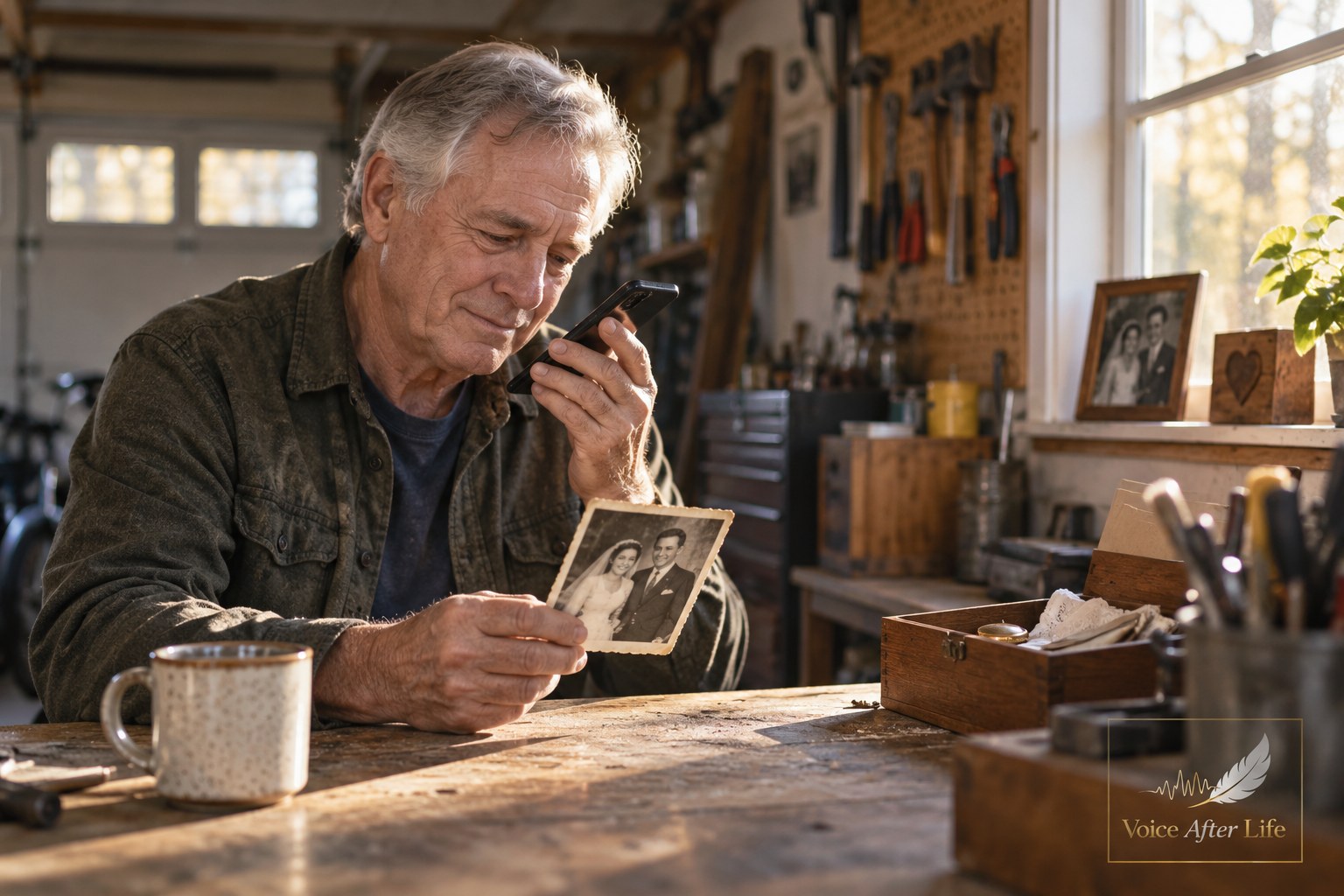
A Phone Full of Forgotten Voices
Walter, a man in his seventies, didn't set out to build an archive. He just answered calls, snapped a photo of his granddaughter's birthday cake, and occasionally left himself a voice memo reminding him to call the plumber. But when his daughter borrowed his phone one afternoon to help him free up storage, she found something else entirely: a voicemail from a grandson reciting a school poem, a shaky video of a Thanksgiving toast, a string of voice messages from an old friend who has since passed. None of it was planned. All of it mattered.
This is the accidental archive — the collection of everyday recordings that pile up on nearly every smartphone without anyone deciding to build a collection at all. Recognizing what's already there, and understanding how fragile it is, is the first step toward keeping it. That recognition is exactly what Voice After Life.com was built to support: helping families notice, organize, and preserve the voices already sitting in their pockets.
What's Already Hiding in Your Pocket
Most people underestimate how much of their phone is actually a personal sound and video library. A few places worth checking:
Voicemail. That folder of missed calls is often the single richest source of a loved one's actual voice, captured in an unguarded moment. But voicemail storage is not permanent, and it isn't controlled by the phone alone. Most carriers delete messages from voicemail after a period of 30 days , and even whether it's photos, voicemails, voice recordings, or files, the iPhone will store the deleted items for 30 days before erasing them for good.
Photos and video clips. These accumulate faster than most people realize. The average smartphone user has roughly 2,000 photos stored on their device, with Apple users having slightly more at 2,400 photos compared to Android users at 1,900 . Tucked among the landscapes and screenshots are almost certainly a few seconds here and there of a parent laughing, a spouse humming while cooking, a grandchild's first attempt at a joke.
Voice memos and audio messages. Many people use the built-in recorder app for practical reasons — a doctor's instructions, a reminder — and never revisit those files. Text-message audio clips fall into the same category: sent once, half-forgotten, and often deleted automatically by messaging apps after a set number of days.
Why These Recordings Are Worth More Than Convenience
It's tempting to think of a voicemail or a blurry video as clutter rather than history. But researchers who study aging and memory have found real value in exactly this kind of material. Research shows that reminiscence therapy is effective for improving mood, reducing symptoms of depression, and decreasing loneliness in older adults . The same act of hearing a familiar voice or watching an old clip that supports well-being in a therapeutic setting also has value in an ordinary living room, whether the listener is the person who made the recording or the family member who keeps it afterward.
Oral history researchers make a related point about why the recording itself — not a paraphrase of it — matters. Recording preserves the interview, in sound or video and later in transcript for use by others removed in time and/or distance from the interviewee, and it preserves the entire interview, in its original form, rather than the interviewer's interpretation of what was said . A voicemail left in a hurry carries tone, pacing, and phrasing that no written note could ever replicate.
The Fragile Window You Don't See
Here is the uncomfortable part: an accidental archive is also an unprotected one. Surveys of everyday phone habits repeatedly find that people don't back up what they assume is safe. Many people assume their digital photos will always be available, but this is naïve, as over half of Americans have had to delete images due to storage limitations, while others have lost pictures when changing or damaging their phones, and despite these risks, only a third of Americans surveyed reported using cloud backups . Meanwhile, broader data-loss surveys have found that over 70% of users have lost data at least once — a category that quietly includes voicemails, voice memos, and video clips along with documents and spreadsheets.
Device upgrades add another layer of risk. Old phones get traded in, reset, or simply left in a drawer once the battery gives out, often with recordings still on them that were never moved anywhere else.
Turning an Accidental Archive Into an Intentional One
The good news is that none of this requires special skill — only a little intention. A useful starting point is simply going through the phone the way Walter's daughter did: opening the voicemail tab, scrolling the camera roll, checking the voice memos app, and asking, "Is there anything here I'd hate to lose?"
Once something meaningful turns up, the next step is getting it off the device and into a place built to last — not just another folder that depends on one phone surviving. This is the kind of quiet, practical work that families are increasingly turning to Voice After Life for: a dedicated place to gather these scattered voice and video fragments so they aren't left to the mercy of a 30-day deletion window or a cracked screen.
A family doesn't need a formal interview or a special occasion to start. The recordings often already exist — in a voicemail from last spring, a video from a birthday dinner, a voice memo meant only as a reminder. The work now is simply noticing them before they're gone.
- Voice After Life.com
Sources
- Deleted iPhone Voicemails Are Still On Your Phone — BGR
- How long will iPhone voicemail messages remain in my voicemail box? — The iPhone FAQ
- The Number of Photos Taken in 2025 is Expected to Exceed Two Trillion — PetaPixel
- Reminiscence Therapy: Benefits for Senior Mental Health — Sailor Health
- How to Do Oral History — Smithsonian Institution Archives
- Millions of Americans are forced to delete photos every year — TechRadar
- The Data Loss Survey: Over 70% of Users Have Faced Data Loss at Least Once — Handy Recovery